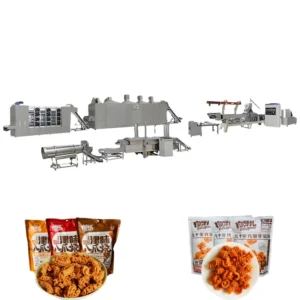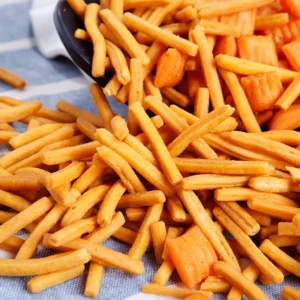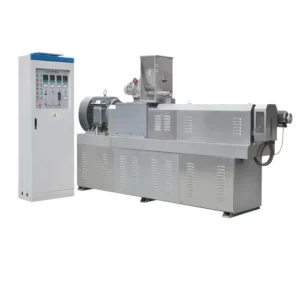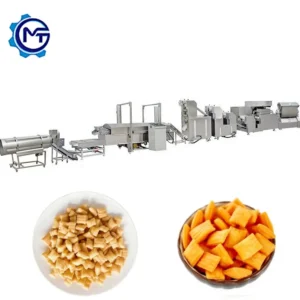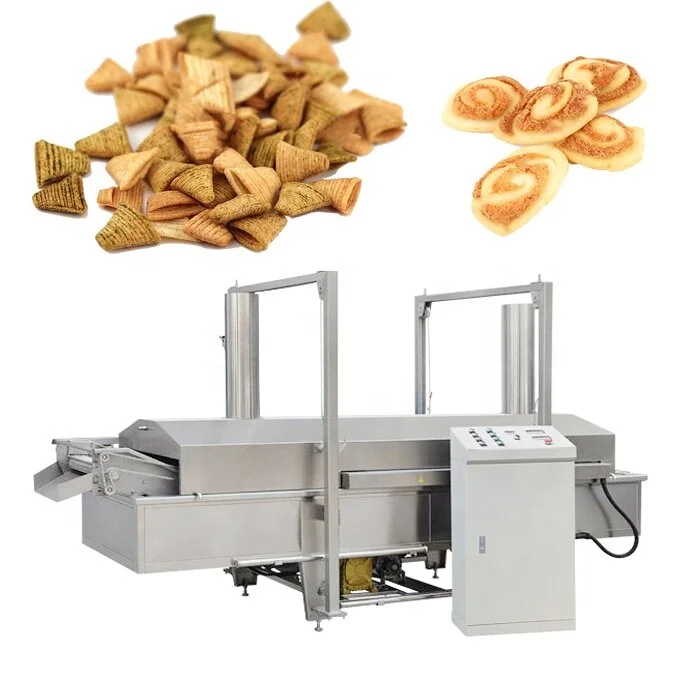
Matched Station Throughput — Every extruder, fryer, and flavoring drum in this frying chips making machine range is sized against the others, so no single station bottlenecks the line you are building or expanding.
Technical Specifications
| Parameter | Value |
|---|---|
| Product Type | Twin Screw Extruder for Puffed Snack and Nacho Chips Production Line |
| Model | MT65 / MT70 / MT70c / MT75 |
| Screw Type | Twin-screw |
| Main Power | 22 kW (MT65) / 30 kW (MT70) / 45 kW (MT70c) / 55 kW (MT75) |
| Real Power | 22 kW (MT65) / 30 kW (MT70) / 55 kW (MT70c) / 55 kW (MT75) |
| Output Capacity | 100–150 kg/h (MT65) / 150–200 kg/h (MT70) / 200–250 kg/h (MT70c) / 200–300 kg/h (MT75) (basis to be confirmed) |
| Overall Dimensions | 22000×1200×2200 mm (MT65) / 25000×1500×2200 mm (MT70) / 30000×3500×4300 mm (MT70c) / 33000×3500×4300 mm (MT75) |
| Screw Material | Alloy (38CrMoAl), nitriding process |
| Main Motor | Siemens |
| Control System | Speed adjusted converter on feeding, extrusion, and cutting systems |
| Gearbox | Automatic lubrication function |
| Feeding System | Food-grade stainless steel twin-screw feeder |
| Cutting System | Cutting knife fixed in die head seat, rotary cutting by V-belt drive |
| Driving Part Cooling | Increased radiator for forced cooling |
| Line Stations Included | Extruder, fryer (electric / diesel / gas options), double drums flavoring system with powder hopper, conveyor, sprayer |
| Raw Material Compatibility | Corn flour, wheat flour |
| Warranty | One year from equipment arrival at customer site |
| Standards | CE, ISO |
Application Suitability
| Application | Material or Output |
|---|---|
| Puffed corn flour snack production | Corn flour and corn powder formulations |
| Nacho chips and Tortilla chips | Corn flour or wheat flour base with frying stage |
| Doritos-style savory extruded snacks | Corn-based dough with post-extrusion frying and seasoning |
| Wheat flour puffed pellets | Wheat flour blends processed through twin-screw extrusion |
Why Nominal Capacity Figures Mislead Snack Line Buyers
A frying chips making machine rated on paper often cannot sustain that throughput on your specific corn or wheat flour blend at your actual moisture content.
I have watched buyers sign off on a line quoted at a clean round number, only to discover during commissioning that the extruder runs fine but the fryer falls behind, or the flavoring drums cannot keep up with the upstream output. The mismatch does not show up in the brochure. It shows up three weeks into production when finished goods pile up before one station while another sits idle [NEED_CITE: throughput balancing principles in snack extrusion lines]. The only reliable way to catch this is a capacity calculation that pairs every station against your raw material and target format, not against a generic test medium.
Station-by-Station Equipment Coverage
The full equipment range behind this frying chips making machine spans from the batching and mixing stage through extrusion, frying, and double-drum flavoring. Each station is available as a standalone unit for buyers replacing a single bottleneck in an existing line, or as part of a matched set where the extruder output, fryer residence time, and flavoring drum throughput are calculated together. This approach matters when a snack food manufacturer is surveying equipment before committing to a layout, because it lets you see exactly where each machine fits and what it contributes to overall line flow.
Fryer Energy Source and Flavoring Drum Matching
The fryer in this range supports electric, diesel, or gas heating, which lets buyers align the choice with local utility cost and infrastructure. A plant running on natural gas will see different operating economics than one relying on electric resistance heating, and the equipment catalogue reflects that flexibility rather than locking you into a single thermal source. Downstream, the double-drum flavoring system integrates a powder hopper, conveyor, and sprayer so seasoning application stays continuous even when the upstream extruder is running at the top of its capacity band [NEED_CITE: industrial seasoning drum configurations for fried snack lines].
Reading the Extruder Specification Sheet
The four extruder models differ in main motor power and physical footprint, but the more consequential distinction lies in screw diameter and barrel length relative to your formulation. A higher main power rating on the MT70c and MT75 allows the screw to process denser dough masses, which matters when corn flour is blended with protein-rich additives that increase shear resistance. The 38CrMoAl nitrided screw material resists abrasive wear from corn particle friction, extending the interval between segment replacements. Siemens motors paired with automatic gearbox lubrication reduce the chance that a mid-shift motor fault halts the entire line. The speed-adjusted converter on the feeding, extrusion, and cutting systems lets operators fine-tune each zone independently, which is critical when switching between a light puffed corn snack and a denser nacho chip sheet.
The Hidden Cost of Skipping Wear Parts at Order Stage
One customer in the Yangtze delta region ordered a full savory snack production line but left the wear parts package off the purchase order to save on the initial invoice. Three weeks into production, their screw segments were worn beyond tolerance, the extruder output dropped noticeably, and the line sat idle for twelve days waiting for replacement segments to ship. That downtime cost far more than the spare parts would have. When a frying chips making machine is specified without matching spare screws, dies, and cutter blades in the first shipment, the buyer is gambling that nothing will wear out before the next order cycle [NEED_CITE: twin screw extruder wear segment replacement intervals in corn flour processing].
What Sets This Equipment Range Apart for Snack Line Builders
Line layout and capacity calculations are prepared against your specific raw material, not against a standard test flour, so throughput projections reflect actual production conditions. Screw configuration and die design are selected to match the corn or wheat flour blend you intend to run, which directly affects product texture and expansion. An in-house testing workshop allows trial runs on customer-supplied raw material before the equipment leaves the factory, catching formulation issues early. The twin-screw expertise behind this range covers pet food, aquatic feed, snacks, cereals, starch, and protein applications, meaning the engineering team has seen how different raw materials behave under heat and shear. Pre-sales consultation carries through to on-site installation, commissioning, and ongoing maintenance rather than ending at shipment.
Documentation & Verification
- Line layout and capacity calculation matching extruder, fryer, and flavoring drum throughput to your target output
- Machine specification sheet with screw configuration and die design recorded for your raw material
- Trial run report on customer-supplied corn or wheat flour conducted before dispatch
- Electrical schematic and voltage confirmation aligned to your plant’s local power supply
- CE declaration of conformity and ISO certificate included with shipment documentation
- Wear parts list specifying screw segments, dies, and cutter blades for first replacement cycle
Installation, Commissioning & Support
- Foundation must support the MT75 line footprint of 33000×3500×4300 mm with level tolerance for conveyor alignment
- Dedicated electrical circuit sized to the 55 kW main motor plus fryer heating load required
- Extruder, fryer, and flavoring drums ship in modular sections for on-site assembly and utility hookup
- First-run commissioning includes screw speed, barrel temperature, and cutter timing calibration on your flour blend
- Operator training covers the speed-adjusted converter interface across feeding, extrusion, and cutting zones
- Spare screw segments and die plates stocked for dispatch when the first wear replacement falls due
What to Include in Your Inquiry
To size the right extruder model and match downstream stations, share your base raw material formulation, target snack format, and planned daily output volume. Include your plant’s available floor area and ceiling height so the line layout can be drafted to fit. Specify local voltage, frequency, and preferred control language to avoid commissioning delays. If you have existing upstream mixers or downstream packing equipment, note those so the new stations integrate cleanly with what is already on your floor.
Frequently Asked Questions
Q: How do I verify the output capacity of each extruder model against my specific corn or wheat flour formulation?
A: Capacity figures in the specification table are based on standard test conditions. To get a realistic throughput projection for your blend, supply your raw material formula and target moisture content. A trial run in the testing workshop using your actual flour produces a verified output report before the equipment ships, so you know the real capacity before committing.
Q: Which fryer energy source should I choose for my plant?
A: The choice among electric, diesel, and gas depends on your local utility rates and infrastructure availability. Plants with reliable natural gas supply often prefer gas-fired fryers for lower operating cost, while facilities with limited fuel storage opt for electric. The equipment range supports all three options, and the selection is confirmed during the line layout stage.
Q: How is the double-drum flavoring system throughput matched to the extruder and fryer?
A: The flavoring drums, conveyor, and sprayer are sized so seasoning application keeps pace with the fryer output without creating a backlog. The capacity calculation prepared during the layout phase confirms this match, and the speed-adjusted converter allows drum rotation speed to be fine-tuned during commissioning to your specific seasoning powder flow characteristics.
Q: Can I order individual stations instead of a complete line?
A: Yes. Each station — extruder, fryer, or double-drum flavoring system — is available separately for buyers upgrading or replacing a single unit in an existing snack line. When ordering a standalone station, share your current upstream and downstream equipment specifications so the new unit can be configured to integrate without throughput mismatch.
Q: What voltage, frequency, and control language options are available?
A: Electrical specifications are confirmed during the pre-sales stage based on your target market. The electrical schematic and control panel language are set to match your plant’s local power grid and operator requirements, preventing commissioning delays that arise when voltage or frequency assumptions are left unchecked until the equipment arrives on site.