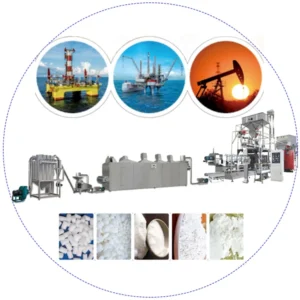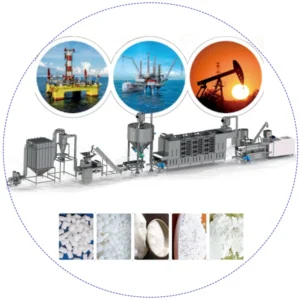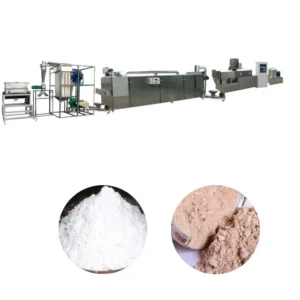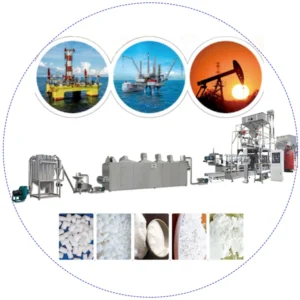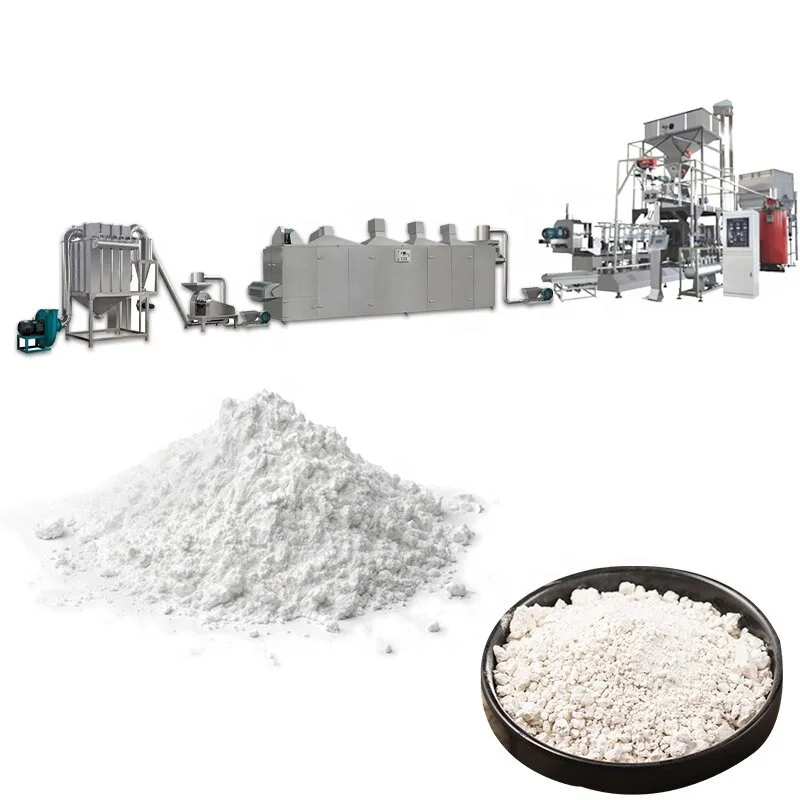
Line-Wide Throughput Matching — every station from batching to grinding is sized together so no single unit bottlenecks the modified starch processing line on your actual raw material.
Technical Specifications
| Parameter | Value |
|---|---|
| Product Type | Modified Starch Processing Line |
| Extruder Type | Twin screw extruder |
| Title Nominal Output | 400 kg/h (basis not stated in source — confirm raw material, moisture and gelatinisation degree) |
| Capacity Range | 80–500 kg/h (basis not stated in source — confirm raw material, moisture and gelatinisation degree) |
| Mixer Main Motor | 4.0 kW |
| Mixer Batch Output | 3.0–4.0 kg per batch |
| Mixer Dimensions | 1.2 × 0.9 × 1.4 m |
| Screw Conveyor Main Motor | 1.1 kW |
| Screw Conveyor Output | 0–150 kg/h |
| Screw Conveyor Dimensions | 2.5 × 0.6 × 2.3 m |
| Voltage Configuration | 380 V / 50 Hz (three phase) or 220 V / 50 Hz (single phase), configurable per destination country |
| Power Consumption (electric heating) | approximately 100 kW at normal capacity |
| Power Consumption (gas or diesel heating) | approximately 50–60 kW |
| Frame Material | Stainless steel 201 |
| Contact Parts Material | Food grade stainless steel 304 |
| Drive and Control Components | Siemens (China) or top China-brand motors; Delixi or Delta inverters |
| Energy Options | Electricity, gas, diesel or steam, selectable per line station |
| Process Flow | Mixer → Screw Conveyor → Twin Screw Extruder → Shift → Air Conveyor → Dryer → Air Conveyor → Conditioning → Conveyor → Grinder |
| Assembly State | Complete multi-station line |
Application Suitability
| Application | Material or Output |
|---|---|
| Pregelatinised starch for instant food mixes | Corn starch, cassava starch |
| Modified starch for paper sizing and coating | Corn starch, wheat flour |
| Cold-water swelling starch for bakery and meat processing | Potato starch, cassava starch |
| Cross-linked starch for high-temperature industrial use | Corn starch, potato starch |
What "400 kg per Hour" Leaves Out About Starch Lines
A nominal figure means nothing until it is verified on the exact starch variety and target modification you plan to run.
I remember a Southeast Asian buyer who ordered a modified starch processing line rated for cassava starch, then switched to a high-amylose corn variety without telling anyone. The gelatinisation temperature window shifted by several degrees, the screw profile could not develop the right shear, and actual output dropped to roughly half of what was quoted. He spent weeks trying to adjust barrel temperatures on site before we flew out to reconfigure the screw elements. That kind of mismatch is avoidable if the trial run happens on the buyer’s own feedstock before the machines leave the workshop [NEED_CITE: typical variation in gelatinisation temperature between corn and cassava starch feedstocks].
How Screw Configuration Controls Gelatinisation
The twin screw extruder at the heart of this modified starch processing line uses interchangeable screw elements that determine shear intensity and residence time inside the barrel. For pregelatinised starch, the screws must generate enough mechanical energy to rupture starch granules without degrading the polymer chains. For oxidised or cross-linked variants, the profile shifts toward longer residence at lower shear. The die plate is matched to the same logic, controlling expansion and moisture flash-off as the product exits the barrel. Getting this combination wrong means the downstream dryer either cannot remove enough moisture or receives material that is already over-processed.
Balancing Mixer Batches with Extruder Feed
A 3.0–4.0 kg mixer batch feeds into a screw conveyor rated for 0–150 kg/h. If the extruder is running at the upper end of its capacity range, the mixer must cycle fast enough to avoid starving the feed hopper, which introduces surging and inconsistent gelatinisation. If the mixer cycles too slowly, operators are forced to run the extruder below its comfortable throughput window, which changes barrel fill level and residence time. The screw conveyor variable output range allows fine-tuning so that each batch transitions smoothly into continuous extrusion without dead spots in the flow. This balance is checked during the in-house trial run, where batch timing and conveyor speed are recorded together [NEED_CITE: importance of continuous feed rate stability in twin screw starch extrusion].
Reading the Numbers That Actually Matter
The 4.0 kW mixer motor is sized for dense starch slurries that are heavier than typical snack doughs; undersizing here leads to incomplete blending and uneven moisture distribution before the material even reaches the extruder. The 1.1 kW screw conveyor motor drives an auger long enough to span the 2.5 m distance from mixer outlet to extruder hopper, maintaining a steady material column. Contact parts in food grade stainless steel 304 resist the mildly acidic conditions that some modification reactions produce, while the stainless steel 201 frame keeps structural costs reasonable without compromising hygiene in non-contact zones. The choice between electric heating at roughly 100 kW and gas or diesel heating at roughly 50–60 kW affects not only running cost but also the temperature ramp rate inside the barrel, which matters for modifications that require a sharp thermal profile.
The Hidden Cost of Skipping the Trial Run
Buyers who accept a generic screw and die configuration often discover problems only after installation. Floating density may fall outside what the downstream packaging line expects, or the ground starch powder may show a wider particle size spread than the specification allows. Correcting these issues on site means ordering new screw elements, waiting for air freight, and running additional test batches while the line sits idle. All of that downtime compounds the initial savings of skipping a pre-shipment trial [NEED_CITE: cost impact of post-installation screw reconfiguration in starch extrusion].
Why Source This Line as One Package
The modified starch processing line is supplied as a single matched system rather than assembled from separate vendors, which means throughput calculations account for every station from the mixer through the grinder. Screw configuration and die design are specified to your raw material and target modification degree, not copied from a generic starch build. The in-house testing workshop runs your actual feedstock before shipment, producing a documented trial report. Electrical schematics and voltage are confirmed against your plant supply before production begins, avoiding the commissioning delays that happen when a 380 V machine arrives at a 220 V site. Food-grade stainless steel 304 contact parts are standard across every station, not an optional upgrade on selected units.
Documentation & Verification
- Line layout drawing with throughput calculation matched to your starch type and target modification
- Screw and die configuration record listing element order, pitch and die aperture for your specific product
- Electrical schematic confirming voltage, frequency and control language before production starts
- Trial run report on your raw material showing actual output, moisture and gelatinisation data
- CE declaration of conformity and ISO certificate included with shipping documents
- Factory test record with photographs of every station before crating
Installation, Commissioning & Support
- Foundation plan accounts for the 2.5 m screw conveyor length and extruder vibration isolation points
- Dedicated circuit sized for approximately 100 kW electric heating load or separate gas line routing
- Stations shipped as individual skids for easier positioning inside low-clearance production halls
- First run includes barrel temperature profiling and screw speed mapping to your starch formulation
- Operator training covers mixer batch timing, conveyor speed adjustment and die change procedure
- Wear parts list identifies screw elements, barrel liners and die plates with replacement intervals
Before You Send an Inquiry
Share your starch feedstock type, the target modification such as pregelatinisation or cross-linking, and the daily output you need from the line. Tell us your plant voltage and frequency, the control language your operators prefer, and whether you have existing upstream or downstream equipment the line must connect to. If you can send a sample of your raw material, we will run it through the testing workshop and include the trial report with our proposal.
Frequently Asked Questions
Q: How is line capacity verified on my specific starch feedstock?
A: We run your actual starch sample in the in-house testing workshop, recording output, moisture content and gelatinisation degree at different screw speeds and barrel temperatures. The trial report accompanies the quotation so you see real numbers on your own material, not a generic capacity claim detached from your formulation.
Q: Which stations use which energy source?
A: The extruder barrel typically uses electric heating at roughly 100 kW total, while the dryer can switch between electric, gas, diesel or steam depending on your plant utilities. We calculate the combined load for your chosen combination and confirm it against your available supply before production.
Q: How are screw elements matched to my target modification?
A: Pregelatinised starch needs high shear and short residence, so we use forward-conveying elements with aggressive kneading blocks. Cross-linked or oxidised variants require longer residence at gentler shear, so we insert reverse elements and spacing rings. The die aperture is then chosen to control expansion and moisture release at the exit.
Q: How do you prevent one station from bottlenecking the rest?
A: Mixer batch size, conveyor output range and dryer capacity are all calculated from the same throughput target. During the trial run we time each station and adjust conveyor speed and dryer belt loading until material flow is continuous, with no surging or starvation between units.