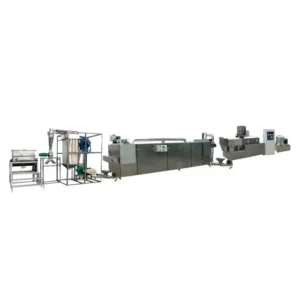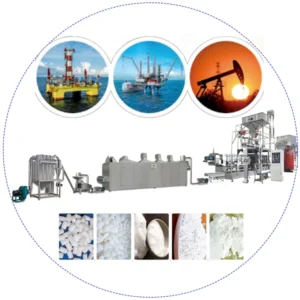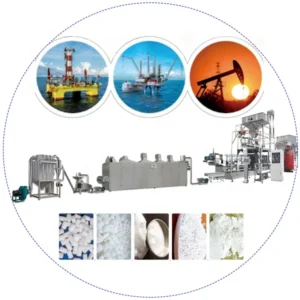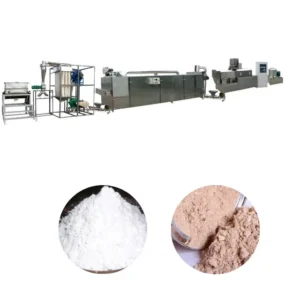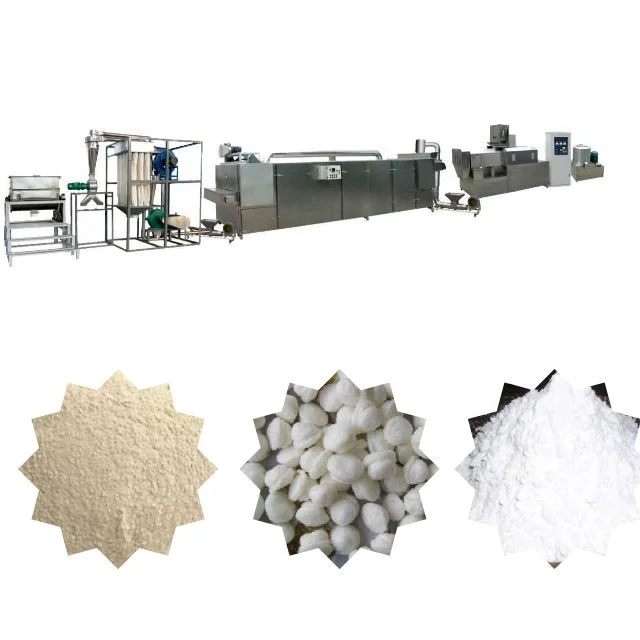
Every station matched for throughput — from mixer batch sizing to dryer fuel selection, the MT70, MT85, and MT75 modified starch processing line configurations are specified so no single station bottlenecks your output.
Technical Specifications
| Parameter | Value |
|---|---|
| Product Type | Modified Starch Processing Line (Twin-Screw Extrusion) |
| Model | MT70 / MT85 / MT75 |
| Screw Type | Twin-screw |
| Screw Diameter | 70 mm |
| Screw Length | 1510 mm |
| Screw Material | 38CrMoAl |
| Installed Power | 160 kW (MT70) / 190 kW (MT85) / 210 kW (MT75) |
| Power Consumption | 120 kW (MT70) / 140 kW (MT85) / 150 kW (MT75) |
| Main Motor Power | 30 kW |
| Feeding Power | 0.75 kW |
| Cutting Power | 0.75 kW |
| Heating Ring | 7 × 2 kW = 14 kW (7-zone) |
| Barrel Cooling System | Equipped |
| Output Capacity | 150–200 kg/h (MT70, basis not stated in source — confirm raw material / moisture) / 300–400 kg/h (MT85, basis to be confirmed) / 300–500 kg/h (MT75, basis to be confirmed) |
| Voltage & Frequency | 380 V / 50 Hz / Three Phase (customizable: 380 V 60 Hz, 415 V 60 Hz, 220 V 60 Hz available) |
| Control System | Automated PLC and MCC |
| Mixer Capacity | 20–30 kg / batch, 70–80 kg / batch, or 170–180 kg / batch (model-dependent) |
| Mixer Power | 4 kW / 7.5 kW / 15 kW (model-dependent) |
| Dryer Dimensions | 5000 × 1200 × 2300 mm |
| Dryer Weight | 1800 kg |
| Dryer Fuel Options | Gas / Diesel / Electricity / Steam (confirm at quotation) |
| Dryer Speed Control | Inverter |
| Grinder Type | Pulse grinder with cyclone discharge, dust collector, and control panel |
| Contact Materials | Food-grade stainless steel (201SS / 304SS options; PVC on select conveyors) |
| Overall Dimensions (L×W×H) | 41000 × 1500 × 2200 mm (MT70) / 43000 × 1500 × 3200 mm (MT85) / 45000 × 1500 × 3500 mm (MT75) |
| Standards | CE, ISO certified |
| Warranty | 1 year complete warranty with life-time maintenance service |
Application Suitability
| Application | Material or Output |
|---|---|
| Modified starch production | Corn starch, wheat flour |
| Pregelatinised starch for food industry | Corn starch with controlled gelatinisation |
| Expanded starch for industrial use | Corn starch, wheat flour blends |
| Nutritional and fortified starch powders | Starch base with vitamin or mineral premix |
| Artificial rice and breakfast cereal base | Wheat flour, corn starch with protein additives |
Why "Nominal Capacity" Without Raw Material Context Fails Starch Processors
A modified starch processing line rated at a fixed throughput means nothing until you test it on your actual starch source at your production moisture.
I have watched lines get shipped to Southeast Asian mills where the trial run used standard corn starch at controlled humidity, then the buyer switched to locally sourced cassava starch with different amylose ratios and particle sizes. The expansion dropped, the dryer could not keep up, and the grinder choked on denser pellets. The screw configuration and barrel temperature profile needed a complete reset, adding weeks before the line produced saleable product. When you survey a modified starch processing line full equipment range, the capacity column in any spec sheet must be validated against the exact raw material you will run [NEED_CITE: starch gelatinisation behaviour across corn, wheat, and cassava sources].
How Each Station in the Range Fits the Modified Starch Workflow
The mixer, extruder, dryer, grinder, and packing interface in this modified starch processing line are specified individually so you can see where each station sits in the material flow. The mixer batch sizes — 20–30 kg, 70–80 kg, or 170–180 kg — are scaled to the extruder throughput of the corresponding model, preventing the common failure where the feeder starves or the hopper overflows. The twin-screw extruder handles the actual starch modification through shear, heat, and moisture control across seven heating zones.
Matching Dryer and Grinder Capacity to Extruder Output
The 5-layer dryer with inverter speed control and selectable fuel source — gas, diesel, electricity, or steam — is sized to handle the moisture reduction required after extrusion. A pulse grinder with cyclone discharge and integrated dust collector follows, reducing dried extrudate to the fine particle size that modified starch buyers expect. If the dryer cannot remove moisture fast enough, the grinder produces inconsistent powder and the packing station sees variable weights. Every connection in the modified starch processing line full equipment range must be checked for this balance before the layout is finalised [NEED_CITE: multi-layer dryer residence time and moisture removal rates in starch applications].
Reading the Screw and Barrel Parameters for Starch Modification
The 70 mm twin-screw diameter and 1510 mm screw length define the shear profile and residence time inside the barrel — both critical for starch gelatinisation. The 38CrMoAl screw material resists abrasion from starch granules during extended production runs. Seven heating zones at 2 kW each give operators precise control over the barrel temperature gradient, which directly affects the degree of starch modification. The barrel cooling system prevents localised overheating that can degrade pregelatinised starch quality. Voltage flexibility — 380 V 50 Hz as standard, with 220 V, 380 V, and 415 V at 60 Hz variants available — ensures the motor and heating systems perform correctly regardless of your local grid specification [NEED_CITE: voltage and frequency standards by export market].
What Happens When Station Capacities Are Mismatched
An extruder producing at full throughput into a dryer that cannot remove moisture quickly enough creates wet pellets that clog the grinder screen. The operator slows the extruder to compensate, and the line never reaches the capacity you paid for. I have seen starch processing installations where the mixer batch cycle took longer than the extruder consumption rate, forcing the extruder to idle between batches and producing inconsistent starch modification due to temperature cycling. These failures are not equipment defects — they are specification mismatches that a full equipment range review should catch before purchase.
Why Buyers Source the Complete Range from One Supplier
Each station in the MT modified starch processing line is designed and tested as part of a matched system, so throughput calculations account for every transfer point. Screw configuration and die design are specified to your raw material — whether corn starch, wheat flour, or a blend — rather than copied from a generic build. The in-house testing workshop runs your actual material before shipment, locking parameters so the line produces to specification from day one. Pre-sales engineering covers layout, utility planning, and voltage confirmation, with on-site installation, commissioning, and operator training included. Wear parts lists and maintenance documentation are provided so your first screw or die replacement does not cause unplanned downtime.
Documentation & Verification
- Line layout with station-by-station capacity calculations for your target starch product
- Machine specification sheet covering mixer, extruder, dryer, grinder, and packing interface
- Screw and die configuration record matched to your raw material and modification target
- Electrical schematic with voltage and frequency confirmed for your local supply
- Trial run report on your raw material with expansion, moisture, and particle size data
- Factory test record with packing photographs and CE declaration of conformity
Installation, Commissioning & Support
- Overall line length up to 45 m requires straight-run floor space with 3.5 m minimum clearance height
- Dedicated three-phase circuit at confirmed voltage with separate breaker for 30 kW main motor
- Stations ship as complete assemblies; extruder barrel and dryer modules bolt on-site
- First-run parameter setting covers barrel temperature profile, screw speed, and dryer belt rate
- Operator training on PLC interface, mixer batch timing, and grinder screen changes
- Wear parts list covers screws, dies, and grinder screens with recommended stock quantities
- Maintenance schedule aligned to 38CrMoAl screw wear intervals and dryer belt inspection
What to Include in Your Inquiry
Share the specific starch source you will process — corn starch, wheat flour, cassava, or a blend — along with your target modification type and daily output requirement. Confirm your local voltage and frequency, available fuel for the dryer, and whether your workshop has height restrictions that affect the dryer or grinder installation. If you can send a raw material sample, we run it in the testing workshop and include the trial report with your quotation so the modified starch processing line full equipment range is validated before you commit.
Frequently Asked Questions
Q: What equipment is included in each modified starch line model?
A: Every model — MT70, MT85, and MT75 — includes a flour mixer scaled to line throughput, a twin-screw extruder with 7-zone heating, a 5-layer dryer with selectable fuel source, a pulse grinder with cyclone discharge and dust collector, and a packing interface. Station capacities are matched so no single point bottlenecks production.
Q: How do mixer batch sizes map to extruder throughput across the three models?
A: Mixer options are 20–30 kg, 70–80 kg, or 170–180 kg per batch, paired to the MT70, MT85, and MT75 respectively. The mixer cycle time is calculated so the extruder receives a continuous feed without starvation or hopper overflow, which is critical for consistent starch gelatinisation.
Q: Which voltage and frequency options are available for export?
A: The standard configuration is 380 V / 50 Hz / three phase. Options include 380 V 60 Hz, 415 V 60 Hz, and 220 V 60 Hz. Voltage and frequency must be confirmed before production so motor windings, heating elements, and the PLC power supply match your local grid.
Q: What fuel options does the dryer support?
A: The 5-layer dryer supports gas, diesel, electricity, and steam. The choice affects line footprint, utility connections, and operating cost. Fuel selection should be confirmed at quotation stage so the burner or heater assembly is installed correctly before shipment.
Q: How is the pulse grinder sized relative to extruder output?
A: The pulse grinder with cyclone discharge is selected to process the full extruder output without accumulation. Its screen size and motor power are matched to the target particle size for modified starch powder, preventing bottlenecks between drying and packing.