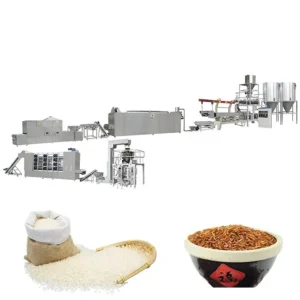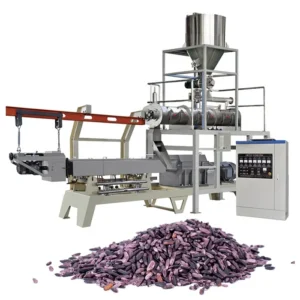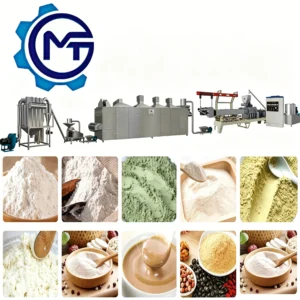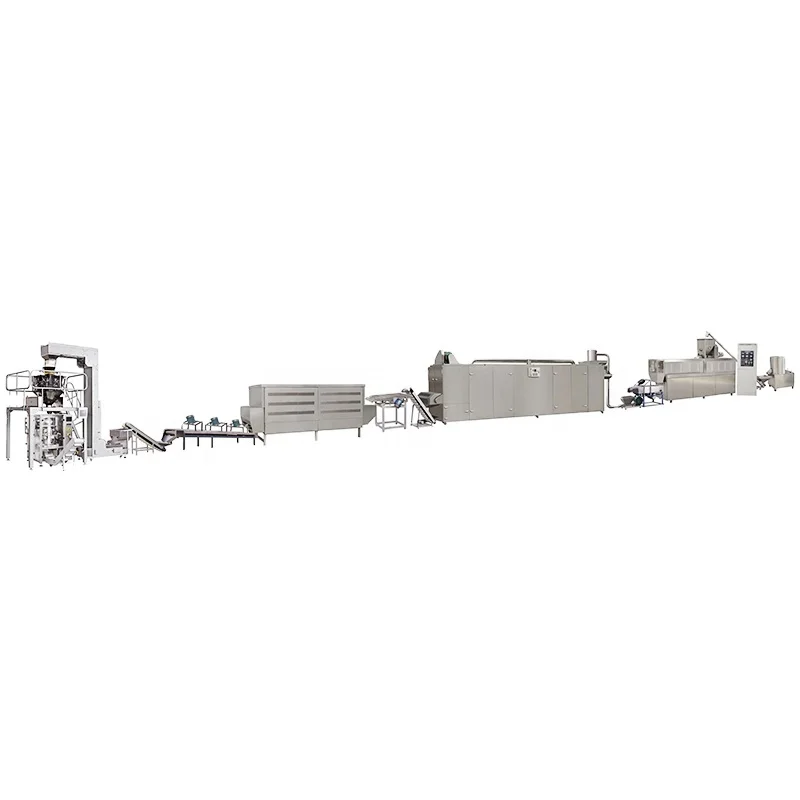
Complete Line Matching — throughput calculated across every station from batching to packing, so extruder output never outpaces dryer or cooler capacity on nutritional powder runs.
Technical Specifications
| Parameter | Value |
|---|---|
| Product Type | Nutritional Powder Processing Line |
| Available Models | MT65 / MT70 / MT85 |
| Installed Power | 66 kW (MT65) / 100 kW (MT70) / 130 kW (MT85) |
| Real Operating Power | 50 kW (MT65) / 67 kW (MT70) / 80 kW (MT85) |
| Output Capacity | 100–150 kg/h (MT65) / 200–240 kg/h (MT70) / 400–500 kg/h (MT85) (basis not stated in source — confirm raw material, moisture, and formulation) |
| Voltage & Frequency | 380V/50Hz (Three Phase) / 220V/50Hz (Single Phase), configurable to local standards |
| Overall Dimensions | 19000×1200×2200 mm (MT65) / 21000×1500×2200 mm (MT70) / 30000×3500×4300 mm (MT85) |
| Screw Type | Twin-screw |
| Motor | Siemens |
| Construction Material | Stainless Steel (food-contact zones) |
| Control System | Frequency changer controlled |
| Processing Method | High-temperature, high-pressure extrusion |
| Assembly State | Complete processing line |
| Standards | CE, ISO |
Application Suitability
| Application | Material or Output |
|---|---|
| Infant cereal and baby food powder | Rice flour, oat flour, corn starch blended with milk powder and micronutrients |
| Meal replacement and instant drink powder | Soy protein, whey, pea protein with grain and fiber bases |
| Fortified nutritional powder for feeding programmes | Maize, sorghum, or millet blended with vitamin-mineral premix |
| Starch-based instant porridge | Pregelatinised starch from cassava, potato, or wheat sources |
What "500 kg/h" Means When Your Formula Changes
A capacity figure tied to one raw material tells you almost nothing about how the line will perform on your actual formulation.
I learned this the hard way in Shandong. We once configured a baby food line for a Southeast Asian buyer using standard rice flour during trial runs. The powder came out clean, the dryer handled moisture levels without strain, and the packing station kept pace. Then the customer switched to a higher-protein grain blend they sourced locally. The extrudate held more moisture, the dryer could not pull it down to specification, and powder clumping jammed the filler within an hour. The nutritional powder processing line equipment was rated correctly — for the wrong material [NEED_CITE: raw material variability in extrusion processing]. That single mismatch cascaded through three downstream stations.
Matching Every Station to Your Formulation
A nutritional powder processing line is only as reliable as its weakest throughput link. The mixer must feed the extruder at a steady rate; the extruder must produce material the dryer can handle within its residence time; the cooler must bring the powder to a temperature the packing system can seal without condensation. When we quote a line, we calculate each station against the same raw material profile and target moisture — not against generic benchmarks.
How High-Temperature Extrusion Changes the Powder
Twin-screw extrusion at elevated temperature and pressure forces starch gelatinisation and protein denaturation inside the barrel. This means the nutritional powder processing line equipment produces a powder that dissolves readily in warm water and delivers improved nutrient bioavailability compared to simple dry blending. The screw configuration and barrel temperature profile are selected based on whether your formulation leans toward starchy cereals or protein-dense legumes, because each demands different shear and residence characteristics [NEED_CITE: starch gelatinisation parameters in twin-screw extrusion].
Reading the Specs That Actually Matter
Motor choice and real operating power reveal what a line draws under load, not just what the nameplate says. The Siemens motors across the MT65, MT70, and MT85 ranges provide consistent torque for viscous doughs containing protein concentrates. Frequency changer control lets operators fine-tune screw speed to match the formulation, which directly affects how completely the starch gelatinises and how uniform the final powder particle size becomes. The stainless steel construction in food-contact zones meets hygiene requirements for infant food production. Line footprint ranges from roughly 19 metres for the MT65 configuration to 30 metres for the MT85, so workshop length and ceiling height must be confirmed before layout is locked [NEED_CITE: workshop utility requirements for extrusion lines].
The Hidden Cost of Undersized Supporting Stations
When an extruder is quoted alone, or paired with a dryer that lacks the thermal capacity for the actual moisture load, the consequences surface weeks after commissioning. Product piles up between stations. The dryer runs at maximum belt speed and still cannot hit target moisture, so powder arrives at the packing station warm and tacky. Seals fail, bags reject, and operators spend shifts clearing blockages instead of running product. Every one of these problems traces back to a line that was assembled from separate specifications rather than engineered as one system [NEED_CITE: throughput bottlenecks in multi-station food processing lines].
Why Buyers Source the Full Line Here
Every station from mixing and batching through extrusion, drying, cooling, and packing is specified under one supplier, so throughput numbers are calculated against each other rather than guessed. Screw configuration and die design are matched to the buyer’s actual raw material report before production starts. An in-house testing workshop runs the customer’s own formulation before shipment, catching the kind of moisture or density surprises that otherwise appear during commissioning. Twin-screw expertise spans infant cereal, meal replacement, fortified porridge, and starch-based powders. Pre-sales consultation carries through to on-site installation, operator training, and ongoing wear parts supply.
Documentation & Verification
- Line layout drawing showing matched throughput at each station for your formulation
- Machine specification sheet with screw and die configuration matched to your raw material
- Trial run report produced on your actual grain or protein blend before dispatch
- Electrical schematic confirming voltage, frequency, and control language for your market
- Factory test record documenting real operating power and output during pre-shipment run
- Operation and maintenance manual with wear parts list and recommended replacement intervals
Installation, Commissioning & Support
- Foundation and floor space planned around the MT85 footprint of 30000×3500×4300 mm including dryer clearance
- Dedicated power circuit sized for real operating load of up to 80 kW on the MT85 configuration
- Line arrives in modular sections for sequential assembly aligned with the station layout drawing
- First-run parameter setting covers barrel temperature profile, screw speed, and dryer belt speed
- Operator training addresses formulation changeover and frequency changer adjustment procedures
- Wear parts list covers screws, dies, and cutter assemblies with recommended stock quantities
What to Include in Your Inquiry
Send us your raw material composition report — protein, fat, starch, and moisture percentages — along with the target powder specification and your daily output target. Confirm your workshop dimensions, local voltage and frequency, and whether your operators need a specific control panel language. If you have existing upstream or downstream equipment you plan to integrate, include those specifications so we can match throughput at the connection points.
Frequently Asked Questions
Q: How do you verify output capacity on my specific raw material and formulation?
A: We request your raw material analysis report and run a trial in our testing workshop using your actual grain blend or protein mix. The trial documents extruder throughput, dryer moisture reduction, and final powder characteristics against your specification. We only lock the line configuration after this trial confirms that every station can sustain the target output on your material.
Q: What stations are included in the complete line, and how is throughput matched?
A: The line covers mixing and batching, twin-screw extrusion, drying, cooling, and packing. Each station is sized so its maximum throughput aligns with the extruder output on your specific formulation. This prevents material backlog between stations and avoids the common problem where a fast extruder feeds a dryer that cannot keep pace.
Q: Can the voltage, frequency, and control language be configured for my local requirements?
A: Yes. The standard offering covers 380V/50Hz three-phase and 220V/50Hz single-phase, but we configure the electrical system to your local grid specification before production. Control panel language and labelling are confirmed during the specification review stage so that your operators can read all parameters in their working language from day one.
Q: Do you conduct trial runs on my raw material before shipment?
A: Every line goes through a trial run in our in-house testing workshop using the customer’s actual raw material. We document screw speed, barrel temperature, moisture content at each station, and final powder particle size. The trial report ships with the equipment and serves as the baseline for commissioning adjustments at your facility.
Q: What supporting equipment is included to avoid line bottlenecks?
A: The line includes a batching and mixing system sized for the extruder feed rate, a dryer with sufficient thermal capacity and belt length for your formulation’s moisture load, a cooling conveyor, and a packing station matched to the line output. Each station is selected so that none becomes a constraint on the others during sustained production.