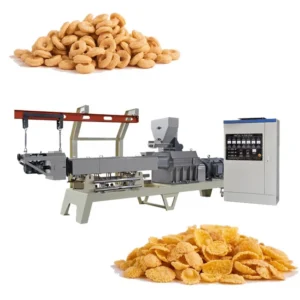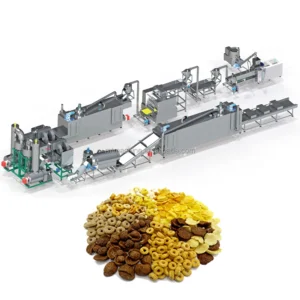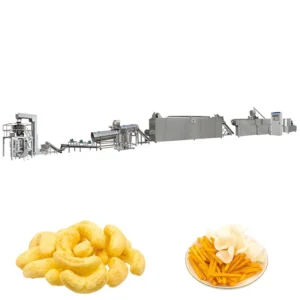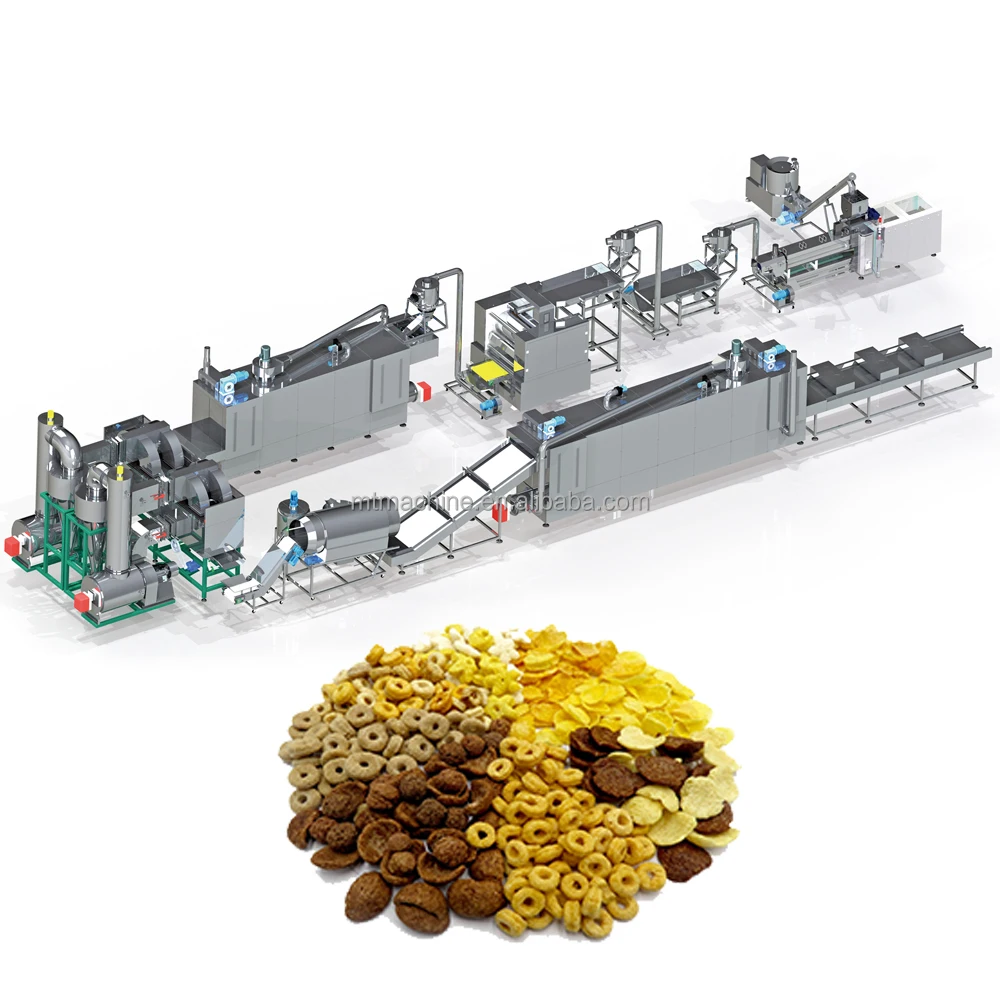
Integrated Throughput Matching — Every station from the corn flakes mixing system to the packing conveyor is sized against the extruder’s real output on your grain formulation, eliminating the mid-line bottlenecks that force entire lines to run below nameplate speed.
Technical Specifications
| Parameter | Value |
|---|---|
| Product Type | Corn Flakes Breakfast Cereal Production Line |
| Models Available | MT70, MT85, MT75 |
| Installed Power (MT70) | 160 kW |
| Installed Power (MT85) | 190 kW |
| Installed Power (MT75) | 210 kW |
| Power Consumption (MT70) | 120 kW |
| Power Consumption (MT85) | 140 kW |
| Power Consumption (MT75) | 150 kW |
| Output Capacity (MT70) | 150–200 kg/h (basis to be confirmed — dependent on raw material formulation and moisture) |
| Output Capacity (MT85) | 300–400 kg/h (basis to be confirmed — dependent on raw material formulation and moisture) |
| Output Capacity (MT75) | 300–500 kg/h (basis to be confirmed — dependent on raw material formulation and moisture) |
| Extruder Type | Twin Screw Extruder |
| Overall Dimensions (MT70) | 41 × 1.5 × 2.2 m |
| Overall Dimensions (MT85) | 43 × 1.5 × 3.2 m |
| Overall Dimensions (MT75) | 45 × 1.5 × 3.5 m |
| Control System | PLC control with automated line integration |
| Dryer Heating Source | Gas or Electric |
| Flaking Machinery Drive | Hydraulic double-roller system with separate dual-motor drive |
| Roasting Oven Airflow | Dual circulating fans with cyclone dust removal |
| Key Features | Infrared sensor temperature control on flakers, automatic screw lubrication and cooling, vibrating pan roaster, double tumble drum coating system |
Application Suitability
| Application | Material or Output |
|---|---|
| Natural corn flakes production | Corn grits and corn flour blends |
| Sugar-coated corn flakes | Corn base with syrup coating in tumble drum |
| Multi-grain breakfast cereals | Rice, wheat, oat, and barley powder formulations |
| Extruded cereal shapes (rings, stars, balls) | Grain-based doughs with die and mould changes |
What the Nameplate Capacity of a Corn Flakes Production Line Leaves Out
A line rated at a certain throughput on paper only holds that rate when every downstream station — dryer, roaster, coater — is matched to the extruder’s real output on your exact grain blend.
I spent years running test batches in our Jinan workshop before moving to line configuration work, and the pattern is consistent: buyers compare extruder models on nominal kg/h, sign the order, then discover the dryer cannot pull moisture down fast enough on their particular corn formulation. The whole corn flakes production line drops to a lower speed while operators wait for the drying tunnel to catch up. The extruder was never the constraint — the mismatch between stations was [NEED_CITE: throughput balancing across sequential food processing stations].
Mapping Every Station Before You Commit
This equipment range covers the full sequence — batching and mixing, twin-screw extrusion, flaking, pre-drying, hot air roasting, optional sugar coating, cooling, and packing. The value of surveying the complete breakfast cereal machine full equipment range lies in seeing how each station connects and where capacity gaps typically appear. When a buyer selects the MT85 extruder, for instance, the corresponding dryer length, roaster pan area, and coating drum volume all shift upward compared to the MT70 configuration.
Why Flaking Consistency Sets the Line Speed
The flaking machinery sits between extrusion and drying, and its behaviour directly governs what the downstream dryer must handle. The hydraulic double-roller system here uses separate motors for each roller, with infrared sensor temperature control maintaining the surface heat that keeps the dough sheet pliable during pressing. Flake thickness determines how much moisture the dryer must remove and how evenly the roasting oven toasts the final product. Inconsistent flakes mean the dryer either over-dries thin pieces or leaves thick ones above spec moisture — and the operator ends up narrowing the belt speed to protect the worst-case flake [NEED_CITE: moisture gradient effects in cereal flake drying].
Reading the Power and Dimension Data
The installed power figures — 160 kW for the MT70, 190 kW for the MT85, 210 kW for the MT75 — cover the full line, not just the extruder. Power consumption values run lower because not every station draws peak load simultaneously; the extruder main drive, dryer heating elements, and roaster burners cycle in overlapping rather than concurrent peaks. Overall line length stretches from 41 m to 45 m across the three models, mostly driven by dryer tunnel and roaster oven length as throughput increases. The twin-screw extruder itself uses a special screw manufacturing process with automatic lubrication and cooling, which reduces the thermal load on the barrel and extends wear life on high-abrasion corn grits formulations. Buyers should confirm their workshop ceiling height against the 2.2–3.5 m range, particularly where the roaster oven’s cyclone dust removal unit adds vertical clearance requirements.
The Hidden Cost of Undersizing the Dryer
I worked on a project last year where the client ordered a microwave tunnel dryer matched to sample-batch throughput, but their actual production flakes came out thicker and with higher moisture than the lab trials predicted. The dryer could not bring the exit moisture to specification at line speed, so the entire corn flakes production line was forced to slow down. The dryer — not the extruder — became the bottleneck. That situation repeats across the industry whenever upstream and downstream capacities are quoted independently rather than as a matched system [NEED_CITE: dryer bottleneck causes in cereal production lines].
Why Buyers Source the Full Range Here
Every station in this catalogue is designed to connect to the others without third-party adapters or custom conveyor transitions. The screw configuration and die design on each twin-screw model are specified to the buyer’s raw material rather than copied from a generic build. An in-house testing workshop runs trial batches on the customer’s actual corn, rice, or oat formulation before the line ships, so throughput and product texture are validated before installation begins. The PLC control system spans the entire line from mixer to packer, giving a single control language and alarm hierarchy rather than separate panels from different vendors. Documentation — from electrical schematics to trial run reports — is issued as one integrated set.
Documentation & Verification
- Machine specification sheet per station with confirmed power, dimensions, and utility requirements
- Screw and die configuration record matched to your grain formulation and target flake geometry
- Trial run report on your raw material showing actual throughput and product moisture readings
- Electrical schematic with voltage, frequency, and control language confirmed before production
- CE declaration of conformity and ISO certificate for the complete integrated line
- Wear parts list covering screws, dies, flaking rollers, and roaster spray tubes
Installation, Commissioning & Support
- Foundation plan based on the selected model’s 41–45 m overall length and station weights
- Dedicated power circuit sized to the line’s 160–210 kW installed capacity with confirmed voltage and frequency
- Modular station delivery with sequenced unloading to match the floor layout
- PLC parameter setup and first-run calibration on your grain blend during on-site commissioning
- Operator training covering extruder screw speed, flaker hydraulic pressure, and roaster temperature profiles
- First-order spare parts package including twin-screw elements, die plates, and flaking roller segments
How to Start the Conversation
Share your target product format — natural flakes, sugar-coated, or multi-shape extruded cereal — along with the grain formulation you plan to run and your intended daily output. We also need your workshop floor dimensions, local voltage and frequency, and whether your existing packing system will integrate or if a new cooling and packing section is required. If you have raw material samples available, a trial run in the testing workshop gives both sides real data before any commitment.
Frequently Asked Questions
Q: How do I select the right extruder model from the range for my target capacity?
A: Start with your raw material formulation and the moisture content at the extruder outlet, because these determine actual throughput more than motor size alone. The MT70, MT85, and MT75 each cover different output tiers, but the correct choice depends on how your specific grain blend behaves under twin-screw shear and temperature. A trial run on your material resolves this faster than comparing nameplate figures.
Q: Which supporting stations must match the extruder to avoid line bottlenecks?
A: The dryer tunnel length, roaster pan area, and coating drum volume all need to handle the extruder’s real output. If the dryer is undersized for your flake thickness and moisture, the entire line slows to match it. We size each station against the extruder’s tested throughput on your formulation rather than quoting independent nominal capacities.
Q: Can the line produce both natural and sugar-coated corn flakes?
A: Yes. Natural flakes go from roasting directly to cooling and packing. Sugar-coated variants add the double tumble drum coating station after roasting, where syrup is applied through spraying nozzles in a rotating drum. The coating system includes a sugar melting unit and elevator, so no separate sugar preparation area is needed.
Q: What are the overall footprint and utility requirements for each configuration?
A: Line length ranges from 41 m to 45 m depending on the extruder model selected, with widths around 1.5 m and heights up to 3.5 m. Installed power spans 160–210 kW with consumption figures of 120–150 kW. The dryer heating source is configurable to gas or electric, and local voltage and frequency must be confirmed before production begins.