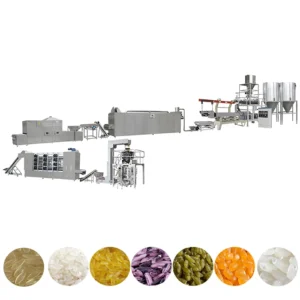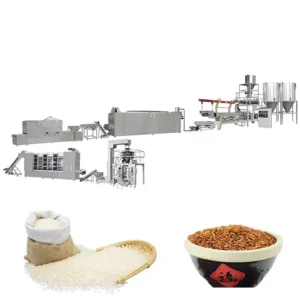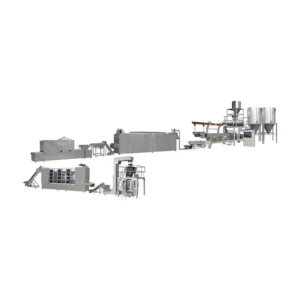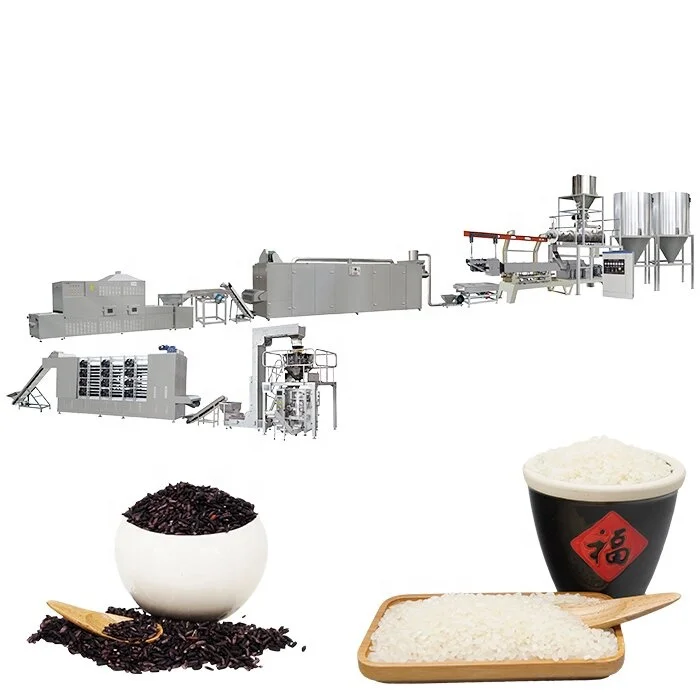
Station-by-station throughput verification — every mixer, extruder, screen, dryer and cooler in the line is capacity-checked against the buyer’s actual raw material and target rice grain specification before the layout is finalised.
Technical Specifications
| Parameter | Value |
|---|---|
| Product Type | Nutritional & Fortified Rice Extrusion Line |
| Mixing Machine Power | 15 kW |
| Mixing Batch Capacity | 130 kg – 150 kg per batch |
| Mixing Machine Dimension | 1450 × 1550 × 980 mm |
| Mixing Tank / Cover Thickness | 1.5 mm / 1.2 mm stainless steel |
| Extruder Type | Twin-screw, 2500 mm screw length |
| Extruder Main Power | 110 kW (frequency control) |
| Feeder Power | 1.5 kW (frequency control) |
| Cutting Power | 2.2 kW (frequency control) |
| Oil Pump Power | 0.75 kW |
| Vibrating Screen Power | 0.2 kW |
| Vibrating Screen Dimension | 1700 × 1210 × 740 mm |
| Low Temperature Dryer Heating | Electric (gas / diesel / steam available on request) |
| Cooling Dryer Power | 2.2 kW |
| Cooling Dryer Dimension | 5000 × 1500 × 1900 mm |
| Output Capacity | To be calculated on buyer’s raw material and moisture basis (basis to be confirmed) |
| Voltage & Frequency | Configurable (e.g., 3ph 380V 50Hz / 3ph 415V 60Hz / 3ph 220V 60Hz) |
| Control System | Frequency control on feeder, extruder and cutter |
| Assembly State | Complete line (mixing → extrusion → vibrating screen → drying → cooling → polishing → storage → packing) |
| Certification | CE, ISO |
Application Suitability
| Application | Material or Output |
|---|---|
| Fortified and artificial rice production | Rice flour blended with vitamins, minerals and micronutrients |
| Instant and self-heating rice meals | Pre-gelatinised rice grains for quick-cook formats |
| Minute rice and quick-cook formats | Partially cooked rice kernels with controlled moisture |
| Konjac and shirataki rice | Konjac flour and starch blends requiring non-standard screw configuration |
| Custom rice grain sizing | Die format adjusted to customer-specified grain length and diameter |
What "Nominal Output" Actually Means on a Fortified Rice Extrusion Line Equipment Purchase
The number on the quotation is only valid if the raw material, moisture content and grain size match the basis it was calculated on.
I spent years flying to Latin American plants because the line ran fine on the factory test material but choked the moment the buyer switched to their local rice flour blend. The extruder would surge, the die would clog, and the grains would stick together coming off the screen. Nobody had asked what flour the buyer was actually using. A complete food machinery range quote that skips this conversation is just a guess with a price tag attached [NEED_CITE: twin-screw extrusion behaviour on varying starch compositions]. That is why the first thing I ask for now is a raw material sample, not a purchase order.
How the Mixing Station Sets the Ceiling for Everything Downstream
The 15 kW mixer handles 130 kg to 150 kg per batch in a 1.5 mm stainless steel tank. That batch cycle time directly determines how often the extruder feeder needs refilling. If the mixer cannot keep pace, the extruder starves and the gelatinisation profile breaks. Every complete food machinery range has to be read as a chain, not a collection of individual machines.
Why the Dryer Selection Matters More Than the Extruder Spec
The low-temperature dryer supports electric, gas, diesel and steam heating. The choice here depends entirely on the buyer’s local energy cost and utility infrastructure. A dryer sized too small for the extruder’s actual throughput becomes the bottleneck, and grains sitting in the extruder barrel too long will over-gelatinise and clump [NEED_CITE: moisture removal rates in low-temperature grain drying]. Matching the dryer to the real output, not the brochure output, is where most line designs fail.
Reading the Specs That Actually Shape the Product
The 110 kW main drive on the twin-screw extruder provides the torque needed to push viscous rice-starch blends through the barrel at 2500 mm screw length. That length gives the material sufficient residence time for complete gelatinisation without burning. Frequency control on the feeder, extruder and cutter means the operator can adjust screw speed, feed rate and cut frequency independently — critical when switching between standard fortified rice and a denser konjac blend. The vibrating screen at 0.2 kW separates grains immediately after cutting, using fan-assisted airflow to prevent hot, sticky rice from fusing before it reaches the dryer.
The Cost of Skipping the Raw Material Trial
I have watched lines sit idle for weeks after arrival because the screw configuration was copied from a generic build that never saw the buyer’s flour. The grains came out under-expanded, too dense, or stuck to the cutting blades. By the time I landed on-site to reconfigure the screws, the buyer had already lost production time, market confidence and money on wasted raw material [NEED_CITE: extrusion screw configuration impact on product density and texture]. A two-week trial run before shipment costs a fraction of a transatlantic service call.
What This Supplier Does Differently at the Equipment Range Level
The line is designed as one integrated system, so the mixer batch cycle, extruder throughput, screen capacity, dryer belt length and cooler airflow are all calculated together rather than sourced from separate vendors. Screw configuration and die design are matched to the buyer’s specific raw material and target rice grain size, not pulled from a standard catalogue. The in-house testing workshop runs the buyer’s actual material before shipment, producing a trial run report that confirms the line can hold specification. Pre-sales engineering covers line layout, utility planning and voltage confirmation before production starts.
Documentation & Verification
- Line layout and capacity calculation based on buyer’s raw material and target grain size
- Screw and die configuration record matched to the specific rice or starch blend
- Electrical schematic and voltage confirmation document before production begins
- Factory trial run report on customer-supplied raw material before shipment
- CE declaration of conformity and ISO certificate in electronic edition for export
- Operation and maintenance manual with wear parts list specific to the line configuration
Installation, Commissioning & Support
- Foundation and floor space planning based on the 5000 mm cooling dryer and full line footprint
- Dedicated circuit provisioning for the 110 kW extruder main drive and 15 kW mixer
- Voltage and frequency configuration confirmed to local supply before wiring begins
- On-site screw and die parameter tuning to buyer’s production raw material
- Operator training covering frequency control adjustment for feeder, extruder and cutter
- Wear parts list with screw and die replacement schedule from first commissioning
What to Include in Your Inquiry
Send the specific rice flour or starch blend composition you plan to run, the target rice grain dimensions, and your local voltage and frequency supply. If you have existing upstream or downstream equipment that this line needs to integrate with, include those specifications. We will run your material in the testing workshop before quoting a final configuration.
Frequently Asked Questions
Q: What raw material and moisture basis is the output capacity calculated on?
A: Output capacity depends on the specific flour blend, moisture content and target grain size. We calculate it after running your material in the testing workshop, so the number on the quotation reflects your actual production conditions rather than a generic benchmark.
Q: How do you match dryer and cooler throughput to the extruder output?
A: The 5000 mm cooling dryer and low-temperature dryer are sized based on the extruder’s verified throughput on your material. We calculate moisture removal requirements from the trial run data, not from nominal extruder capacity.
Q: Can the voltage and frequency be configured for my local power supply?
A: Yes. The line supports configurations such as 3-phase 380V 50Hz, 415V 60Hz or 220V 60Hz. Voltage and frequency are confirmed in the electrical schematic before production starts to avoid commissioning delays on-site.
Q: What screw configuration is recommended for konjac or non-starch blends?
A: Konjac and shirataki rice require different screw element arrangements and die formats compared to standard rice flour. The configuration is determined during the trial run on your specific blend, and the record is documented for future reference and replacement orders.
Q: Do you supply the packaging station or only upstream processing?
A: The complete line includes polishing, storage and packing stations matched to the upstream throughput. If you already have a packaging machine, we can design the line to integrate with your existing equipment at the cooling conveyor discharge point.