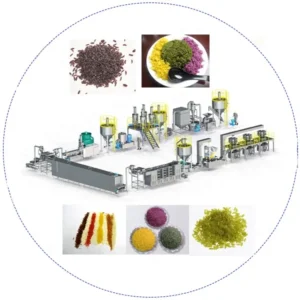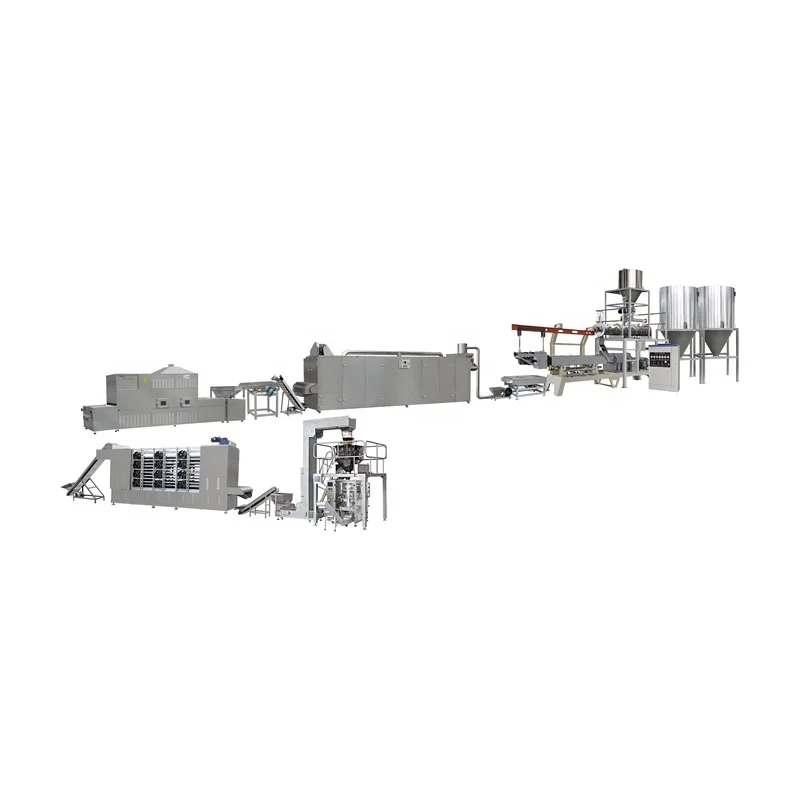
Matched Station Throughput — Every dryer, cooler, and roaster in the fortified rice line is sized to the extruder’s actual output so wet kernels never pile up between stages.
Technical Specifications
| Parameter | Value |
|---|---|
| Model | MT65 / MT70 / MT85 / MT75 / MT95 |
| Product Type | Fortified Rice Kernel Extrusion Line |
| Screw Type | Twin-screw |
| Installed Power | 85 kW (MT65); 120 kW (MT70); 235 kW (MT85); 180 kW (MT75); 260 kW (MT95) |
| Power Consumption | 60 kW (MT65); 85 kW (MT70); 165 kW (MT85); 135 kW (MT75); 195 kW (MT95) |
| Output Capacity | 80–100 kg/h (MT65, basis to be confirmed); 100–120 kg/h (MT70, basis to be confirmed); 200–300 kg/h (MT85, basis to be confirmed); 300–500 kg/h (MT75, basis to be confirmed); 800–1000 kg/h (MT95, basis to be confirmed) |
| Overall Dimensions (L×W×H) | 28×1.2×2.2 m (MT65); 30×1.5×2.2 m (MT70); 34×3.5×4.3 m (MT85); 32×3.5×4.3 m (MT75); 36×3.5×4.3 m (MT95) |
| Control System | Frequency speed control; available with PLC and MCC |
| Line Stations | Mixing, Extruding, Vibrating, Low-temperature Drying, Cooling, High-temperature Roasting, Cooling, Packing |
| Drying Oven Heat Source | Electric or Gas |
| Feeding System | Single or double screw feeding, selected by material |
| Assembly State | Complete line |
| Standards | CE; ISO |
Application Suitability
| Application | Material or Output |
|---|---|
| Micronutrient-fortified rice for public health programmes | Corn, millet, wheat, oat, or buckwheat base with vitamin-mineral premix |
| Artificial rice from broken rice and rice bran | Reprocessed rice fractions blended with starch binders |
| High-nutrition grain analogues | Multi-grain formulations with added iron, zinc, folic acid, and B-vitamins |
| Instant fortified rice kernels | Starch-rich base materials shaped to mimic natural rice grain geometry |
What "Nominal Capacity" Hides on a Fortified Rice Kernel Extrusion Line Full Equipment Range
A line rated at a certain kg/h means nothing until the raw material formula and moisture content are factored into every station.
I once watched a production line stall because the dryer was spec’d for the extruder’s brochure number, not the actual moisture load coming off the die. Wet fortified rice kernels sat on the mesh belt, sticking together before the cooling stage could separate them. The extruder kept running, but everything downstream choked. That bottleneck cost the operator days of rework before the drying curve was recalculated. With the Fortified Rice Kernel Extrusion Line full equipment range, throughput must be verified against the specific grain blend — rice starch behaves differently from corn or buckwheat under heat and shear [NEED_CITE: starch gelatinisation behaviour across grain types].
How Each Station in the Fortified Rice Kernel Extrusion Line Full Equipment Range Connects
The mixing station feeds a single or double screw feeder chosen for the raw material’s flow characteristics. Fine vitamin-mineral premix powders need different feeding mechanics than coarse broken rice grits, and getting this wrong introduces inconsistent nutrient distribution across batches. The twin-screw extruder then gelatinises the starch matrix under controlled barrel temperature zones, forming the kernel shape through the die plate.
After extrusion, the vibrating conveyor separates individual kernels before they enter the low-temperature drying oven. Circulation airflow and frequency-controlled mesh belt speed manage moisture removal without case-hardening the kernel surface. If drying is too aggressive, the outer shell seals and traps internal moisture, leading to cracking during storage. The high-temperature roasting stage that follows develops colour and texture, while the final cooling conveyor stabilises the kernels before packing.
Where Mismatches Between Stations Show Up First
A dryer that is undersized relative to the extruder output forces the line to slow down or produce kernels with uneven moisture. Over time, those moist pockets invite mould growth in finished packaging. On the other hand, an oversized dryer wastes energy and can over-dry the surface while the kernel core remains too wet [NEED_CITE: moisture equilibrium in extruded starch products]. The cooling conveyors must also match throughput; if kernels arrive at the packing station above ambient temperature, condensation forms inside bags during transport. Every station in the Fortified Rice Kernel Extrusion Line full equipment range needs its capacity confirmed against the same raw material baseline.
Reading the Specs That Actually Matter
The twin-screw configuration across the MT65 through MT95 models provides positive conveying and self-cleaning action, critical when switching between grain blends. Barrel length-to-diameter ratio determines residence time inside the extruder, which directly affects how completely the starch gelatinises — incomplete gelatinisation yields kernels that disintegrate during cooking. Installed power ratings range from 85 kW on the MT65 to 260 kW on the MT95, reflecting the mechanical and thermal energy required at each scale. Frequency speed control on the main drive allows operators to fine-tune screw RPM for different formulations without changing pulleys or belts. The choice between electric and gas heat sources for the drying oven depends on local utility costs and available infrastructure at the installation site.
The Cost of Skipping the Drying Calculation
When the drying oven capacity is guessed rather than calculated, the consequences appear weeks after startup. Kernels that feel dry on the surface may retain internal moisture above the safe storage threshold, leading to spoilage claims from downstream buyers. Production managers then reduce line speed to compensate, which drops actual output well below the original projection [NEED_CITE: post-extrusion moisture targets for shelf-stable grain products]. In some cases, the entire drying section must be replaced or supplemented with auxiliary units, adding cost and floor space that was never budgeted.
Why Source the Fortified Rice Kernel Extrusion Line Full Equipment Range Here
The complete line from mixing through packing comes from a single supplier, so throughput at each station is calculated together rather than assembled from independent vendors who each guarantee only their own machine. Screw configuration and die design are specified to your raw material formula and target kernel dimensions before production begins. An in-house testing workshop runs trial extrusion on your actual grain blend, producing a test report that documents moisture, expansion, and kernel integrity before the line ships. CE and ISO compliance documentation accompanies every shipment, supporting customs clearance and local regulatory registration. Electrical schematics confirm voltage, frequency, and control language for the destination market before the panels are wired.
Documentation & Verification
- Line layout drawing confirming station spacing and throughput balance for your target output
- Screw and die configuration record matched to your grain blend and kernel shape
- Trial run report on your raw material documenting moisture, density, and kernel geometry
- Electrical schematic with voltage, frequency, and PLC language confirmed for your facility
- CE declaration of conformity and ISO certificate included with shipping documents
- Wear parts list specifying replacement screws, dies, and dryer belt sections
Installation, Commissioning & Support
- Floor plan showing the 28–36 m line length with clearance for maintenance access on both sides
- Dedicated power circuit sized to the installed power rating of the selected extruder model
- On-site assembly of drying oven sections and cooling conveyors to final line configuration
- First-run parameter setting including barrel temperatures, screw speed, and dryer airflow
- Operator training on formulation changeover and frequency drive adjustment procedures
- Spare screw elements and die plates stocked for the first replacement cycle
What to Share With Your Inquiry
Provide the specific grain base — broken rice, corn, buckwheat, or a custom blend — along with the vitamin-mineral premix composition and target kernel dimensions. Include your local voltage and frequency standards so the electrical package is built correctly from the start. If you have existing upstream milling or downstream packing equipment, share the interface requirements so the line connects without modification.
Frequently Asked Questions
Q: How is output capacity verified for my specific raw material?
A: The rated kg/h figures in the specification table are based on reference conditions that may not match your formula. Before shipment, a trial run using your actual grain blend and premix is conducted in the testing workshop. The resulting report documents real throughput, moisture content at each stage, and kernel integrity, giving you a verified baseline rather than a brochure estimate.
Q: Which extruder model fits a mid-scale nutrition programme contract?
A: The MT75 and MT85 models cover the middle capacity tiers and suit production volumes where programme demand exceeds pilot scale but does not justify the largest line. The choice depends on your specific formulation’s throughput behaviour, which is confirmed during the pre-shipment trial run. Footprint and utility requirements differ between models, so workshop space should be reviewed against the layout drawing.
Q: What supporting stations are included and how is their capacity balanced?
A: The line includes mixing, extruding, vibrating separation, low-temperature drying, cooling, high-temperature roasting, a second cooling stage, and packing. Each station is sized based on the extruder’s verified output on your raw material, not on a generic capacity chart. This prevents bottlenecks where wet kernels accumulate before drying or hot kernels reach packing above safe temperature.
Q: Can the line process a blend of broken rice, corn starch, and micronutrient premix?
A: Yes. The twin-screw extruder handles multi-component blends, and the feeding system is selected based on the flow characteristics of your specific mix. Starch-rich materials like corn and broken rice gelatinise at different rates, so barrel temperature zones and screw configuration are adjusted during the trial run to achieve uniform kernel structure and nutrient distribution.
Q: Is a trial run performed before the line ships, and what does it cover?
A: A trial run on your raw material is conducted in the in-house testing workshop before dispatch. The test report includes actual throughput achieved, moisture readings at the dryer outlet, kernel dimensions and shape consistency, and any adjustments made to screw speed or barrel temperature. This gives you documented performance data before the equipment leaves the factory.