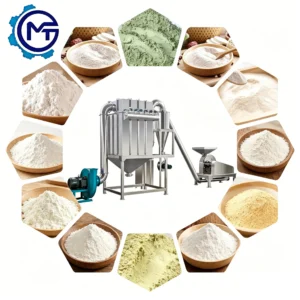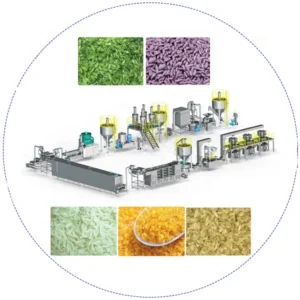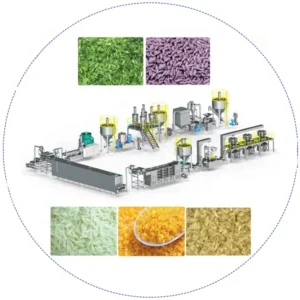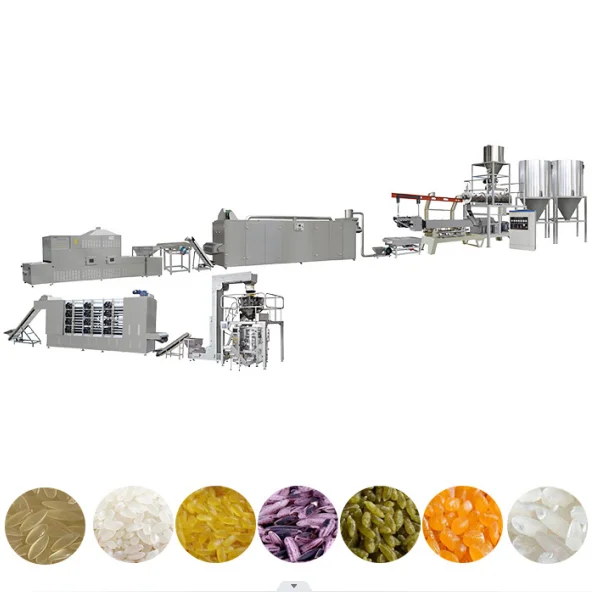
Full Equipment Range — Every station from mixing to packing is matched by throughput under one supplier, preventing the bottleneck that occurs when extruders and dryers are sourced separately for artificial fortified rice processing lines.
Technical Specifications
| Parameter | Value |
|---|---|
| Product Type | Artificial Fortified Rice Processing Line |
| Models Available | MT65 / MT70 / MT75 / MT85 / MT95 |
| Extruder Type | Twin-screw (single or double screw feeding selectable) |
| Line Sequence | Mixing → Extruding → Vibrating → Low-temperature Drying → Cooling → High-temperature Roasting → Cooling → Packing |
| Basic Material | Broken rice, rice, corn, millet, wheat, oats, buckwheat, bean, starch with vitamin and mineral additives |
| Final Products | Artificial rice, fortified rice kernels |
| Installed Power (MT65) | 85 kW |
| Power Consumption (MT65) | 60 kW |
| Capacity (MT65) | 80–100 kg/hr (basis to be confirmed with raw material and moisture) |
| Overall Dimensions (MT65) | 28 × 1.2 × 2.2 m |
| Installed Power (MT70) | 120 kW |
| Power Consumption (MT70) | 85 kW |
| Capacity (MT70) | 100–120 kg/hr (basis to be confirmed with raw material and moisture) |
| Overall Dimensions (MT70) | 30 × 1.5 × 2.2 m |
| Installed Power (MT85) | 235 kW |
| Power Consumption (MT85) | 165 kW |
| Capacity (MT85) | 200–300 kg/hr (basis to be confirmed with raw material and moisture) |
| Overall Dimensions (MT85) | 34 × 3.5 × 4.3 m |
| Installed Power (MT75) | 180 kW |
| Power Consumption (MT75) | 135 kW |
| Capacity (MT75) | 300–500 kg/hr (basis to be confirmed with raw material and moisture) |
| Overall Dimensions (MT75) | 32 × 3.5 × 4.3 m |
| Installed Power (MT95) | 260 kW |
| Power Consumption (MT95) | 195 kW |
| Capacity (MT95) | 800–1000 kg/hr (basis to be confirmed with raw material and moisture) |
| Overall Dimensions (MT95) | 36 × 3.5 × 4.3 m |
| Speed Control | Frequency inverter (VFD) |
| Lubrication | Automatic lubricating system |
| Cooling | Integrated cooling system on extruder |
| Screw Material | Wear-resistant alloy |
| Drying Oven Heating Source | Electric or gas |
| Drying Oven Belt Speed | Frequency motor controlled |
| Drying Oven Structure | Circulation drying with mesh belt |
| Control System | PLC / MCC |
| Voltage & Frequency | Customized to customer’s local supply |
| Standards | CE, ISO |
Application Suitability
| Application | Material or Output |
|---|---|
| Nutritional fortification programs | Vitamin and mineral embedded rice kernels from broken rice and starch base |
| Rice millers valorising broken rice | Artificial rice kernels for retail and institutional distribution |
| Public health and school feeding programs | Fortified staple grains from corn, millet, wheat and oat blends |
| Quick-cooking rice production | Pre-gelatinised kernels from rice flour and bean starch |
| Food aid supply contracts | Shelf-stable fortified rice from locally sourced grains and micro-nutrient premix |
What "200 kg/hr" Hides About Your Fortified Rice Line
Nominal capacity means nothing until it is measured against your specific broken-rice formulation and moisture content.
When I first started quoting artificial fortified rice processing lines, I would send out capacity numbers pulled straight from the spec sheet. Then a buyer running a high-starch buckwheat blend found that the extruder choked at two-thirds of the rated output. The dryer ran half-empty while the extruder struggled, and the whole line fell out of balance [NEED_CITE: throughput matching across extrusion line stations]. That is why every capacity figure in the table above carries a note asking you to confirm your raw material and moisture before we commit to a number.
How Extruder, Dryer and Roaster Must Align
An artificial fortified rice processing line is only as fast as its slowest station. If the extruder pushes out kernels faster than the low-temperature dryer can reduce moisture to a safe level, wet kernels pile up on the belt and deform under their own weight. Every supporting machine in this range — mixer, vibrating conveyor, dryer, roaster, cooler and packing station — is selected so its throughput ceiling sits above the extruder’s real-world output on your material.
Why Trial Runs on Your Own Raw Material Matter
A standard test on white rice flour tells you almost nothing about how a formulation heavy in bean flour and oat bran will behave inside the barrel. Starch gelatinisation temperature, fibre content and fat ratio all shift the expansion and density of the final kernel. Running your exact blend through the testing workshop before shipment reveals which screw configuration and die geometry produce the correct rice shape and cooking texture [NEED_CITE: twin-screw extrusion behaviour on mixed grain formulations].
Reading the Power and Footprint Data
Installed power across the MT65 to MT95 models ranges from 85 kW to 260 kW, but the running consumption sits considerably lower because heating zones and drive motors do not all peak simultaneously. The MT75 and MT85 share similar footprint widths yet differ substantially in installed power, reflecting barrel length and screw diameter rather than floor space. Buyers planning utility connections should size the main breaker for the full installed figure while expecting average draw closer to the consumption value. Frequency inverters on both the extruder drive and the dryer belt allow fine tuning of energy use once the line is running on production material.
The Cost of Skipping Screw and Die Specification
A generic screw set copied from a standard build may produce kernels that crack during roasting or swell unevenly when the end user cooks them. For nutrition programs where kernel integrity affects nutrient retention, that mismatch can fail a laboratory audit. Selecting the right compression ratio and die orifice diameter for your starch-to-fibre ratio avoids weeks of post-installation adjustment [NEED_CITE: die geometry impact on extruded rice kernel density].
Why Buyers Source the Whole Line Here
Matching throughput across stations under one supplier means the dryer belt width, the cooler length and the packing head speed are all calculated against the same extruder output, eliminating the finger-pointing that happens when separate vendors supply each section. Screw configuration and die design are specified to the buyer’s raw material and target kernel shape rather than carried over from a previous job. The in-house testing workshop runs the customer’s actual formulation before shipment, producing a documented trial report. Voltage, frequency and control language are confirmed at the quotation stage so the PLC and MCC panels arrive pre-configured for the destination market. CE and ISO compliance documentation ships with every line, simplifying customs clearance and local inspection.
Documentation & Verification
- Line layout drawing showing throughput balance across mixing, extrusion, drying, roasting and packing stations
- Screw and die configuration record matched to your grain blend and target kernel dimensions
- Trial run report executed on your raw material in the testing workshop before dispatch
- Electrical schematic with confirmed voltage, frequency and control language for your facility
- CE declaration of conformity and ISO certificate included with shipping documents
- Wear parts list covering screws, dies and mesh belt sections for first-year planning
Installation, Commissioning & Support
- Foundation plan accounts for the MT95 footprint of 36 m line length and requires level concrete with vibration isolation at the extruder base
- Main electrical supply must match the confirmed voltage and frequency; dedicated breaker sized to installed power per model
- Line ships in modular sections for container loading; on-site assembly reconnects barrel zones, dryer segments and conveyor runs
- Commissioning includes first-run parameter logging for barrel temperature profile, screw speed and dryer belt rate
- Operator training covers PLC navigation, screw changeover and mesh belt tension adjustment
- Spare screw and die sets ship with the line so replacements are on hand before the first wear interval
What We Need to Quote Your Line
To configure an artificial fortified rice processing line that fits your facility, share your raw material list with percentages, target kernel size and daily output requirement. Include your local voltage and frequency, workshop length and ceiling height, and whether gas or electric heating is preferred for the dryer. If you have existing packing equipment upstream or downstream, let us know the interface specifications so the cooling conveyor can be matched.
Frequently Asked Questions
Q: What equipment is included between mixing and packing?
A: The line covers a mixer, twin-screw extruder with selectable feeding system, vibrating conveyor, low-temperature mesh belt dryer, cooling conveyor, high-temperature roaster, second cooling stage and packing interface. Each station is sized so its maximum throughput sits above the extruder’s real-world output on your formulation, preventing any single machine from limiting the line.
Q: How is capacity rated for each model?
A: The kg/hr figures shown are measured under factory test conditions that may not match your material. Starch type, fibre content, moisture percentage and kernel size all influence actual output. We confirm a capacity range only after running your formulation in the testing workshop, so the number on the quotation reflects your product rather than a generic benchmark.
Q: Can the dryer run on gas or electric heating?
A: Both options are available. Gas-heated ovens suit sites with existing gas infrastructure and generally reduce running energy cost at higher capacities. Electric ovens offer finer zone-by-zone temperature control and simpler installation where gas supply is limited. The mesh belt speed is frequency-controlled under either heating source.
Q: Is a trial run done before the line ships?
A: Yes. Your raw material is processed through the extruder and dryer in the testing workshop, and a trial run report documenting screw speed, barrel temperatures, die selection and kernel quality is issued before dispatch. This step catches formulation-specific issues early and reduces on-site commissioning time.
Q: Which spare parts should I stock for the first year?
A: A wear parts list is supplied with every line, typically covering screw elements, die plates and dryer mesh belt sections. Stocking one full screw element set and two die sets ensures production can continue through the first replacement cycle without waiting for international freight.