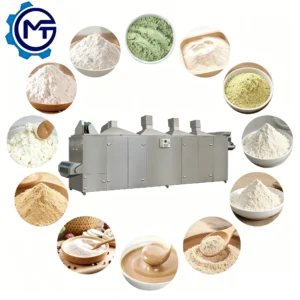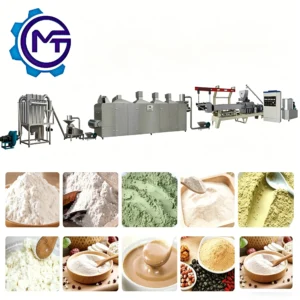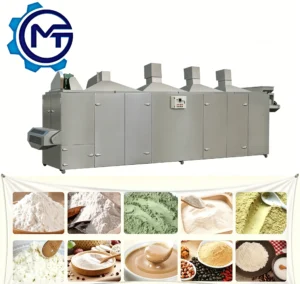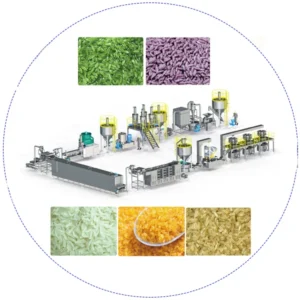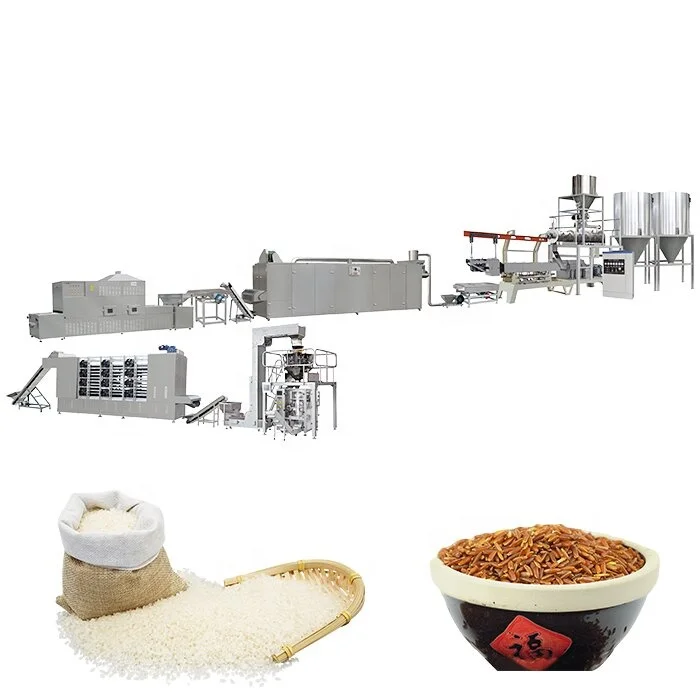
Turnkey Integration — Every station from mixing to packing is matched for throughput, so your Fortified Rice Production Line equipment range runs at the capacity you planned without a single bottleneck.
Technical Specifications
| Parameter | Value |
|---|---|
| Model | MT65 / MT70 / MT85 / MT75 / MT95 |
| Product Type | Fortified Rice Production Line |
| Extruder Configuration | Twin-screw with selectable single or double screw feeding |
| Installed Power | MT65: 85 kW | MT70: 120 kW | MT85: 235 kW | MT75: 180 kW | MT95: 260 kW |
| Power Consumption | MT65: 60 kW | MT70: 85 kW | MT85: 165 kW | MT75: 135 kW | MT95: 195 kW |
| Output Capacity | MT65: 80–100 kg/h (basis not stated in source); MT70: 100–120 kg/h (basis not stated in source); MT85: 200–300 kg/h (basis not stated in source); MT75: 300–500 kg/h (basis not stated in source); MT95: 800–1000 kg/h (basis not stated in source) |
| Overall Dimensions (L×W×H) | MT65: 28 × 1.2 × 2.2 m | MT70: 30 × 1.5 × 2.2 m | MT85: 34 × 3.5 × 4.3 m | MT75: 32 × 3.5 × 4.3 m | MT95: 36 × 3.5 × 4.3 m |
| Control System | Frequency speed controlling with high automation (PLC / MCC architecture to be confirmed) |
| Drying Oven Heating | Electric or gas options with circulation drying and frequency-controlled mesh belt speed |
| Screw Material | Special wear-resistant alloy with automatic lubrication and cooling system |
| Assembly State | Complete turnkey line |
Application Suitability
| Application | Material or Output |
|---|---|
| Artificial Rice Kernels | Broken rice, rice bran, corn, and starch as base ingredients with added vitamins and minerals |
| Fortified Rice for Nutrition Programmes | Multi-grain blends including millet, wheat, oats, and buckwheat with nutrient premix |
| Instant Rice Processing | Pre-gelatinised starch and bean flour formulations requiring controlled expansion and density |
| High-Nutrition Staple Foods | Protein-enriched and mineral-fortified grain mixtures for institutional feeding initiatives |
What the Stated Output Capacity Figures Leave Out About Your Fortified Rice Production Line Equipment Range
The numbers on the spec sheet only hold when your actual raw material matches the test conditions.
I once stood in a workshop watching a nutrition line run at half its quoted capacity because the buyer switched from a standard rice flour to a high-protein formulation after signing. The extrusion parameters, die configuration, and dryer retention time all needed recalculation, and the commissioning team spent weeks adjusting what should have been settled before shipment. Capacity claims mean very little unless the testing was done on your specific grain blend, moisture content, and nutrient loading. [NEED_CITE: twin-screw extrusion behaviour varies with starch gelatinisation and protein denaturation thresholds]
How Each Station in the Line Connects to the Next
A Fortified Rice Production Line equipment range is only as reliable as its weakest transition point. The mixing station must deliver a homogeneous premix before material enters the extruder, because inconsistent nutrient distribution causes density variation in the final kernel. The vibrating conveyor then separates clumped output so that the low-temperature drying oven receives a uniform product bed, preventing uneven moisture removal that would compromise shelf stability.
Why Dryer Sizing Matters More Than Extruder Power
The drying oven does not simply remove moisture; it sets the internal structure of the fortified kernel. A circulation drying process with frequency-controlled mesh belt speed lets operators match retention time to the product’s starch gelatinisation state leaving the extruder. If the dryer is undersized relative to extruder output, kernels retain excess moisture in the core, leading to cracking during the high-temperature roasting stage and unacceptable breakage rates at packing. [NEED_CITE: moisture gradient control in multi-stage cereal drying]
Reading the Specs: What Twin-Screw Configuration and Feeding Choices Mean for Your Formulation
The twin-screw extrusion platform offers different shear and residence time profiles depending on screw element arrangement and barrel temperature zones. When processing high-starch bases like broken rice and corn, the screw configuration must generate sufficient mechanical energy to fully gelatinise the starch without scorching the added vitamin premix. The choice between single or double screw feeding determines how reliably abrasive materials like mineral-fortified blends enter the barrel; a double screw feeder prevents bridging when fine powders are involved. Installed power ranging from 85 kW on the MT65 to 260 kW on the MT95 reflects the motor capacity available for different throughput targets, while actual power consumption sits lower during steady-state operation.
The Cost of Mismatched Stations Down the Line
When a line is assembled from separate vendors, the extruder may deliver output that the downstream dryer cannot handle, creating a backlog that forces operators to slow the entire line. Alternatively, an oversized cooler following a modest dryer wastes floor space and energy. These mismatches are rarely visible until commissioning, when throughput data reveals the bottleneck and the buyer discovers that resolving it requires replacing or repositioning equipment already installed on the factory floor. [NEED_CITE: production line throughput balancing in food processing plants]
Why Sourcing the Full Range From One Supplier Changes the Outcome
Every station in this Fortified Rice Production Line equipment range is specified as part of a single system, meaning the mixing batch size, extruder output, dryer capacity, and packing speed are calculated together before production begins. Screw configuration and die design are matched to the buyer’s raw material rather than copied from a generic build, ensuring the kernel shape, density, and cooking behaviour meet market expectations. An in-house testing workshop allows trial runs on the customer’s actual formulation before the line ships, catching density and expansion issues early. Electrical schematics, voltage confirmation, and control language are verified against the destination market’s standards, and the factory test record documents performance on the specific grain blend that will run in production.
Documentation & Verification
- Line layout and capacity calculation showing throughput matching across all stations
- Screw and die configuration record specific to your grain formulation and nutrient loading
- Electrical schematic with voltage and frequency confirmed for your destination market
- Trial run report generated on your actual raw material before shipment
- CE declaration of conformity and ISO certificate for the complete line
Installation, Commissioning & Support
- Floor plan and utility connections sized to the specific MT model footprint and installed power rating
- Voltage and frequency verification at the control panel before energising the main drive motors
- Modular station assembly allowing phased installation from mixing through to the packing station
- First-run parameter tuning on your grain blend with screw speed, barrel temperature, and dryer belt speed logged
- Operator training covering twin-screw feeding adjustments, die changeover, and dryer temperature profiling
- Wear parts list identifying screws, dies, and mesh belts with reorder specifications for ongoing supply
What We Need From You to Build an Accurate Proposal
Send your target raw material formulation including the base grain type, any added protein or fibre sources, and the vitamin-mineral premix ratio. Specify the kernel shape and size your market expects, the daily production volume you plan to sustain, and the available workshop dimensions including ceiling height. Confirm your local voltage, frequency, and preferred control panel language so that the electrical design is correct before fabrication begins.
Frequently Asked Questions
Q: How is the stated output capacity verified for each extruder model?
A: Output figures are established during factory trial runs, but the actual capacity depends on raw material formulation, moisture content, and target kernel density. We run your specific grain blend in our testing workshop before shipment and document the sustained throughput, so the number you see reflects your product rather than a generic test condition.
Q: Which supporting stations are matched to each extruder to prevent bottlenecks?
A: The drying oven, cooling conveyor, and packing station are each sized to handle the maximum output of the selected extruder model. The line layout document shows the calculated throughput at every transition point, so you can verify that no station limits overall production speed.
Q: What voltage and control options are available for different export markets?
A: The control system supports frequency speed controlling and can be configured with PLC or MCC architecture. Voltage, frequency, and control panel language are confirmed during the specification stage to match your local electrical standards and operator requirements before production begins.
Q: How does screw and die configuration change across different grain formulations?
A: High-starch bases like rice and corn require different screw element arrangements than protein-enriched or fibre-heavy blends. The die design controls kernel shape and expansion ratio. We record the configuration used during your trial run so that replacement screws and dies match the original setup exactly.
Q: What spare wear parts are included, and how are replacements supplied?
A: The initial shipment includes a wear parts list identifying screws, dies, and dryer mesh belts specific to your line configuration. Replacement components are manufactured to the same specifications and can be ordered with documented lead times to maintain uninterrupted production.