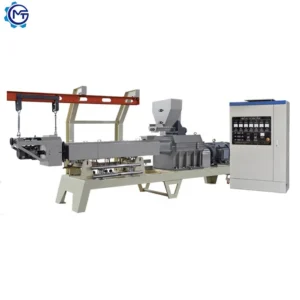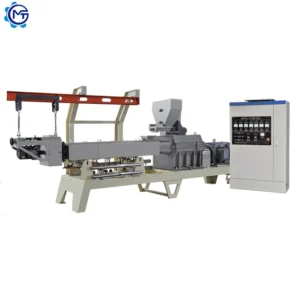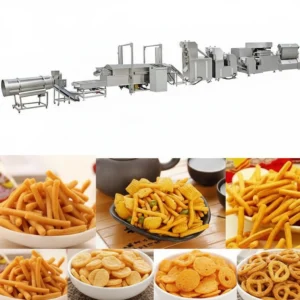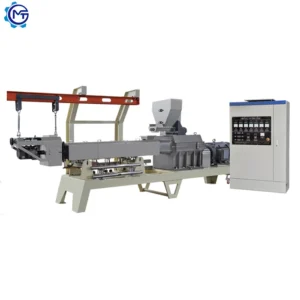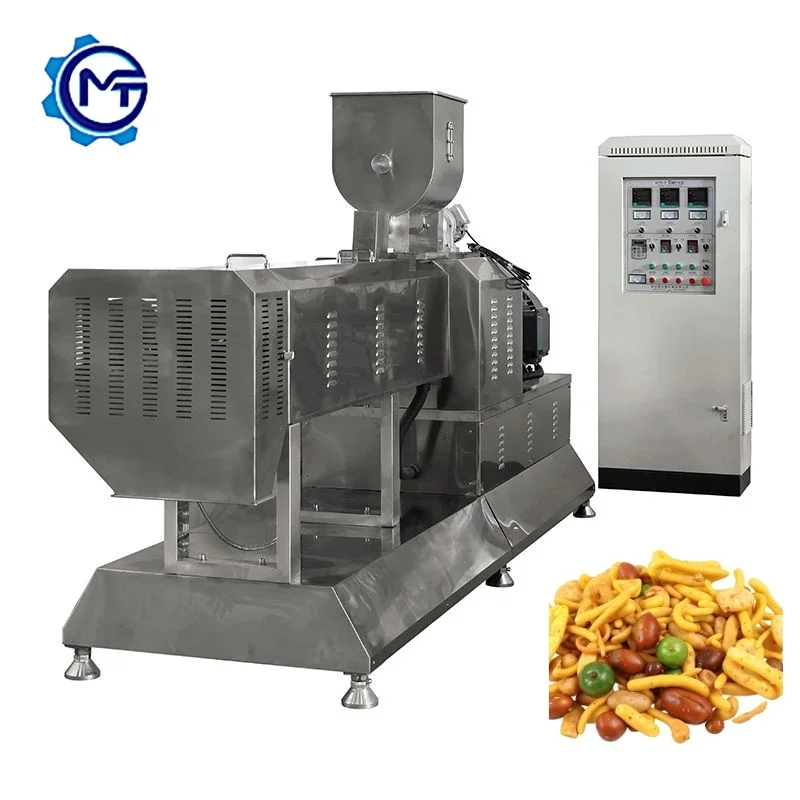
Synchronized Line Integration — Every fryer station is capacity-matched to upstream extruders and downstream coolers within the full processing line, eliminating the bottlenecks that arise when frying capacity is specified in isolation.
Technical Specifications
| Parameter | Value |
|---|---|
| Product Type | Continuous Deep Fryer Production Line |
| Power Source | Electric / Gas (configurable) |
| Voltage | 380V / 50Hz |
| Rated Power | 2.6 kW (control/drive); 60 kW heating tube (basis to be confirmed) |
| Heating Method | Electricity Heating / Gas Heating |
| Control System | PLC |
| Overall Dimensions (L×W×H) | 6700 × 2200 × 1200 mm |
| Net Weight | 2000 kg |
| Oil Capacity | 320 L |
| Output Capacity | 100–1000 kg/h (basis not stated in source) |
| Belt Transmission | Frequency conversion stepless speed regulation |
| Belt Configuration | Upper and lower double-layer mesh belt |
| Oil Filtration | Automatic oil circulation filtration system |
| Slag Discharge | Bottom-equipped slag discharge system |
| Lifting System | Automatic lifting for upper hood and mesh belt |
| Material | Food-grade 304 Stainless Steel |
| Key Features | Complete assembly with belt conveying, oil filling, filtering, and temperature control |
Application Suitability
| Application | Material or Output |
|---|---|
| Fried Nimko Production | Gram flour, chickpea flour, lentil flour dough formed into strands or pellets |
| Extruded Pellet Frying | Corn starch, potato starch, or wheat-based 2D/3D pellet snacks |
| Fried Chip Lines | Sliced root vegetables, formed dough sheets, or extruded chip formats |
| Coated Snack Finishing | Pre-extruded or pre-formed snack pieces requiring deep frying before seasoning |
What "100–1000 kg/h" Means Without a Raw Material Baseline
A frying chips making machine rated across a tenfold output range tells you the motor and belt can run, not what your product will actually yield.
I spent three weeks stabilizing a Nimko line for a Middle Eastern buyer because the trial run used standard wheat flour while their production mix was chickpea and lentil flour. Moisture absorption and starch gelatinisation behaved completely differently, and the first batches came out unevenly expanded with a hard bite. The continuous deep fryer for snack production line hardware was never the problem — the gap was in defining frying time, oil temperature, and belt speed against the actual raw material before the machine left the factory [NEED_CITE: raw material variability in legume-based snack frying]. Capacity figures only become meaningful once they are anchored to a specific product formulation, moisture content, and target texture.
Heat Distribution Across the Full Mesh Belt Width
The double-layer mesh belt configuration addresses a recurring issue in continuous frying: product buoyancy. Lightweight snack pellets or formed Nimko strands tend to float in hot oil, exposing only the submerged surface to direct heat transfer. The upper belt holds the product below the oil surface, maintaining consistent contact on all sides throughout the frying zone. This mechanical constraint is what allows uniform colour and moisture reduction across the full 2200 mm belt width, rather than relying on manual agitation or turbulent oil flow that can damage fragile extruded shapes.
Oil Quality Management Over Extended Production Runs
The automatic oil circulation filtration system continuously draws oil from the fryer sump, passes it through a filter medium to remove carbonized particle residue, and returns it to the heating zone. In a frying chips making machine running eight or more hours per shift, unfiltered oil accumulates free fatty acids that accelerate rancidity and darken product colour progressively through the day [NEED_CITE: oil degradation rates in continuous industrial frying operations]. The bottom slag discharge system complements this by collecting heavier sediment that the circulation loop does not capture, reducing the frequency of full oil changeovers.
Reading the Specification Sheet Against Your Production Target
The 6700 mm overall length defines the effective frying zone residence time. At a given belt speed, a longer fryer allows lower oil temperatures and gentler moisture removal — important for dense dough formats like traditional Nimko that need thorough internal cooking without excessive surface browning. The 320 L oil capacity relates directly to thermal mass: a larger oil volume recovers temperature more quickly when cold product enters, maintaining the set-point within a tighter band. Frequency conversion stepless speed regulation on the belt drive lets the operator dial in frying time from seconds to several minutes, covering the range from thin extruded chips to thicker pellet snacks. The PLC control system coordinates belt speed, oil temperature, and filtration cycle timing from a single interface, reducing the operator variables that cause shift-to-shift inconsistency. Food-grade 304 stainless steel on all contact surfaces meets the sanitation standards required for food export markets [NEED_CITE: food contact material regulations for snack processing equipment].
The Downstream Consequence of Undersized Frying Capacity
When a fryer is sourced as a standalone unit without verifying throughput against the upstream extruder, the typical result is a line that runs at the extruder’s pace for fifteen minutes, then stops while the fryer catches up. Product queues at the fryer inlet, cooling and sticking together, while the extruder output degrades in texture. On the seasoning side, an oversupply of fried product overwhelms the flavouring drum, resulting in uneven coating coverage. These mismatches do not show up in any single machine specification — they only appear during commissioning, when the buyer discovers the line cannot sustain its nameplate rate [NEED_CITE: line throughput balancing in snack food production].
Why Sourcing the Frying Station Within a Complete Line Matters
Every station in the line — from batching through extrusion to frying, cooling, and packing — is capacity-calculated together, so the fryer belt width and oil volume are specified to match the extruder output and the downstream seasoning drum batch size. Screw and die configurations on the upstream extruder are selected for the same raw material that the fryer will process, meaning frying parameters are validated against the actual product geometry and density. The in-house testing workshop runs the buyer’s raw material through the complete line before shipment, producing a trial run report that documents frying temperature, belt speed, and oil condition against the target product specification. Electrical schematics and voltage are confirmed against the buyer’s facility supply before production begins, avoiding the commissioning delays that occur when a 380V/50Hz machine arrives at a site running different standards. CE declaration of conformity and ISO certification are documented at the company level, and the full documentation package travels with each shipment.
Documentation & Verification
- Line layout drawing with fryer positioned relative to extruder and cooler throughput
- Machine specification sheet confirming heating method, oil capacity, and belt speed range
- Electrical schematic and voltage confirmation matched to buyer’s facility supply
- Trial run report on buyer’s actual raw material documenting frying parameters
- Factory test record verifying temperature stability and filtration cycle performance
- Wear parts list covering mesh belt sections and heating elements with replacement intervals
Installation, Commissioning & Support
- Foundation must support 2000 kg net weight plus 320 L oil load across the 6700 mm footprint
- Dedicated electrical circuit required for 60 kW heating load plus 2.6 kW drive and control systems
- Machine ships as a complete assembly with integrated belt, lifting hood, and filtration loop
- Commissioning includes PLC parameter setup for belt speed, temperature set-point, and filtration timing
- Operator training covers oil level management, slag discharge procedure, and emergency stop sequences
- Spare mesh belt sections and heating elements supplied with recommended inspection intervals
What to Include in Your Initial Inquiry
To configure the frying chips making machine correctly within your line, share the specific raw material formulation and moisture content, the target fried product weight and texture, and the upstream extruder hourly output you need the fryer to absorb. Confirm your facility voltage, frequency, and available gas supply if gas heating is preferred, along with any local control language requirements for the PLC interface. If you can send a sample of your raw material, a trial run in the testing workshop will establish the frying parameters before the quotation is finalized.
Frequently Asked Questions
Q: How is the fryer output capacity verified against a specific snack product?
A: Output capacity is confirmed through a trial run using your raw material in the testing workshop. Frying time, oil temperature, and belt speed are documented against your target product weight and texture. The resulting trial run report accompanies the quotation, so the capacity figure reflects your actual formulation rather than a generic benchmark.
Q: What voltage and frequency configurations are available for export markets?
A: The standard specification is 380V/50Hz, but the electrical system can be configured for other voltage and frequency standards before production. The electrical schematic and voltage confirmation are finalized during the specification stage, ensuring the PLC, heating elements, and drive motors match your facility supply.
Q: How does this fryer integrate with upstream and downstream equipment?
A: The fryer belt speed and oil volume are calculated to match the upstream extruder output rate and the downstream cooling or seasoning station capacity. Line layout documentation positions each station with verified throughput balance, preventing product queuing or starvation between stages during continuous operation.
Q: What does the PLC control system manage on this fryer?
A: The PLC coordinates oil temperature set-point, belt speed via frequency conversion, and oil filtration cycle timing from a single interface. This centralised control reduces operator variables that cause inconsistency between shifts, and the control language can be specified to match your production team’s requirements.
Q: Are spare mesh belts and heating elements available, and when should they be replaced?
A: Spare mesh belt sections and heating elements are listed in the wear parts documentation supplied with the machine. Replacement intervals depend on production hours and oil type, and are confirmed during commissioning based on your operating schedule.