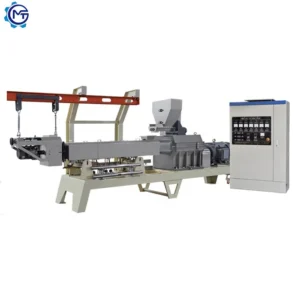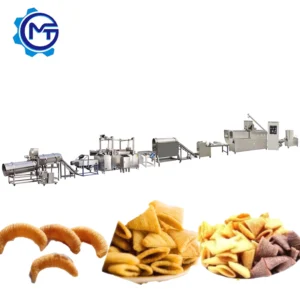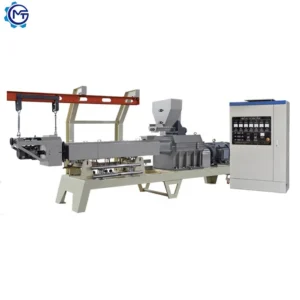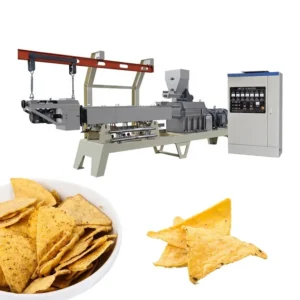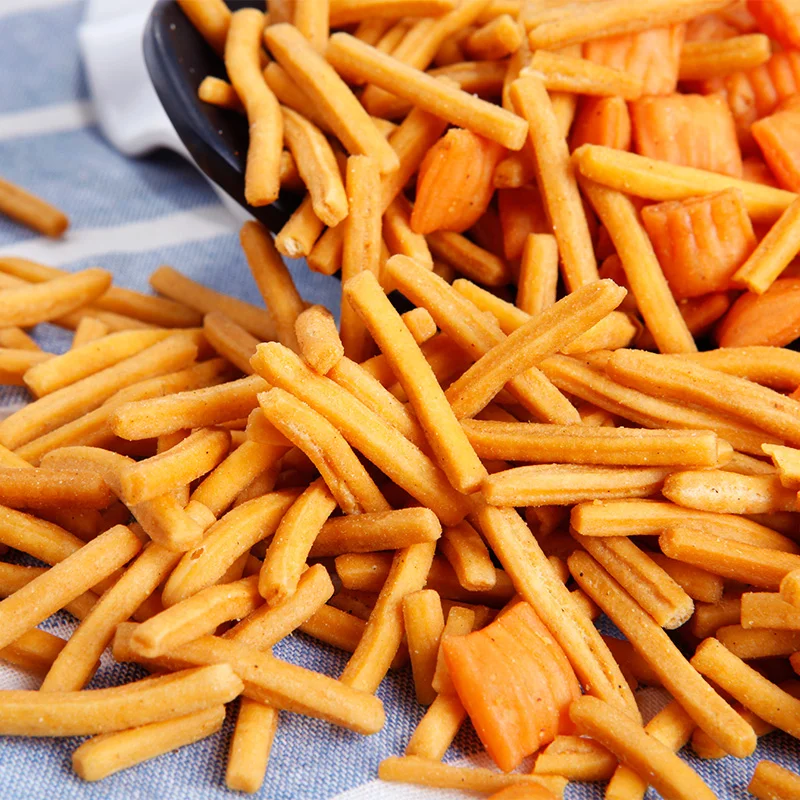
Integrated Frying Station — Every support machine from mixer to flavouring drum is matched to the fryer belt speed so throughput stays balanced across the entire snack line.
Technical Specifications
| Parameter | Value |
|---|---|
| Product Type | Continuous Deep Fryer for Snack Food Production Line |
| Rated Power | 2.6 kW |
| Heating Tube Power | 60 kW |
| Voltage & Frequency | 380V / 50Hz |
| Control System | PLC |
| Overall Dimensions (L×W×H) | 6700 × 2200 × 1200 mm |
| Net Weight | 2000 kg |
| Oil Capacity | 320 L |
| Heating Method | Electric heating / Gas heating |
| Belt System | Upper and lower double-layer mesh belt with frequency conversion stepless speed regulation |
| Oil Filtration | Continuous oil circulation filtration system |
| Slag Discharge | Bottom slag discharge system |
| Lifting System | Automatic lifting for upper hood and mesh belt |
| Material | Food-grade 304 stainless steel |
| Assembly State | Fully assembled |
| Warranty | 1 year |
Application Suitability
| Application | Material or Output |
|---|---|
| Fried puffed corn snack production | Corn grits and corn flour extrudates |
| Pellet snack frying line | 2D and 3D starch-based pellets after extrusion |
| Fried extruded crisp snacks | Rice and corn blend doughs, noodle-style snacks |
| Continuous frying for snack factories | Output matching upstream extruder capacity across a range of formulations |
Why Frying Capacity Must Match the Extruder Upstream
A fryer that cannot keep pace with the extruder quietly becomes the most expensive machine on the line.
I have watched snack food producers install a continuous fryer that looked adequate on paper, only to find the extruder running at full output while the fryer belt crawled behind, forcing operators to buffer product on tables and lose oil temperature stability every time the belt stopped and started. The frying chips making machine manufacturer you choose should size the fryer belt width and oil volume against the real extruder throughput, not the catalogue nominal [NEED_CITE: throughput matching between extrusion and frying stations]. When these two stations are out of balance, the downstream flavouring drum ends up half-empty and the packing line sits idle.
How the Full Equipment Range Connects at the Frying Station
From mixing and batching through extrusion to frying and flavouring, every station on the line must pass product at the same rate. This continuous deep fryer sits between the extruder dryer-cooler and the seasoning drum, and its belt speed, oil volume, and dwell time are set so that extruded pieces arrive, fry, and exit without accumulating or starving the next step. The frying chips making machine manufacturer supplies this fryer as part of the full equipment catalogue, where each supporting station is selected to match the extruder output.
Oil Circuit Design and Product Consistency
The continuous oil circulation filtration system pulls oil from the frying zone, passes it through a filter to remove carbonized crumbs, and returns it heated to the bath. This loop maintains oil quality over long production runs and prevents off-flavours from building up in the oil [NEED_CITE: oil degradation and free fatty acid buildup during continuous frying]. The bottom slag discharge system collects heavy sediment separately, so operators can drain fines without shutting the belt down. Together these circuits keep colour and texture consistent from the first batch of the morning to the last.
Specification Notes for Line Planning
The 60 kW heating tube power provides the thermal load needed to recover oil temperature quickly when cold extrudate enters the bath. Frequency conversion stepless speed regulation on the double-layer mesh belt lets operators set exact dwell times for different recipes — a thin corn chip may need a shorter fry than a dense pellet snack. Food-grade 304 stainless steel construction across all contact surfaces meets hygiene standards expected in export markets and withstands daily caustic washdowns. The 320 L oil capacity is sized to sustain a stable thermal mass, reducing temperature swings that cause uneven colour. Electric or gas heating options allow the fryer to match local utility costs and availability. The automatic lifting system for the upper hood and mesh belt simplifies cleaning and belt inspection without heavy manual labour.
The Hidden Cost of Undersized Oil Filtration
When oil filtration is treated as optional or undersized, free fatty acids accumulate and the oil darkens ahead of schedule, forcing expensive full oil changes and producing snacks with a rancid aftertaste that reaches the consumer [NEED_CITE: impact of oil quality on snack shelf life and sensory profile]. A bottom slag system that is not drained regularly allows carbonized particles to re-enter the frying zone, scorching product surfaces. These problems are not visible during a short factory acceptance test but appear within the first week of continuous production.
Why Source This Fryer as Part of the Full Line
Sizing the fryer against the extruder and the flavouring drum within one supplier’s catalogue means throughput calculations are done at the line level, not per machine. Screw and die configuration on the extruder are matched to the frying behaviour of the specific snack format. An in-house testing workshop allows trial runs on your raw material before the fryer ships, catching issues like oil absorption rate and expansion behaviour early. PLC control language and voltage are confirmed to your factory standard before production begins. Pre-sales layout design places the fryer at the correct height relative to the extruder discharge and the seasoning drum infeed.
Documentation & Verification
- Line layout drawing showing fryer position relative to extruder discharge and flavouring drum infeed
- Machine specification sheet confirming 380V or site-specific voltage and heating method selection
- Trial run report on your snack formulation with recorded oil temperature profile and dwell time
- CE declaration of conformity for machinery placed on European market production lines
- Wear parts list covering mesh belt sections, heating elements, and oil filter cartridges
Installation, Commissioning & Support
- Foundation must support 2000 kg net weight with level tolerance across the 6700 mm length
- Dedicated 380V three-phase circuit rated for the combined 2.6 kW drive and 60 kW heating load
- Unit ships fully assembled; hood and belt lift system enables rapid first-day cleaning access
- PLC parameters set on site for belt speed, oil temperature setpoint, and filtration cycle timing
- Operator training covers oil top-up procedure, slag discharge routine, and belt tension adjustment
- Spare mesh belt sections and filter cartridges staged for first scheduled replacement
What to Include in Your Frying Line Inquiry
Share the exact snack product format, raw material composition, and the hourly output of your upstream extruder so the fryer belt and oil volume can be calculated against real throughput. Confirm your factory voltage and frequency, and whether electric or gas heating suits your utility tariff. If you are replacing a batch fryer in an existing line, provide the current extruder model and the seasoning drum capacity so the snack food frying production line equipment integrates without bottlenecking either station.
Frequently Asked Questions
Q: How is frying capacity verified against my actual product and upstream extruder output?
A: The fryer belt speed and oil volume are calculated from your extruder’s real hourly throughput and the specific snack format. A trial run on your raw material in the testing workshop confirms oil absorption, colour development, and dwell time before the machine is shipped to your factory.
Q: Can the fryer be configured for electric or gas heating based on my factory utility supply?
A: Both electric heating tubes and gas burner configurations are available. The selection depends on your local utility cost and availability. Voltage, frequency, and heating method are confirmed on the specification sheet before production begins.
Q: What voltage, frequency, and PLC language options are confirmed before shipment?
A: Electrical schematics are reviewed with you before production. Voltage and frequency are set to your factory standard, and the PLC interface language is configured to match your operator team. A factory test record verifies all settings before dispatch.
Q: How is the fryer integrated with upstream extruding and downstream flavouring stations?
A: The fryer is positioned in the line layout so that its belt speed matches extruder discharge rate and its exit feeds the seasoning drum at a steady flow. Throughput at every station is balanced during the layout design phase.
Q: What trial run testing is performed on my raw material before the machine ships?
A: Your raw material is run through the complete frying section in the testing workshop. Oil temperature profile, belt speed, colour result, and product texture are recorded in a trial run report shared with you before the equipment leaves the factory.