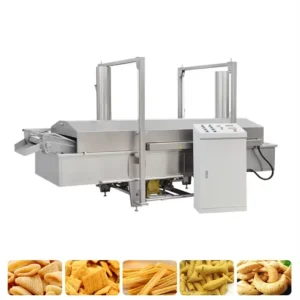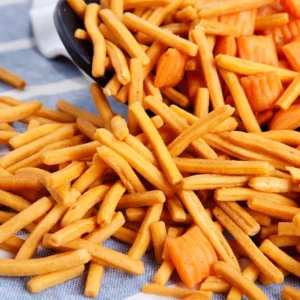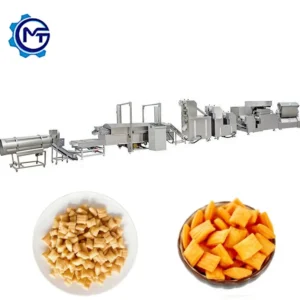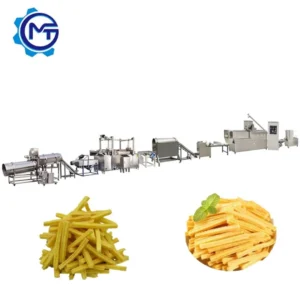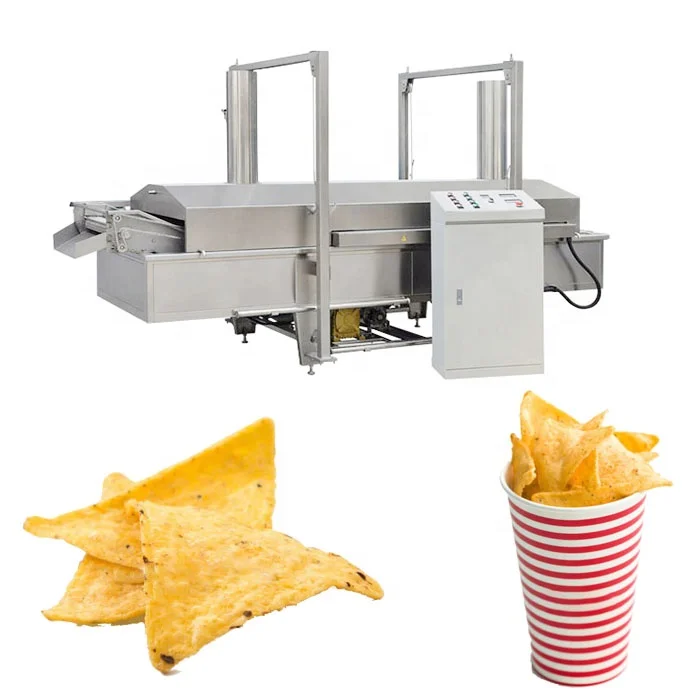
Line Balancing — Every station from mixer to flavoring drum is throughput-matched and verified before shipment, eliminating mid-line bottlenecks on this bugles chips production line full equipment range.
Technical Specifications
| Parameter | Value |
|---|---|
| Product Type | Bugles & Crispy Chips Frying Snack Production Line |
| Model Options | MT65 / MT70 / MT85 / MT75 / MT95 |
| Extruder Type | Twin-screw |
| Installed Power | 142 kW (MT65) / 185 kW (MT70) / 240 kW (MT85) / 245 kW (MT75) / 370 kW (MT95) |
| Actual Power Consumption | 100 kW (MT65) / 130 kW (MT70) / 180 kW (MT85) / 185 kW (MT75) / 280 kW (MT95) |
| Output Capacity | 120–150 kg/h (MT65) / 200–250 kg/h (MT70) / 300–500 kg/h (MT85) / 400–500 kg/h (MT75) / 800–1000 kg/h (MT95) (basis not stated in source — confirm raw material formulation, moisture content, and product shape) |
| Extruder Main Motor Power | 30 kW (source value for MT70 variant) |
| Powder Mixer Tank Volume | 150 kg |
| Powder Mixer Rotary Speed | 385 rpm |
| Powder Mixer Power | 4 kW |
| Fryer Temperature Range | 0–260 °C |
| Fryer Capacity | 200–300 kg/h (basis not stated in source — confirm product type and frying time) |
| Flavoring Line Power | 1.5 kW |
| Contact Material | 304 Stainless Steel |
| Line Stations | Mixing → Extrusion → Shaping/Cutting → Frying → Flavoring → Drying |
| Overall Dimensions (L×W×H) | 22000×1200×2200 mm (MT65) up to 30000×1500×2800 mm (MT95) |
| Warranty | 1 year |
Application Suitability
| Application | Material or Output |
|---|---|
| Bugles and horn-shaped snack production | Corn flour, wheat flour, blended starch formulations |
| Tortilla chips and triangle crisps | Corn flour, rice flour blends |
| Rice crust and savory puffed snacks | Rice flour, corn grits, blended starches |
| 3D shaped snacks (fish, ducks, gourds) | Wheat flour, corn flour with moisture adjustment |
| Breakfast and snack pellets | Corn, wheat, rice blends |
What "Up to 1000 kg/h" Leaves Out About Your Bugles Chips Production Line Full Equipment Range
Nominal output means nothing if the fryer cannot keep up with the extruder.
I recently worked on a frying snack line where the extruder was rated for a high output, but the downstream fryer was sized for a lower tier. The result was product piling up on the conveyor, moisture re-absorption before frying, and uneven color batch after batch. Buyers often fixate on extruder capacity while ignoring whether the fryer, flavoring drum, and dryer are matched to that same throughput. This bugles chips production line full equipment range lists every station so you can verify the balance yourself before placing an order [NEED_CITE: line throughput balancing methodology for extruded snack lines].
Station-by-Station Catalog for Line Planning
The bugles chips production line full equipment range covers six sequential stations — mixing, extrusion, shaping and cutting, frying, flavoring, and drying — each with independently listed power, dimensions, and capacity values. This allows process engineers and equipment buyers to compare station specifications side by side and identify potential mismatches before the line is built. The twin-screw extruder is available in five models, each with documented installed and actual power consumption.
Fryer and Flavoring Station Throughput Alignment
The fryer operates across a 0–260 °C range with a listed capacity of 200–300 kg/h, though the basis for this figure should be confirmed against your specific product shape and frying residence time. The flavoring line is rated at 400 kg/h output with a 1.5 kW drive. When selecting a higher-tier extruder such as the MT85 or MT95, it is necessary to verify whether a single fryer module is sufficient or whether parallel frying units are required to maintain product quality [NEED_CITE: frying capacity requirements for high-throughput extruded snack lines].
Reading the Extruder Specifications for Your Application
The five extruder models differ significantly in power draw and footprint. The MT65 consumes 100 kW in actual operation and fits within a 22-meter line length, while the MT95 draws 280 kW and requires a 30-meter layout. The main motor on the MT70 variant is rated at 30 kW. Screw configuration and die selection determine the final product shape — from bugles and triangles to rice crust and 3D forms. All contact surfaces are constructed from 304 stainless steel, meeting food-grade requirements for snack production. Control system options, including PLC and MCC configurations, should be confirmed during the specification phase to match your facility’s automation standards and operator language requirements.
The Hidden Cost of Undersized Downstream Equipment
When an extruder pushes more volume than the fryer can handle, the snack pieces sit on the conveyor too long, absorbing ambient moisture and losing surface temperature. This leads to uneven oil absorption and color variation that no amount of seasoning can mask. Similarly, if the flavoring drum rotates too slowly for the incoming volume, coating thickness becomes inconsistent across the batch. These problems are not visible during factory acceptance tests that run each station independently — they only appear when the full line runs continuously [NEED_CITE: common causes of quality variation in continuous snack frying lines].
Why Source the Full Range Here
Every station in this catalog is built and tested under one supplier, meaning throughput calculations are validated across the entire line rather than assembled from disconnected vendors. Screw configuration and die design are specified to your raw material formulation and target product shape, not copied from a generic template. The in-house testing workshop runs trial production on your actual raw material before shipment, so product development begins at the factory — not at your facility. Pre-sales engineering includes line layout and capacity calculation, and post-delivery support covers on-site installation, commissioning, and operator training. Wear parts such as screws, dies, and cutting blades are stocked and documented from day one.
Documentation & Verification
- Line layout drawing showing throughput match between extruder, fryer, and flavoring stations
- Screw and die configuration record specific to your raw material and target snack shape
- Electrical schematic with voltage and frequency confirmed for your facility
- Factory trial run report using your supplied raw material formulation
- CE declaration of conformity covering the complete line assembly
- Operation and maintenance manual with wear parts replacement intervals
Installation, Commissioning & Support
- Foundation must accommodate line lengths from 22 meters (MT65) to 30 meters (MT95) with level tolerance specified per layout drawing
- Electrical supply must match confirmed voltage and frequency, with dedicated circuits for extruder motors up to 370 kW installed power
- Line arrives in modular sections; assembly sequence and station alignment are supervised on site
- First production run includes parameter setting for barrel temperature profile, screw speed, and fryer temperature
- Operator training covers die changes, screw replacement, and fryer oil management procedures
- Spare screws, dies, and cutting blades are listed and available for first replacement cycle
Preparing Your Inquiry
To specify the right configuration from this bugles chips production line full equipment range, provide your raw material formulation including flour type, starch ratio, and target moisture content. Share your daily production target and available workshop dimensions including ceiling height. Confirm your local voltage, frequency, and preferred control language so the electrical package is built correctly before dispatch.
Frequently Asked Questions
Q: How do I choose the right extruder model for my target output?
A: Start with your target hourly output and raw material formulation. The five models cover different capacity tiers, but actual throughput depends on your specific recipe moisture content, product shape, and die configuration. We confirm the selection through a trial run on your raw material in our testing workshop before finalizing the line specification.
Q: What happens if the fryer capacity does not match the extruder output?
A: Product accumulates on the conveyor between stations, absorbing moisture and losing temperature before entering the oil. This causes uneven frying, color variation, and inconsistent oil uptake. We calculate throughput match across every station during the layout phase to prevent this bottleneck.
Q: Can I confirm voltage and control language before the machine is built?
A: Yes. Voltage, frequency, and control interface language are confirmed during the specification stage, documented in the electrical schematic, and verified before production begins. This prevents commissioning delays caused by incompatible power supply or unreadable control panels at your facility.
Q: What spare parts should I plan for in the first year?
A: Screws, dies, and cutting blades are the primary wear items. We provide a complete wear parts list with the line documentation, and replacement components are available from stock. The specific consumption rate depends on your raw material abrasiveness and production hours, which we assess during the trial run.
Q: How is the line footprint determined for my facility?
A: Overall line length ranges from 22 to 30 meters depending on the selected extruder model. We produce a detailed layout drawing showing each station position, utility connection points, and operator access clearances. This drawing is based on your confirmed workshop dimensions and ceiling height before manufacturing starts.