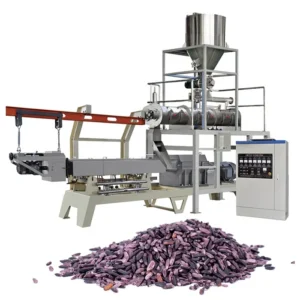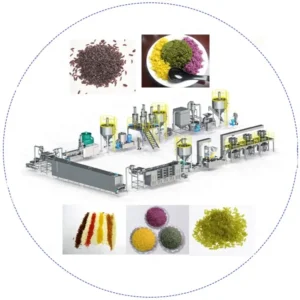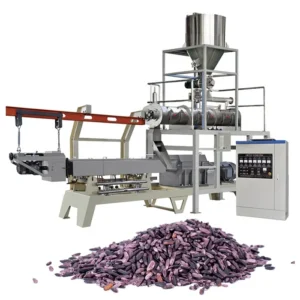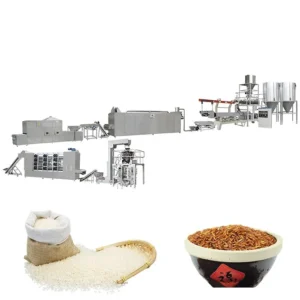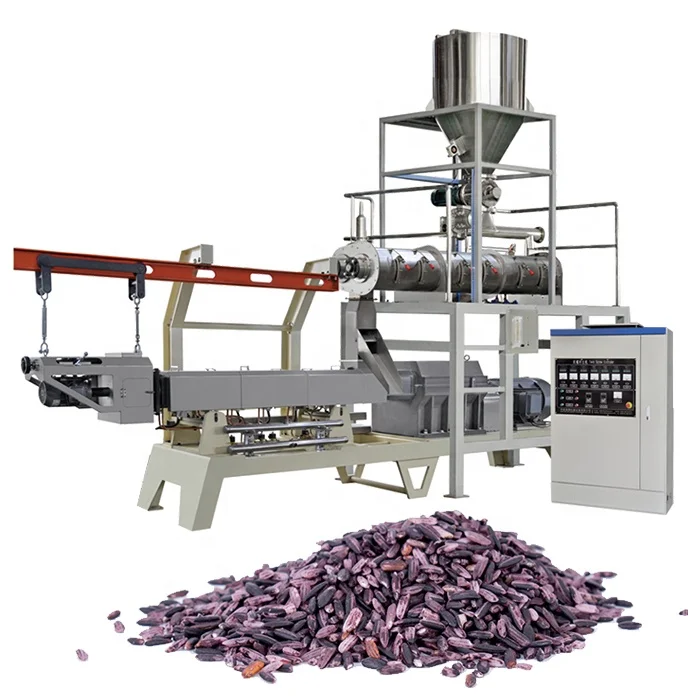
Full Range Integration — Every station from mixing to packing is sourced under one supplier, eliminating the throughput mismatches that occur when extruders, dryers, and coolers are assembled from separate vendors.
Technical Specifications
| Parameter | Value |
|---|---|
| Product Type | Fortified Rice Production Line |
| Output Capacity | 100–500 kg/h (basis not stated in source — confirm raw material formulation / moisture / grain size) |
| Total Installed Power | 100 kW |
| Voltage & Frequency | 380V / 50Hz (customizable on request) |
| Control System | Automated PLC / MCC (details to be confirmed at inquiry) |
| Construction Material | Food-grade stainless steel on product contact surfaces |
| Certification | CE |
Application Suitability
| Application | Material or Output |
|---|---|
| Fortified rice manufacturing | Rice flour blended with vitamin and mineral premix, extruded into rice-shaped kernels |
| Artificial rice production | Broken rice, corn flour, or other starch-based raw materials reconstituted into whole-grain shapes |
| Nutrition-enhanced rice for institutional supply programmes | Starch base fortified with micronutrient premix per government or NGO specification |
What the Stated Capacity Range Actually Depends On
Output figures shift the moment the raw material formulation changes.
The 100–500 kg/h range printed on most Fortified Rice Production Line for sale brochures assumes a specific moisture content and starch composition. Swap in a premix loaded with calcium carbonate or iron fumarate and the extruder barrel pressure profile changes — material residence time, gelatinisation behaviour, and die expansion all respond differently. I once watched a line spec’d at mid-range throughput drop noticeably in actual output because the buyer’s local premix supplier used a coarser grind than the trial material. Nobody had flagged it during the order stage. [NEED_CITE: effect of mineral premix particle size on extrusion throughput]
Matching Every Station to the Formulation
A Fortified Rice Production Line for sale is only as reliable as its weakest throughput match. When the extruder pushes material faster than the downstream dryer can handle, moisture stays trapped in the kernels and shelf life shortens. When the cooler is undersized relative to the extruder, hot product stacks up on the conveyor and deforms before reaching the packing station. Sourcing every station from one supplier means the mixing capacity, extrusion rate, dryer belt length, and cooler airflow are all calculated against the same target formulation rather than pulled from independent catalogues.
How Screw and Die Choices Shape the Kernel
The screw profile determines how much shear the rice flour blend receives inside the barrel, which directly controls starch gelatinisation. A configuration that works for plain rice flour may under-gelatinise a blend carrying twenty percent mineral premix, leaving the extruded kernel brittle. Die geometry then decides whether the cut piece resembles a long-grain rice kernel or something visibly artificial. Getting both the screw arrangement and the die orifice right — and confirming them against the buyer’s actual raw material before the line ships — avoids weeks of trial-and-error on the factory floor. [NEED_CITE: twin-screw configuration for starch-based fortified food extrusion]
Reading the Spec Sheet Beyond the Headline Numbers
The 100 kW total power figure covers every motor from the mixer through the packing conveyor. In practice, the extruder main drive claims the largest share, and its amperage draw fluctuates with raw material density and moisture. Buyers should verify that the electrical schematic accounts for peak current during start-up under load, not just steady-state running. The 380V/50Hz standard suits most Asian and African grids, but facilities running on 440V/60Hz or 220V/60Hz need transformers or rewound motors confirmed before production begins. Food-grade stainless steel on contact surfaces is non-negotiable for any line handling micronutrient premixes — residues trapped in carbon steel pores can oxidise and contaminate subsequent batches.
The Cost of Skipping a Pre-Shipment Trial Run
Lines that arrive at the destination factory without a documented trial run on the buyer’s exact formulation often require extended on-site commissioning. Engineers spend days adjusting barrel temperatures, screw speeds, and die clearances to compensate for raw material differences that could have been identified in the supplier’s testing workshop. The downtime cost is not just idle labour — it is delayed market entry and unsettled product specifications that buyers cannot show to their own customers. [NEED_CITE: commissioning delays from untested raw material formulations]
Why Procurement From a Full-Range Catalogue Matters Here
Every station on this Fortified Rice Production Line for sale is specified together, so throughput calculations reference a single material flow rather than independent machine ratings. The screw configuration and die design are documented against the buyer’s raw material, not copied from a generic build. An in-house testing workshop allows trial runs on the actual premix blend before the equipment leaves the factory. Electrical schematics and voltage confirmations are issued as part of the documentation package, reducing the chance of commissioning delays caused by utility mismatches. CE-certified components satisfy import requirements across most markets that demand machinery conformity declarations.
Documentation & Verification
- Line layout with capacity calculation for your specific premix formulation and target throughput
- Machine specification sheet covering every station from mixer to packing conveyor
- Electrical schematic with voltage and frequency confirmation matching your factory supply
- Trial run report documenting results on your raw material before shipment
- CE declaration of conformity for core extrusion and drying components
- Wear parts list identifying screws, dies, and dryer belt sections
Installation, Commissioning & Support
- Foundation plan accounting for the 100 kW total load and vibration isolation at the extruder base
- Dedicated electrical circuit sized for peak start-up current, confirmed against your local 380V or custom voltage supply
- Pre-assembled modules shipped in sections that fit standard container dimensions for reduced on-site assembly time
- First-run parameter setting on your raw material including barrel temperature zones and screw speed
- Operator training covering PLC interface navigation, emergency stop sequences, and die changeover procedure
- Spare screw and die sets identified on the wear parts list with lead times confirmed at order
What to Include in Your Inquiry
Send your raw material formulation — including the exact premix supplier and blend ratio — along with your target daily output and the voltage and frequency available at your facility. If your workshop has height restrictions or existing upstream milling equipment, note those dimensions so the line layout accounts for them from the first draft.
Frequently Asked Questions
Q: Which stations are included in the full line and how is throughput balanced?
A: The line covers mixing, extrusion, drying, cooling, and packing. Each station’s capacity is calculated against the same target formulation so material flow stays continuous. No station is rated independently and then assembled — the throughput match is confirmed during the layout design stage before production begins.
Q: How do I confirm voltage, frequency, and control language for my factory?
A: Share your local utility specification at the inquiry stage. The standard 380V/50Hz configuration can be adjusted, and motor windings or transformers are arranged accordingly. Control panel language is confirmed before the PLC programme is finalised so operators see instructions in their working language from day one.
Q: What determines the actual output I will see on my raw material?
A: Output depends on premix composition, moisture content, and particle size. A formulation with a high mineral load behaves differently inside the barrel than plain rice flour. Requesting a trial run on your exact blend before shipment provides a realistic throughput baseline rather than relying on generic catalogue figures.
Q: Are spare wear parts available and what is the typical lead time?
A: Screws, dies, and dryer belt sections are listed on the wear parts document provided with each line. Lead times vary by part and order timing — confirming spare quantities at the initial order stage ensures replacements are ready before the first changeover falls due.