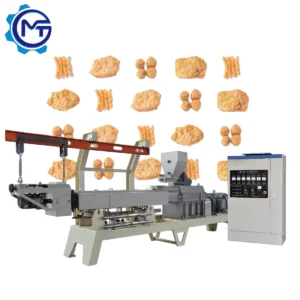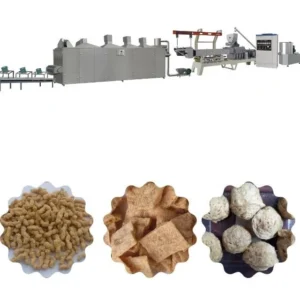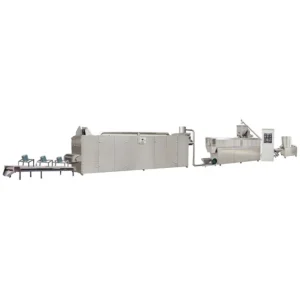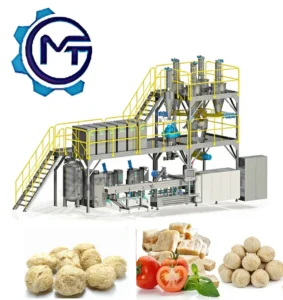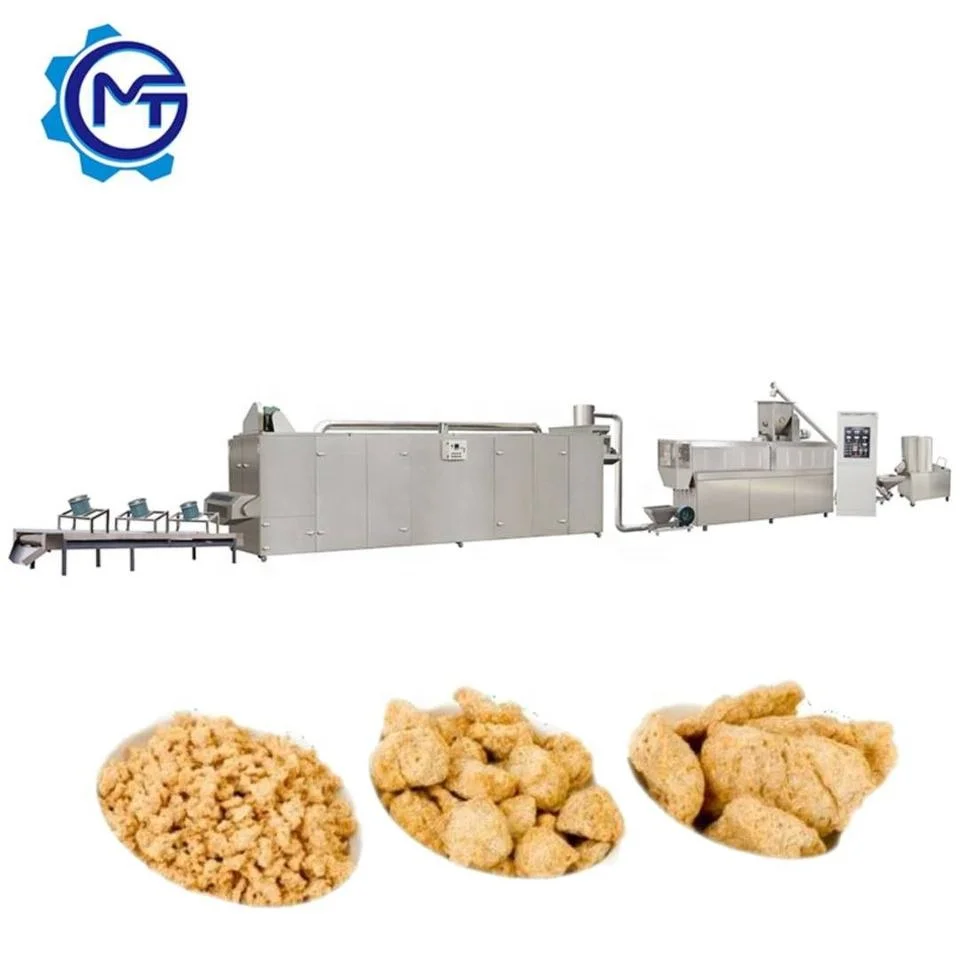
Matched Throughput Across Stations — Every machine from the 150 kg powder mixer to the high-temperature roaster is sized to keep the textured soy protein extrusion line moving without bottlenecks or idle time.
Technical Specifications
| Parameter | Value |
|---|---|
| Product Type | Textured Soy Protein Extrusion Line |
| Model Options | MT65 / MT70 / MT85 |
| Extruder Type | Double Screw (Twin-screw) |
| MT65 Installed Power | 85 kW |
| MT65 Real Power | 65 kW |
| MT65 Output Capacity | 150–200 kg/h (basis not stated in source — confirm raw material / moisture content) |
| MT65 Overall Dimensions | 18000 × 1300 × 2300 mm |
| MT70 Installed Power | 120 kW |
| MT70 Real Power | 90 kW |
| MT70 Output Capacity | 200–300 kg/h (basis not stated in source — confirm raw material / moisture content) |
| MT70 Overall Dimensions | 20000 × 1500 × 2400 mm |
| MT85 Installed Power | 195 kW |
| MT85 Real Power | 165 kW |
| MT85 Output Capacity | 600–800 kg/h (basis not stated in source — confirm raw material / moisture content) |
| MT85 Overall Dimensions | 24000 × 3500 × 4300 mm |
| MT70 Extruder Main Motor Power | 30 kW |
| MT70 Extruder Installed Power | 45.87 kW |
| MT70 Extruder Actual Power | 30–35 kW |
| MT70 Extruder Dimension | 2800 × 830 × 1875 mm |
| Powder Mixer Tank Volume | 150 kg |
| Powder Mixer Output | 300–600 kg/h |
| Powder Mixer Rotary Speed | 385 rpm |
| Powder Mixer Mixing Time | 10 min per cycle |
| Powder Mixer Power | 4 kW |
| Powder Mixer Dimension | 1000 × 630 × 1100 mm |
| High-temperature Roaster Output | 300–400 kg/h |
| Roaster Effective Belt Length | 3.5 m |
| Roaster Far Infrared Heater Power | 3.9 kW × 24 |
| Roaster Gas Consumption | 6.8 m³ |
| Roaster Belt Motor Power | 0.55 kW |
| Roaster Dimension | 4500 × 1500 × 1600 mm |
| Cooling Machine Capacity | 200–300 kg/h (source value — verify against manufacturer catalog) |
| Line Stations | Raw material preparation → mixing → conveying → extrusion → conveying → drying → cooling → packing |
| Material | Stainless steel (304 for main parts) |
| Warranty | 1 year complete warranty |
| Standards | CE, ISO |
Application Suitability
| Application | Material or Output |
|---|---|
| Textured vegetable protein (TVP) chunks | Low-temperature soybean meal |
| Soy meat analogues for sausages and ham | Soybean meal and peanut meal blends |
| Plant-based protein pieces for canned food | Defatted soy flour at controlled moisture |
| Quick-frozen food protein ingredients | High-protein meal blends requiring fibrous texture |
| Fast food meat substitute portions | Extruded and dried soy protein with layered fibre structure |
What "200 kg/h Output" Actually Means on Your Raw Material
The number on the spec sheet only holds if your soybean meal protein content and moisture match the test basis.
I worked with a buyer who ordered a plant based meat processing line full equipment range based on a brochure figure. Their local soybean meal had lower protein content than the standard test material. The extruder ran, but the fibrous pull-apart texture was flat and the real throughput dropped well below expectation. The dryer and cooler downstream were oversized for what actually came out, and the whole line rhythm fell apart. That is why capacity figures for the MT65, MT70, and MT85 must always be confirmed against your specific raw material before the line is configured [NEED_CITE: raw material protein content effect on extrusion throughput].
How the Full Equipment Range Prevents Station Mismatches
A plant based meat processing line full equipment range is only as reliable as its weakest throughput link. If the powder mixer delivers 600 kg/h but the extruder can only accept 300 kg/h, material backs up and批次 consistency suffers. This catalogue lists each station — powder mixer, twin-screw extruder, high-temperature roaster, cooling machine — with individual output data so you can verify the flow before any steel is cut. Matching these figures to your target daily volume is the first engineering step, not an afterthought.
Why Screw Configuration Decides the Fibre Structure
The twin-screw extruder is where protein molecules align under heat and shear to form the layered, meat-like fibre that defines textured soy protein. Screw element arrangement, barrel temperature zones, and die geometry must be set to your specific meal blend. A generic screw build copied from a standard chart will produce dense, rubbery chunks instead of the open, shreddable texture the market expects. Every MT65, MT70, and MT85 order requires a screw configuration record matched to the buyer’s raw material and target product before production begins [NEED_CITE: twin-screw element arrangement and protein texturization mechanism].
Reading the Power and Dimension Data
The gap between installed power and real power on the MT85 — 195 kW versus 165 kW — reflects the headroom needed for start-up surges and load variation when dense protein meal enters the barrel. The MT70 extruder alone draws 30–35 kW in actual operation, meaning the main motor is sized for continuous duty rather than peak rating. Dimension figures such as the MT85’s 24-metre line length and the roaster’s 4.5-metre belt tell you what floor space to allocate. The far infrared heater array — 24 elements at 3.9 kW each — explains why gas consumption sits at 6.8 m³: the roaster uses a dual-energy approach to hold surface temperature while removing internal moisture.
The Hidden Cost of Skipping the Trial Run
When a line ships without a factory trial on the buyer’s actual soybean meal, all product development happens after installation. Engineers burn raw material on-site chasing the right screw combination and moisture level while the rest of the factory waits. Downtime costs accumulate, and the buyer bears the expense of commissioning delays that could have been resolved in the testing workshop before the machines left Shandong [NEED_CITE: on-site commissioning delays due to untested raw material].
Why Buyers Source This Line Here
The line covers every station from batching to packing under one supplier, so throughput is matched across each machine rather than assembled from separate vendors. Screw configuration and die design are specified to the buyer’s raw material and target fibre structure, not pulled from a generic template. An in-house testing workshop runs the buyer’s soybean meal or peanut meal before shipment, confirming texture and output. Electrical schematics and voltage are confirmed for the destination market before production starts. Documentation includes a trial run report, line layout with capacity calculation, and a wear parts list covering screws, dies, and belts.
Documentation & Verification
- Line layout and capacity calculation matching each station’s throughput to your raw material
- Screw and die configuration record specific to your soybean meal protein content
- Electrical schematic and voltage confirmation for your local power grid before production
- Factory test record and trial run report on your actual raw material before dispatch
- CE declaration of conformity and ISO certificate included with shipment
- Wear parts list with screw element, die, and belt part numbers for first reorder
Installation, Commissioning & Support
- Foundation must support the MT85’s 24-metre line length and 4.3-metre height clearance
- Dedicated power circuit required for the MT70 extruder’s 30–35 kW continuous draw
- Roaster far infrared heater array needs three-phase supply matching local voltage and frequency
- On-site commissioning includes screw combination fine-tuning on your meal blend
- Operator training covers mixing cycle timing, barrel temperature zones, and moisture control
- Spare screw elements, dies, and roaster belts available for first replacement cycle
What We Need to Configure Your Line
To size each station correctly, share your raw material specification — soybean meal or peanut meal, protein content, and moisture level — along with your target daily output. Confirm your workshop’s available floor area, ceiling height, local voltage, and frequency. Let us know the final product format you need, whether chunks, flakes, or granules, and whether you want a trial run on your material before the line ships.
Frequently Asked Questions
Q: How is the output capacity for each extruder model confirmed?
A: Output figures for the MT65, MT70, and MT85 depend on the protein content and moisture of your soybean meal or peanut meal. We run your actual raw material in our testing workshop and document the real throughput before finalising the line configuration, so the capacity you see is based on your product, not a generic benchmark.
Q: What voltage and control options are available?
A: Voltage, frequency, and control language must match your local grid and operator preference. We confirm the electrical schematic with you before production, covering motor ratings for the extruder, roaster heaters, and cooling machine. This avoids rewiring or transformer costs after the equipment arrives at your facility.
Q: How are the screw and die selected for my material?
A: Low-temperature soybean meal and peanut meal behave differently under shear and heat. We match the screw element arrangement and die geometry to your specific blend to achieve the required fibre structure. The configuration record is documented and included with your shipment so you can reorder identical wear parts later.
Q: Which supporting stations are included in the full line?
A: The plant based meat processing line full equipment range covers a powder mixer, twin-screw extruder, high-temperature roaster, cooling machine, and conveyors between each station. Each unit’s throughput is listed individually so you can verify the line is balanced and no station creates a bottleneck.
Q: How do I obtain spare wear parts after installation?
A: A wear parts list ships with every line, listing screw elements, dies, and roaster belts by part number. You can order replacements directly from us, and we keep production records so reorders match your original configuration. We recommend ordering a first spare set before the initial replacement window arrives.