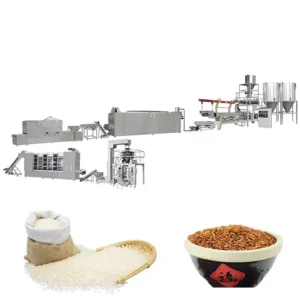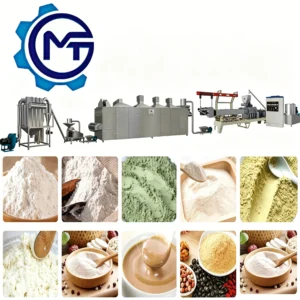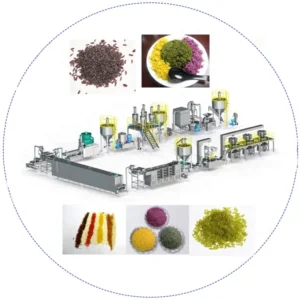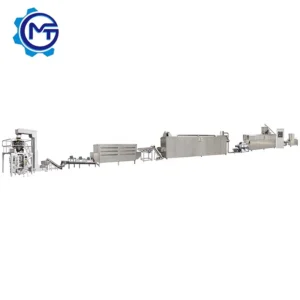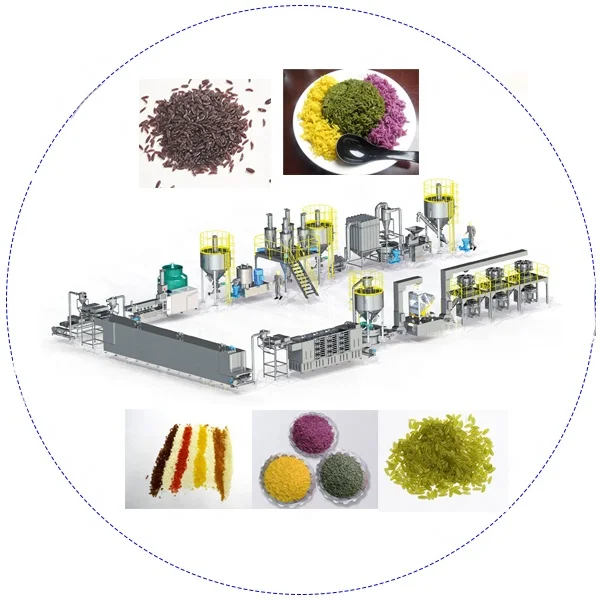
Throughput-Matched Equipment Catalogue — every station from batching to packing is specified as a unified system, preventing extruder-dryer bottlenecks in artificial rice and fortified rice kernel lines.
Technical Specifications
| Parameter | Value |
|---|---|
| Model | MT65, MT70, MT85, MT75, MT95 |
| Product Type | Artificial Rice & Fortified Rice Kernel Extrusion Production Line |
| Screw Type | Twin-screw with single or double screw feeding system option |
| Installed Power | 85 kW (MT65) / 120 kW (MT70) / 180 kW (MT75) / 235 kW (MT85) / 260 kW (MT95) |
| Power Consumption | 60 kW (MT65) / 85 kW (MT70) / 135 kW (MT75) / 165 kW (MT85) / 195 kW (MT95) |
| Output Capacity | 80–100 kg/h (MT65, basis not stated in source — confirm raw material and moisture content) |
| Output Capacity | 100–120 kg/h (MT70, basis not stated in source — confirm raw material and moisture content) |
| Output Capacity | 200–300 kg/h (MT85, basis not stated in source — confirm raw material and moisture content) |
| Output Capacity | 300–500 kg/h (MT75, basis not stated in source — confirm raw material and moisture content) |
| Output Capacity | 800–1000 kg/h (MT95, basis not stated in source — confirm raw material and moisture content) |
| Overall Dimensions | 28 × 1.2 × 2.2 m (MT65) / 30 × 1.5 × 2.2 m (MT70) / 32 × 3.5 × 4.3 m (MT75) / 34 × 3.5 × 4.3 m (MT85) / 36 × 3.5 × 4.3 m (MT95) |
| Control System | Frequency speed control with high automation (verify PLC/MCC specifics against manufacturer catalogue) |
| Screw Lubrication | Automatic lubricating and cooling system |
| Dryer Heating Source | Electric or gas |
| Dryer Feature | Circulation drying with frequency motor mesh belt speed control |
| Line Process | Mixing → Extruding → Vibrating → Low temperature drying → Cooling → High temperature roasting → Cooling → Packing |
| Voltage & Frequency | Customised to customer’s local supply |
| Raw Materials | Broken rice, rice, corn, millet, wheat, oats, buckwheat, bean, starch; vitamin and mineral supplements |
| Certifications | CE (since 2014), ISO |
Application Suitability
| Application | Material or Output |
|---|---|
| Reformed rice from milling by-products | Broken rice, rice bran, and starch-based binders |
| Fortified rice kernel production | Rice flour or corn grits blended with vitamin and mineral premix |
| Artificial rice for snack portfolios | Millet, buckwheat, oat, wheat, or bean flour bases |
| Nutritional rice for food programme supply | Grain blends with micro-nutrient enrichment targets |
What "Nominal Capacity" Hides in an Artificial Rice Extrusion Machine Line
Capacity is meaningless without the raw material formula and moisture content that produced it.
An extruder rated for a certain throughput on standard rice flour can drop noticeably when fed a heavier grain blend or a mineral-loaded premix. [NEED_CITE: effect of raw material density on twin-screw extruder throughput]. I once watched a line stall for days because the buyer’s actual formula had more fibre than the test recipe, and the screw configuration was not adjusted for it. Before any capacity number matters, it must be tied to your specific blend, moisture level, and target kernel density.
Matching Every Station to Prevent Line Choke Points
An Artificial Rice Extrusion Machine line is only as fast as its slowest station. The extruder may push material forward at a given rate, but if the circulation drying oven cannot remove moisture quickly enough, product backs up and the entire line slows. Each supporting station — vibrating conveyor, low temperature dryer, cooling belt, high temperature roaster, and packing system — must be sized against the extruder’s actual output on your formula, not against a catalogue maximum.
Screw Configuration Decides Kernel Shape and Texture
The twin-screw arrangement in MT65 through MT95 models allows screw element rearrangement to control shear, residence time, and pressure profile inside the barrel. For a dense fortified rice kernel meant to survive parboiling, a different screw layout is required compared to a light artificial rice format. The single or double screw feeding system option addresses whether the raw material blend flows uniformly or needs forced feeding — a distinction that directly affects kernel consistency across a production run. [NEED_CITE: twin-screw element arrangement and food extrusion texture control]
Reading the Spec Sheet Beyond Installed Power
Installed power across the MT series ranges from 85 kW to 260 kW, while actual consumption sits notably lower — between 60 kW and 195 kW depending on model. The gap between these two figures reflects motor headroom: an extruder running near its installed power ceiling will overheat and wear screws faster. Buyers should compare consumption figures against their daily run hours to estimate true energy cost. The automatic lubricating and cooling system on the screw shaft sustains longer production runs by keeping barrel temperatures stable. Frequency speed control on the dryer mesh belt lets operators fine-tune drying time to match whatever moisture level exits the die.
The Hidden Cost of Skipping Raw Material Trials
When an extruder ships without a trial run on the buyer’s actual formula, the first weeks of production become an expensive experiment. Kernel shape drifts, moisture content misses the target, and the dryer cannot compensate. [NEED_CITE: cost of post-installation line adjustment versus pre-shipment trial runs]. Operators spend shifts tweaking screw speed, barrel temperature, and die clearance — burning raw material the whole time. A test run before dispatch using the buyer’s own premix eliminates most of this waste.
Why Source the Full Range from One Equipment Supplier
Sourcing every station from a single catalogue means throughput is matched across extruder, dryer, and packing — no station is over- or under-sized. Screw configuration and die design are specified to the buyer’s raw material rather than copied from a generic build. An in-house testing workshop allows trial runs on customer premix before the line ships. Voltage, frequency, and control language are confirmed against the buyer’s local supply before production begins. Wear parts such as screws and dies are documented and available from the same supplier that built the line.
Documentation & Verification
- Line layout with capacity calculation confirming station-by-station throughput match
- Screw and die configuration record matched to your grain blend and target kernel
- Electrical schematic with voltage, frequency, and control language confirmed for your market
- Factory test record and trial run report using your raw material before dispatch
- CE declaration of conformity and ISO certificate for import clearance
Installation, Commissioning & Support
- Floor plan review against the 28–36 m line length depending on model selected
- Dedicated power circuit sized to the 85–260 kW installed power range of the chosen extruder
- Assembled line alignment and belt tensioning performed on-site after delivery
- First-run parameter setting using buyer’s raw material to match target kernel density
- Operator training on frequency speed control adjustment for dryer and extruder stations
- Wear parts list with screw and die replacement intervals documented before handover
Before You Send the Inquiry
To specify the right Artificial Rice Extrusion Machine configuration, share your raw material formula including grain type and micro-nutrient premix ratios, target kernel dimensions, and daily production requirement. Include your workshop length, available voltage and frequency, and preferred control language so the line layout and electrical package can be prepared accurately.
Frequently Asked Questions
Q: How is output capacity verified against my specific raw material blend?
A: Capacity figures in the spec sheet are based on reference materials and must be confirmed against your actual formula. We request a sample of your grain blend and premix, then run it through the extruder in our testing workshop. The trial run report documents actual throughput, kernel density, and moisture content so you know the number is real before the line ships.
Q: Which extruder model fits my target product?
A: Model selection depends on your required throughput and kernel specification. MT65 and MT70 suit pilot or small-batch production, while MT75 and MT95 handle higher-volume lines. Screw configuration is then adjusted to match whether you are producing dense fortified kernels or lighter artificial rice formats, and the feeding system is set to single or double screw based on your material flow behaviour.
Q: How are dryer and extruder throughput matched?
A: The circulation drying oven is sized to handle the moisture load exiting the extruder at your confirmed output rate. Mesh belt speed is controlled by a frequency motor, allowing operators to adjust drying time if the extruder output or ambient humidity shifts. This prevents wet product from backing up or over-dried kernels from cracking downstream.
Q: What electrical details are confirmed before production?
A: Voltage, frequency, and control panel language are agreed during the specification phase. An electrical schematic is issued for buyer approval before the control cabinet is wired. This prevents commissioning delays caused by mismatched power supply or unreadable HMI text once the line is installed at the buyer’s facility.