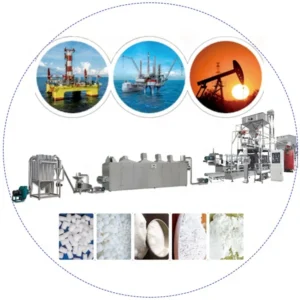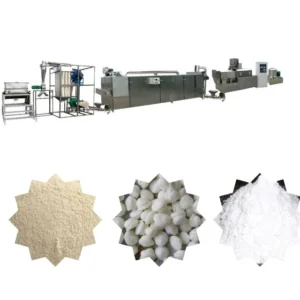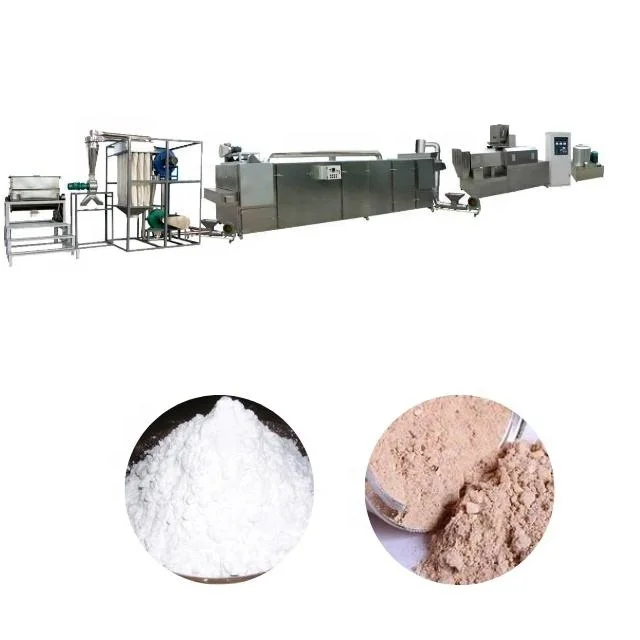
Throughput-matched stations from batching to packing — Every machine in the modified starch processing line full equipment range is sized so the extruder output feeds directly into a dryer and packing system built to handle the same rate without bottlenecking.
Technical Specifications
| Parameter | Value |
|---|---|
| Product Type | Modified Starch Processing Line |
| Model Options | MT70 / MT85 / MT100 |
| Installed Power | MT70 160 kW / MT85 190 kW / MT100 210 kW |
| Power Consumption | MT70 120 kW / MT85 140 kW / MT100 150 kW |
| Output Capacity | MT70 150–200 kg/h (basis to be confirmed); MT85 300–400 kg/h (basis to be confirmed); MT100 300–500 kg/h (basis to be confirmed) |
| Overall Dimensions (L×W×H) | MT70 41000×1500×2200 mm / MT85 43000×1500×3200 mm / MT100 45000×1500×3500 mm |
| Extruder Type | Double-screw (Twin-screw) |
| Screw Material | 38CrMo alloy steel |
| Main Motor Power | MT70 30 kW (varies by model) |
| Barrel Heating | Electric heating zones with integrated cooling system |
| Control System | PLC and MCC |
| Voltage & Frequency | 380V 50Hz Three Phase (configurable: 3ph 380V 60Hz, 3ph 415V 60Hz, 3ph 220V 60Hz) |
| Contact Material | Food-grade stainless steel (conveyors with PVC belting) |
| Dryer Fuel Options | Gas / Diesel / Electricity / Steam |
| Standards | CE, ISO |
Application Suitability
| Application | Material or Output |
|---|---|
| Pregelatinised starch for food processing | Corn starch, wheat flour, cassava starch |
| Modified starch for textile sizing | Corn starch, potato starch with chemical additives |
| Modified starch for paper coating | Corn starch, wheat flour with denaturation agents |
| Instant starch blends for nutritional formulations | Multi-grain starch blends with hydrolysis or saccharification treatment |
What "300–400 kg/h" Means When Your Raw Material Is Cassava, Not Corn
A quoted capacity only holds if the screw, die, and temperature profile were matched to your exact starch source and moisture content.
In this industry, a modified starch processing line full equipment range often arrives with a nameplate output that assumes a standard corn starch feed at a fixed moisture level. When the actual raw material is cassava starch with a lower gelatinisation temperature, or wheat flour requiring different shear conditions, the extruder may need significant parameter adjustments on site. I recall a Southeast Asian buyer whose line ran perfectly during our trial on standard corn starch, but once they fed cassava starch at their facility, the gelatinisation window shifted and parameters had to be reworked from scratch, costing them days of production [NEED_CITE: raw material gelatinisation temperature differences across starch sources]. This is why a trial run on the buyer’s actual raw material before shipment is not optional — it is the only way to validate that the modified starch processing line full equipment range will deliver its stated output under real conditions.
Screw Profile and Barrel Zones Define the Modification
The MT70, MT85, and MT100 extruders use 38CrMo alloy steel screws with a configurable profile that determines residence time, shear intensity, and the degree of starch gelatinisation achieved inside the barrel. The barrel is divided into multiple heating zones, each independently controlled, with an integrated cooling circuit that prevents runaway temperatures when processing heat-sensitive starches. For pregelatinised starch, the screw profile is typically set to provide sufficient residence time for complete gelatinisation without excessive degradation, while modified starch destined for industrial applications may require a more aggressive shear profile to achieve the desired denaturation.
Matching Dryer Capacity to Extruder Output
The dryer in a modified starch processing line full equipment range must handle the full extruder discharge rate without creating a backup or running the product through too quickly for adequate moisture removal. Available fuel options include gas, diesel, electricity, and steam, allowing the dryer to be configured around local utility costs and availability. A steam-heated dryer suits facilities that already operate a boiler for other processes, while a gas-fired unit may be preferable in regions where natural gas is the most economical fuel. The dryer length and airflow are specified to bring the extruded starch from its post-extrusion moisture level down to the target packing moisture within the residence time the belt provides [NEED_CITE: industrial starch moisture targets for storage stability].
Reading the Parameter Sheet Against Your Production Target
The installed power figures — 160 kW for the MT70, 190 kW for the MT85, 210 kW for the MT100 — cover the entire line from mixer through extruder, dryer, and packing. Actual power consumption during steady-state operation is lower, at 120 kW, 140 kW, and 150 kW respectively, reflecting the fact that heating elements cycle and motors do not run continuously at full load. The PLC and MCC control system manages these loads, coordinating start-up sequences so that heating zones reach set-point temperature before the main motor engages, reducing thermal shock to the starch feed. Voltage and frequency are configurable to match the destination market, whether that is 380V 50Hz for most of Asia and Europe, 415V 60Hz for parts of the Middle East, or 220V 60Hz for specific industrial installations.
When Downstream Stations Cannot Keep Up
An extruder rated for a given output is only useful if the dryer, cooling conveyor, and packing station can accept that same throughput continuously. I have seen lines where the extruder was correctly specified but the dryer was undersized, forcing the operator to slow the screw speed and run the extruder below capacity just to avoid wet product reaching the packing stage. This mismatch turns a modified starch processing line full equipment range into a constant source of frustration, with operators manually adjusting speeds and temperatures to compensate. The consequence is not just lower output but inconsistent product moisture, which affects shelf life and downstream performance in food or industrial applications [NEED_CITE: consequences of moisture variation in modified starch products].
What Makes This Line Different in Practice
The screw configuration and die design are specified to the buyer’s raw material and target starch modification, not copied from a generic build. An in-house testing workshop allows trial runs on the buyer’s actual starch before shipment, catching gelatinisation or expansion issues before the line leaves the factory. Every station — mixer, extruder, dryer, cooler, packing — is supplied as a single matched set, so throughput is balanced rather than assembled from separate vendors with different capacity assumptions. Food-grade stainless steel is used on all product-contact surfaces throughout the line. Pre-sales engineering includes a line layout and capacity calculation document that shows throughput matching across every station.
Documentation & Verification
- Line layout drawing with throughput calculation for each station in the modified starch line
- Screw and die configuration record matched to your specific starch source and modification target
- Trial run report on your actual raw material performed in the testing workshop before dispatch
- Electrical schematic with confirmed voltage, frequency, and control language for your installation site
- CE declaration of conformity and ISO certificate for the complete line
- Wear parts list with part numbers for screws, dies, and dryer components
Installation, Commissioning & Support
- Foundation plan accounting for the MT70 to MT100 line length up to 45 metres and dryer weight distribution
- Dedicated three-phase power circuit sized to the line’s installed power, up to 210 kW depending on model
- On-site assembly supervision covering extruder barrel alignment and dryer duct connection
- First-run parameter setting on your raw material with PLC set-point calibration and MCC sequence verification
- Operator training covering screw speed adjustment, barrel temperature zones, and dryer moisture control
- Spare screw and die set recommended for first replacement cycle based on your starch abrasiveness
Before You Send an Inquiry
To move from a general enquiry to a specific line configuration, the useful starting points are your starch source — corn, wheat, cassava, potato, or a blend — and the modification or treatment you need, whether that is pregelatinisation, hydrolysis, or chemical denaturation. Share your target daily output, the voltage and frequency standard at your facility, and whether your site has access to steam, gas, or only electricity for the dryer. If you have existing upstream batching or downstream packing equipment that the new line must integrate with, provide the make and throughput rating so the interface can be designed correctly.
Frequently Asked Questions
Q: How is the output capacity verified and what raw material basis is it stated on?
A: The output figures for each model are based on specific raw material and moisture conditions that must be confirmed for your application. We conduct a trial run in our testing workshop using your actual starch source, documenting the achieved throughput, product moisture, and degree of modification in a report that accompanies the shipment. This ensures the capacity you see on paper matches what the line delivers on your factory floor.
Q: Which stations are included in the complete line and how is throughput matched between them?
A: The modified starch processing line full equipment range includes batching and mixing, twin-screw extrusion, drying, cooling, and packing stations supplied as one set. Each station is sized so that its maximum handling rate meets or exceeds the extruder discharge rate, preventing bottlenecks. The line layout document provided during engineering shows the calculated throughput at each station for your specific configuration.
Q: What voltage and frequency configurations are available for different target markets?
A: The standard configuration is 380V 50Hz three-phase, but the line is available in 380V 60Hz, 415V 60Hz, and 220V 60Hz to match local electrical standards. The voltage and frequency are confirmed during the specification stage and recorded on the electrical schematic before production begins, so the motors, heating elements, and control system arrive configured for your facility’s power supply.
Q: Can the screw configuration and die be specified to a buyer’s particular starch source?
A: Yes. The screw profile and die geometry are selected based on your raw material — whether corn, wheat, cassava, or a blend — and the target modification, such as pregelatinisation or denaturation. The 38CrMo screw sections are arranged to provide the residence time and shear needed for your product, and the configuration is validated during the pre-shipment trial run on your starch.
Q: What dryer fuel options are available and how is the dryer sized relative to extruder output?
A: The dryer can be configured for gas, diesel, electricity, or steam heating depending on your local utility costs and existing infrastructure. Its length and airflow capacity are calculated to reduce the extruded starch from post-extrusion moisture to the target packing moisture at the full extruder discharge rate, ensuring the dryer does not become a bottleneck in the modified starch processing line full equipment range.