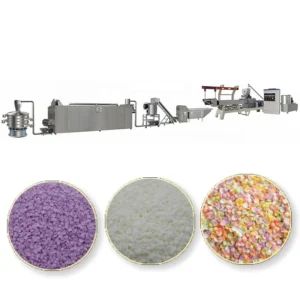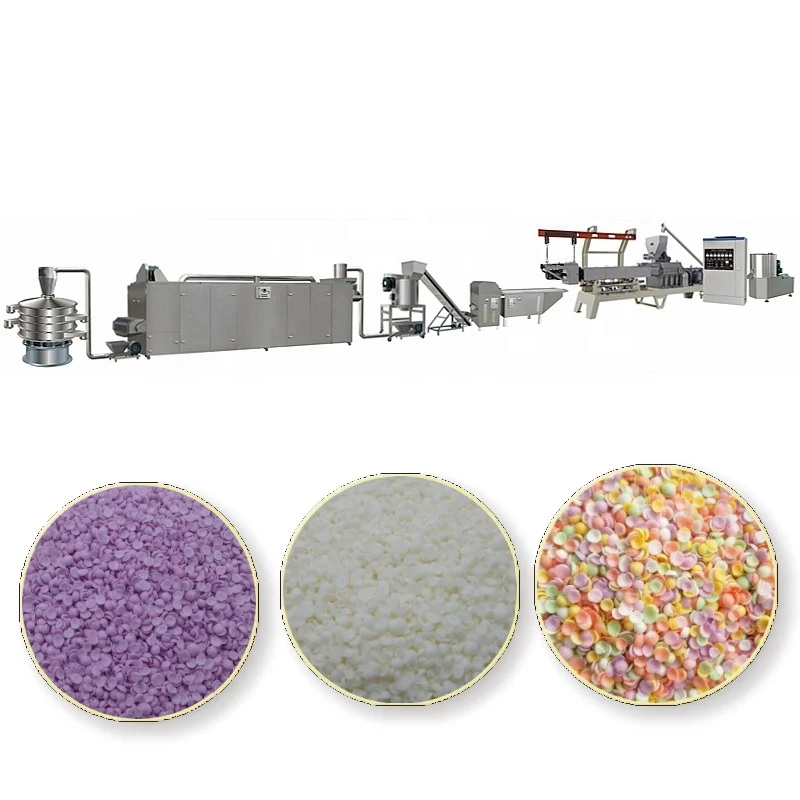
Throughput-Matched Stations — every station from mixer to sizer specified under one catalogue so buyers can verify line balance before committing.
Technical Specifications
| Parameter | Value |
|---|---|
| Product Type | Bread Crumb Processing Line |
| Model Options | MT65 / MT70 / MT85 |
| Screw Configuration | Twin-screw |
| Output Capacity (MT65) | 100–150 kg/h (basis not stated in source — confirm raw material formulation / moisture content / crumb format) |
| Output Capacity (MT70) | 200–250 kg/h (basis not stated in source — confirm raw material formulation / moisture content / crumb format) |
| Output Capacity (MT85) | 300–500 kg/h (basis not stated in source — confirm raw material formulation / moisture content / crumb format) |
| Installed Power (MT65) | 80 kW |
| Real Running Power (MT65) | 60 kW |
| Installed Power (MT70) | 100 kW |
| Real Running Power (MT70) | 80 kW |
| Installed Power (MT85) | 185 kW |
| Real Running Power (MT85) | 145 kW |
| Overall Dimensions (MT65) | 24000 × 1200 × 2200 mm |
| Overall Dimensions (MT70) | 26000 × 1500 × 2200 mm |
| Overall Dimensions (MT85) | 24000 × 3500 × 4300 mm |
| Roaster Far Infrared Heater Array | 24 elements × 3.9 kW |
| Roaster Belt Effective Length | 3.5 m |
| Roaster Gas Consumption | 6.8 m³ (per cycle basis not stated in source) |
| Powder Mixer Tank Volume | 150 kg per batch |
| Powder Mixer Rotary Speed | 385 rpm |
| Material Contact Parts | Stainless steel (304 grade) |
| Product Formats | Needle-shaped crumbs / Granular crumbs / Needle-shaped chaff / Granular chaff |
| Line Sequence | Powder mixer → Twin-screw extruder → Cutting machine → Air conveyor → Drying box → Air conveyor → Grinder → Sizer |
| Control System | PLC / MCC (to be confirmed before order) |
| Voltage & Frequency | To be confirmed before order |
| Assembly State | Complete turnkey line |
| Warranty | 1 year complete warranty, lifetime maintenance service |
Application Suitability
| Application | Material or Output |
|---|---|
| Western-style frying coating | Needle-shaped bread crumbs for fried steaks, chicken legs, and seafood |
| Panko-style crumb production | Granular and needle-shaped formats via twin-screw extrusion |
| Industrial food service supply | Bulk crumb output for commercial frying operations and bakery additives |
| Small-to-medium scale entry | Lower capital investment compared to large-scale breadcrumb lines |
What the Quoted Capacity Number Leaves Out on a Bread Crumb Processing Line
A stated output figure means nothing until you confirm which raw material formulation and moisture level it was measured against.
I once watched a Middle East buyer take delivery of an extruder that was rated perfectly on paper, only to discover that his local flour blend absorbed moisture differently and the downstream dryer could not keep pace. The bottleneck was invisible in the quotation but painfully obvious on the factory floor. On a bread crumb processing line full equipment range, every station — mixer, extruder, cutting machine, air conveyor, roaster, grinder, and sizer — must be checked against your specific recipe before you sign [NEED_CITE: industrial extrusion line capacity validation standards]. When one vendor supplies and matches all stations, the throughput conversation happens before shipment, not after.
Every Station Visible Before You Commit
This bread crumb processing line full equipment range lays out each station with its own power draw, footprint, and throughput envelope so you can cross-check balance at the planning stage. The powder mixer runs 150 kg batches at 385 rpm, feeding into the twin-screw extruder, which then passes cut pieces through the high-temperature roaster and onward to the grinder and sizer. Because the entire sequence is documented in one catalogue, you can spot where a station might lag and request a resize before production begins.
Heating Flexibility Inside the Roaster
The roaster section uses a 24-element far infrared array rated at 3.9 kW per element, with an optional gas burner consuming 6.8 m³ per cycle. This dual-input design lets you switch between electric and thermal energy depending on your local utility cost structure. The 3.5-metre effective belt length gives the crumb pieces sufficient dwell time to reach the moisture level required for clean grinding downstream. Getting this stage wrong means the grinder chokes or the sizer produces inconsistent fractions [NEED_CITE: thermal drying requirements for extruded breadcrumb products].
Reading the Power and Dimension Sheet
Installed power and real running power are listed separately for each model tier because the gap between them tells you about motor sizing headroom and actual energy cost. On the MT65, installed power sits at 80 kW while real consumption drops to 60 kW, meaning the main motors are not running at their thermal ceiling. The footprint difference between MT70 and MT85 is substantial — the MT85 line spans 24000 × 3500 × 4300 mm, requiring considerably more floor width and ceiling height than the MT70 at 26000 × 1500 × 2200 mm. Matching the line to your available bay dimensions avoids costly structural modifications later. Stainless steel 304 contact parts throughout the line meet food-grade expectations and simplify wash-down routines between crumb format changeovers.
The Cost of Skipping the Dryer-Grinder Balance Check
When the roaster output does not align with grinder infeed rate, you get either a starved grinder producing excessive fines or an overloaded grinder jamming mid-shift. On crumb lines I have seen where the dryer was undersized, operators were forced to slow the extruder down, effectively running a larger machine at a fraction of its capability. That mismatch does not show up in any single station’s spec sheet — it only appears when you map the entire chain. Buyers who treat each machine as an isolated purchase end up paying for capacity they cannot actually use [NEED_CITE: common line bottleneck causes in food extrusion plants].
Why Source the Full Range Under One Supplier
Every station in this bread crumb processing line is specified and supplied under one catalogue, so throughput matching is calculated before equipment leaves the factory rather than debugged on your floor. Screw configuration and die design are selected against your raw material and target crumb format — needle-shaped or granular — not copied from a generic build. An in-house testing workshop allows trial runs on your actual flour blend before shipment, meaning product development starts before the crate is nailed shut, not after. Electrical schematics, voltage confirmation, and control language are verified in advance so commissioning is measured in days, not weeks. Ongoing wear parts — screws, dies, grinder screens — are catalogued from day one so your first replacement order is not a scramble.
Documentation & Verification
- Line layout drawing with capacity calculation matched to your flour formulation and target crumb format
- Screw and die configuration record specifying barrel zones and die plate to your product
- Electrical schematic with voltage, frequency, and control language confirmation sheet
- Factory trial run report on your raw material conducted before shipment
- CE declaration of conformity and ISO certificate for import clearance
Installation, Commissioning & Support
- Foundation plan accounts for the MT85 footprint of 24000 × 3500 × 4300 mm and roaster weight distribution
- Dedicated power circuit sized to the real running power of your selected model tier (60 kW to 145 kW)
- Assembly crew handles station-by-station alignment from mixer through sizer on your floor
- First-run parameter setting covers barrel temperatures, roaster belt speed, and grinder screen selection
- Operator training addresses format changeover between needle-shaped and granular crumbs
- Wear parts list identifies screws, dies, and grinder screens with lead times for first reorder
What to Include in Your Enquiry
To size this bread crumb processing line correctly, share your flour or starch formulation, target moisture content after drying, and whether you need needle-shaped crumbs, granular crumbs, or both. Confirm your workshop floor dimensions, ceiling height, and local voltage and frequency so the electrical package matches before production. If you have existing upstream mixers or downstream packing lines, provide their throughput and interface details so the new stations integrate cleanly.
Frequently Asked Questions
Q: What supporting stations are included in the full line, and which are optional?
A: The standard sequence covers powder mixer, twin-screw extruder, cutting machine, two air conveyors, drying box, grinder, and sizer. Optional stations include additional flavouring or coating drums and automated packing systems. Each station’s throughput is matched to the others so no single machine bottlenecks the line.
Q: Where might a throughput bottleneck appear on my target output?
A: Bottlenecks most often appear between the roaster and grinder when dwell time and infeed rate are not aligned. Because every station’s capacity envelope is listed, you can cross-check the chain against your target output during the layout stage and resize the dryer or grinder before production begins.
Q: What is the footprint and utility requirement for each model tier?
A: The MT65 occupies 24000 × 1200 × 2200 mm with 80 kW installed power, the MT70 spans 26000 × 1500 × 2200 mm at 100 kW, and the MT85 requires 24000 × 3500 × 4300 mm with 185 kW installed. Voltage and frequency must be confirmed before order to match local supply.
Q: Can the roaster be configured for electric, gas, or hybrid heating?
A: The roaster includes a 24-element far infrared electric array and an optional gas burner consuming 6.8 m³ per cycle. You can specify electric-only, gas-only, or hybrid operation depending on your local energy cost structure and available utility connections at the installation site.
Q: How is the grinder and sizer matched to produce needle-shaped versus granular crumbs?
A: Grinder screen aperture and sizer mesh are selected based on your target crumb format. Needle-shaped crumbs require a coarser screen to preserve elongated particle geometry, while granular crumbs pass through finer screens for uniform particle size. Configuration is confirmed during the trial run before shipment.