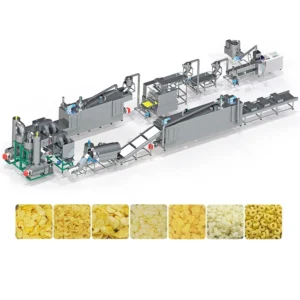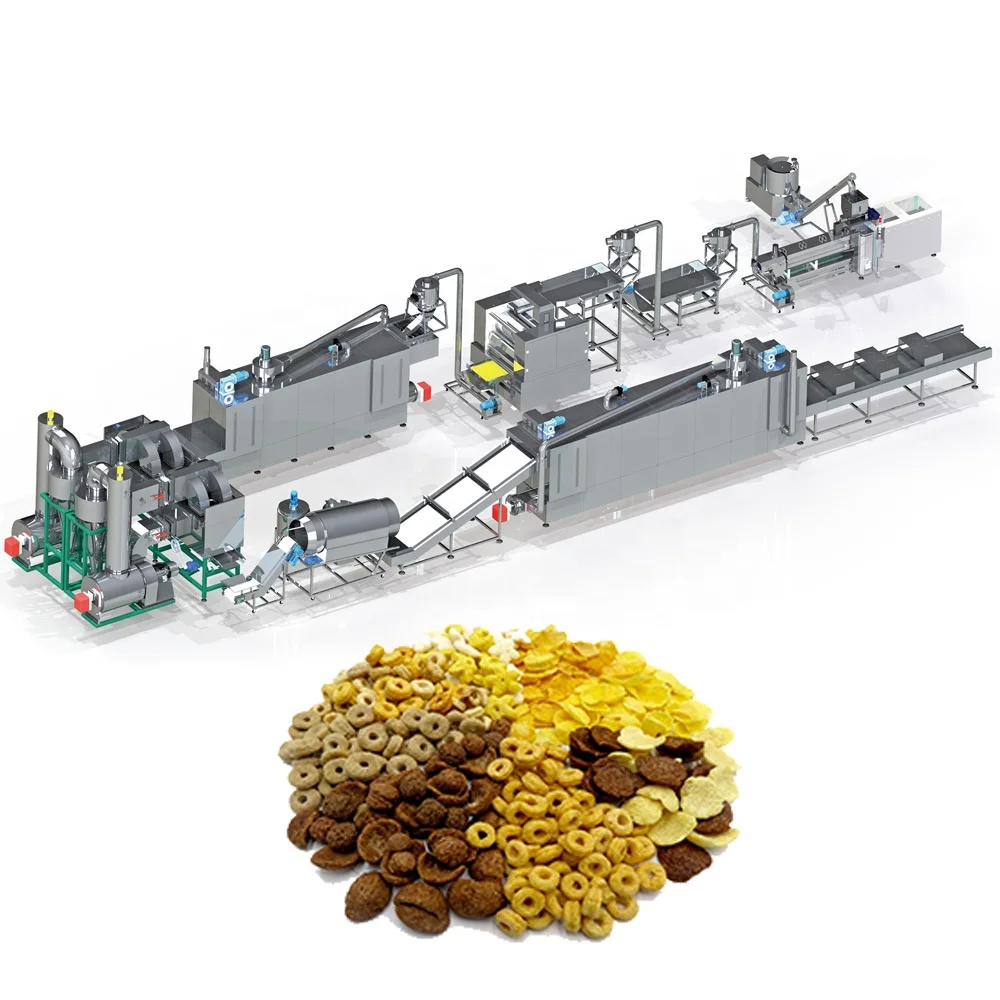
Integrated Line Sizing — every station from mixer to roaster is throughput-matched to the extruder output, eliminating the mid-line bottlenecks that plague split-vendor setups.
Technical Specifications
| Parameter | Value |
|---|---|
| Product Type | Twin Screw Extruder Corn Flakes Processing Line |
| Model Options | MT70 / MT85 / MT75 |
| Screw Type | Twin-screw |
| Installed Power | MT70: 160 kW; MT85: 190 kW; MT75: 210 kW |
| Power Consumption | MT70: 120 kW; MT85: 140 kW; MT75: 150 kW |
| Output Capacity | MT70: 150–200 kg/h (basis to be confirmed); MT85: 300–400 kg/h (basis to be confirmed); MT75: 300–500 kg/h (basis to be confirmed) |
| Overall Dimensions | MT70: 41 × 1.5 × 2.2 m; MT85: 43 × 1.5 × 3.2 m; MT75: 45 × 1.5 × 3.5 m |
| Control System | PLC control with MCC available |
| Flaking Drive | Double motors for separate roller driving, hydraulic system for double rollers |
| Flaking Temperature Control | Infrared sensor for even temperature pipe control |
| Dryer Heating Source | Gas or Electric |
| Roasting Oven | Hot air roasting with conciliation burner, dual circulating fans, cyclone dust removal |
| Coating System | Double tumble sugar melting, elevator, coating drum, spraying nozzle |
| Raw Materials | Corn, rice, wheat, oat, barley powder |
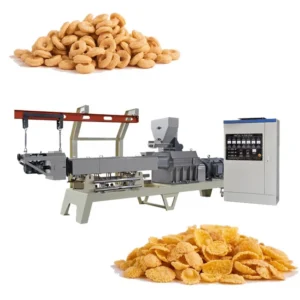
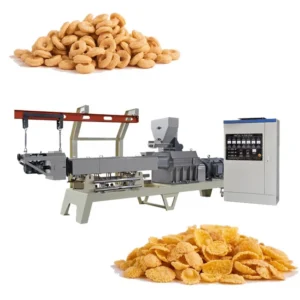
| Final Product Shapes | Ball, tube, stick, ring, fruit loop, star, wheel, flower, heart |
| Certifications | CE, ISO |
Application Suitability
| Application | Material or Output |
|---|---|
| Natural corn flakes production | Corn grits and corn flour through extrusion, flaking, drying and roasting |
| Sugar-coated corn flakes | Corn-based pellets with sugar spraying and tumble coating stages |
| Extruded breakfast cereal shapes | Rice, wheat, oat and barley powder blends for rings, stars, fruit loops |
| Puffed snack variants | Same extruder platform adapted for direct-expanded snack formats |
Why "Nominal Line Capacity" Misses the Real Bottleneck in a breakfast cereal corn flakes machine full equipment range
Matching throughput across every station matters more than the extruder nameplate.
I have walked into plants where the extruder was pushing product at its rated output but the dryer could not keep up, leaving trays of half-dried flakes sitting in a humid hallway for hours before roasting. The result is inconsistent moisture, uneven crispness, and a line that never reaches its promised capacity. When surveying a breakfast cereal corn flakes machine full equipment range, the question is not what the extruder can produce in isolation but whether the flaker, dryer, roaster and coating drum are each sized to handle the same flow without queuing or starving downstream [NEED_CITE: throughput balancing principles in continuous food processing lines].
Surveying the Station Sequence for Corn Flake Lines
The natural corn flakes path runs through mixing, extruding, flaking, drying, hot air roasting, cooling and packing. Sugar-coated variants insert sugar spraying and a second coating and drying stage after roasting. Understanding this sequence helps buyers see where a breakfast cereal corn flakes machine full equipment range must branch and where additional floor space, utilities and conveying links are needed between stations.
How Each Supporting Station Connects to Extruder Output
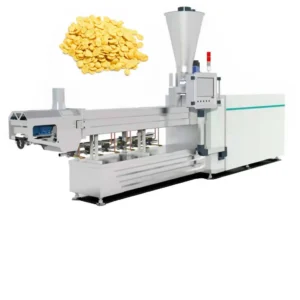
The flaking machinery uses a hydraulic double-roller system with separate motor drives, and an infrared sensor monitors roller temperature to keep flake thickness consistent. Downstream, the hot air roasting oven uses a conciliation burner with two circulating fans and a cyclone dust removal device to achieve the crisp texture the market expects. The coating system adds a double tumble sugar melter, a dedicated elevator, a coating drum and spraying nozzles so that sugar application stays even at the line rate [NEED_CITE: sugar coating uniformity requirements for breakfast cereals].
Reading the Specs That Actually Shape Production
The twin-screw extruder is available in three capacity tiers, and the choice between them determines not only motor load but also the physical footprint of the entire line — the MT75 layout stretches to 45 metres long while the MT70 fits within 41 metres. The flaking station’s hydraulic roller pressure and infrared temperature control directly affect flake integrity; too little pressure yields thick flakes that roast unevenly, while excessive pressure cracks the sheet before it reaches the dryer. The roasting oven’s dual circulating fans create cross-flow air patterns that reduce moisture gradients across the tray bed, which is critical when running corn-based formulations that are sensitive to case hardening. PLC control across the line allows recipe parameters — barrel temperature profile, screw speed, dryer residence time — to be stored and recalled, reducing batch-to-batch variation when operators change shifts.
The Cost of Mismatched Upstream and Downstream Equipment
When the flaker cannot keep pace with extruder output, the extruder must be throttled back, meaning the installed power and screw configuration are never used at their designed operating point. I have seen lines where a sugar coating drum was specified for a lower capacity than the roaster feeding it, causing coated flakes to pile up and stick together before they could enter the final dryer. These mismatches rarely show up in a single-machine quotation but surface quickly once the line runs continuously [NEED_CITE: common causes of downtime in cereal production lines].
Why Sourcing the Full Range from One Supplier Changes the Outcome
Every station in this breakfast cereal corn flakes machine full equipment range is specified against the same throughput target, so the flaker, dryer and roaster are not independent purchases that might conflict. Screw configuration and die design are matched to the buyer’s raw material — corn, rice, wheat or oat blends — rather than pulled from a generic template. An in-house testing workshop runs trial production on the buyer’s actual material before shipment, so product development does not start from zero on installation day. Line layout and capacity calculations are provided as part of the proposal, mapping each station’s utility requirements and floor footprint. Pre-sales consultation carries through to on-site installation, commissioning and operator training on the PLC interface.
Documentation & Verification
- Line layout with capacity calculation matched to your target corn or grain blend
- Machine specification sheet for every station from mixer to packing conveyor
- Screw and die configuration record specific to your raw material formulation
- Electrical schematic with voltage and frequency confirmation for your local grid
- Trial run report produced on your raw material in the testing workshop before dispatch
- CE declaration of conformity and ISO certificate for the complete line
Installation, Commissioning & Support
- Foundation and floor space planning based on the selected model’s overall dimensions up to 45 metres in length
- Dedicated power circuit sized to the installed power requirement, reaching 210 kW on the MT75
- PLC and MCC control language configured to your operator team before commissioning begins
- First-run parameter tuning on your raw material covering barrel temperatures, screw speed and dryer settings
- Operator training on recipe recall, flaking roller adjustment and roasting oven fan balance
- Wear parts list covering screws, dies and flaking rollers with recommended replacement intervals
What to Share When Requesting a Line Proposal
Provide the grain type and particle size you plan to run, your target daily output in finished product weight, and whether the line will produce natural flakes, sugar-coated flakes or both. Include your local voltage and frequency, preferred control language, and available workshop dimensions including ceiling height so the layout can account for the dryer and roaster clearance. If you have existing upstream milling or downstream packing equipment, share those specifications so the conveying interfaces can be designed to match.
Frequently Asked Questions
Q: How is throughput matched between the extruder, flaker, dryer and roaster to avoid line bottlenecks?
A: Each station is sized against the same target output derived from your raw material and moisture profile. The flaker roller width, dryer belt length and roasting oven tray capacity are all calculated so that no single station queues or starves product when the extruder runs at its designed operating point.
Q: What supporting stations differ between natural and sugar-coated corn flakes?
A: Natural corn flakes require mixing, extruding, flaking, drying, roasting, cooling and packing. Sugar-coated variants add a sugar spraying station, a tumble coating drum and a second drying stage after roasting, which increases both the line length and the total utility load.
Q: How do the MT70, MT85 and MT75 extruder models map to different production targets?
A: Each model covers a different capacity tier and occupies a different overall footprint. Selection depends on your target output, available floor space and the specific raw material formulation, which together determine which model reaches stable production most efficiently.
Q: Can the extruder produce shapes beyond traditional corn flakes on the same line?
A: Yes. By changing the extruder die, the same twin-screw platform can produce balls, tubes, sticks, rings, fruit loops, stars, wheels, flowers and heart shapes, allowing producers to diversify into extruded breakfast cereals without a separate extruder investment.