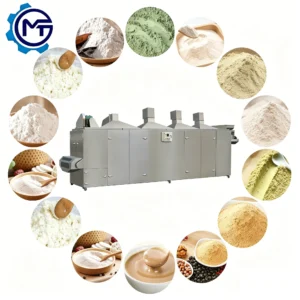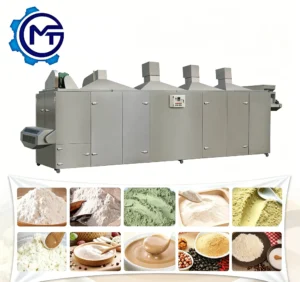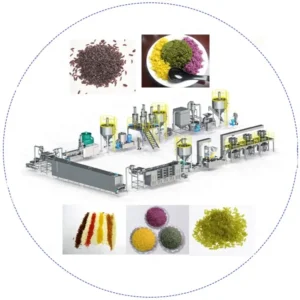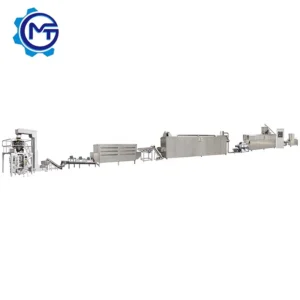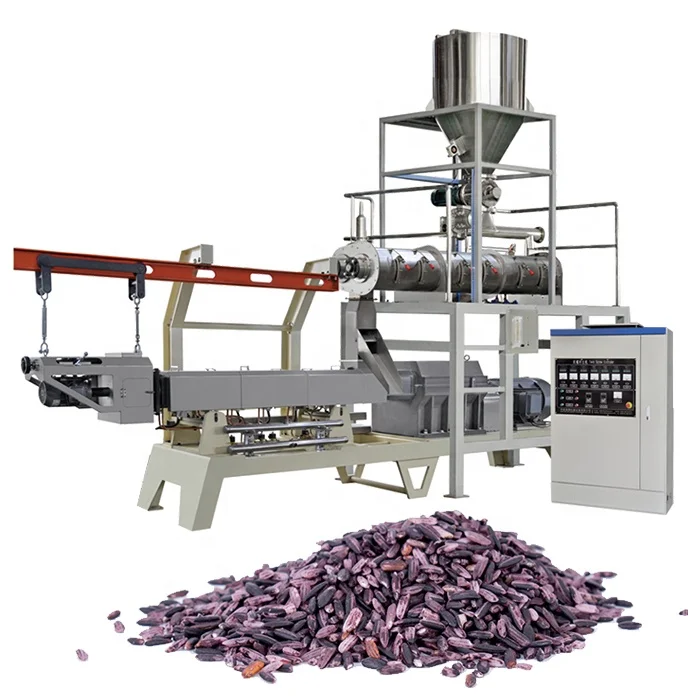
Complete line engineering — every station from batching to packing is sized against the actual extruder output so throughput holds at the rated level across the full sequence.
Technical Specifications
| Parameter | Value |
|---|---|
| Product Type | Fortified Rice Production Line |
| Rated Power | 100 kW |
| Output Capacity | 100–500 kg/h (basis not stated in source — confirm raw material formulation and moisture content) |
| Voltage & Frequency | 380 V / 50 Hz (customizable on request) |
| Construction Material | Food-grade stainless steel on all product-contact surfaces |
| Control System | Automated controls (PLC / MCC options available on request) |
| Assembly State | Complete production line — mixing through packing |
| Certification | CE |
| Screw Type | To be confirmed — single or twin screw based on formulation |
| Line Stations | Mixing, extrusion, drying, cooling, packing (scope confirmed at quotation) |
Application Suitability
| Application | Material or Output |
|---|---|
| Fortified rice for government nutrition programmes | Rice flour blended with micronutrient premix, vitamins and mineral salts |
| Artificial rice for retail health-food markets | Rice flour, starch and dietary fibre composites shaped into rice-grain geometry |
| Institutional meal supply | Shelf-stable extruded rice kernels blended with natural grain at point of use |
| Nutrition-enhanced rice for school feeding schemes | Parboiled or milled rice flour with added iron, folic acid and vitamin A |
What "Nominal Output" Leaves Out on a Fortified Rice Production Line Full Equipment Range
A line rated on plain rice flour can lose significant throughput the moment bran fibre or a micronutrient premix enters the barrel.
I learned this the hard way on a project for a Saudi client. We ran trials on standard rice flour and the extruder held its numbers. Their actual blend carried extra bran fibre. Expansion dropped, die pressure spiked, and the entire die set had to be re-cut before the barrel temperature profile was remapped. A Fortified Rice Production Line Full Equipment Range only delivers its rated output when every station — mixer, extruder, dryer, cooler, packer — is matched to the buyer’s real formulation, not a generic reference recipe. When the dryer is undersized relative to extruder throughput, wet product piles up on the belt and the line stalls [NEED_CITE: extruder-dryer throughput matching principles in food processing].
Matching Every Station to the Extruder
A Fortified Rice Production Line Full Equipment Range is only as reliable as its weakest link between stations. If the mixer cannot deliver a homogeneous blend at the rate the extruder demands, die pressure fluctuates and grain shape varies batch to batch. The dryer must remove moisture at the same mass rate the extruder deposits it; otherwise product backs up or arrives at the cooler still too warm for stable packing. Each supporting unit in this catalogue is selected so that rated throughput carries through the entire sequence without manual pacing.
Die Geometry and Grain Shape Consistency
The die plate defines whether the extrudate looks like a natural rice kernel or an obvious pellet. Length-to-diameter ratio of the die orifice, land length and face angle all influence how cleanly the cutter slices each grain. For artificial rice that must blend visually with natural grain in a retail bag, die tolerances matter far more than for a kibble or snack format [NEED_CITE: die design parameters for extruded rice analogues]. Selecting the correct die set during line configuration avoids costly re-tooling after the machines arrive on site.
Reading the Core Specs for Production Impact
The 100 kW rated power figure tells you the mechanical and thermal headroom available inside the barrel. Higher available power allows the screw to maintain shear on viscous, fibre-loaded doughs without stalling. Voltage at 380 V / 50 Hz is the industrial standard across much of Asia and the Middle East, but buyers in regions running 60 Hz or different three-phase voltages must confirm compatibility before the motor and heater elements are built — rewiring a control panel on site is expensive and risks voiding the CE mark. Food-grade stainless steel on all contact surfaces means no carbon steel corrosion points in high-humidity drying zones. Automated controls reduce operator dependence, but the interface language should be specified at order so the HMI screens arrive in a language the floor team reads.
The Hidden Cost of Mismatched Supporting Equipment
When the dryer capacity lags behind extruder output, operators slow the screw speed to let the belt catch up — and the line never reaches the throughput written in the contract. Cooling conveyors that are too short leave kernels warm and tacky going into the packing weigher, causing clumping and reject bags. These bottlenecks do not show up in a spec sheet; they surface during the first week of production [NEED_CITE: common bottleneck failures in extruded food lines]. Specifying the full equipment range together, rather than sourcing stations from separate vendors, keeps every link rated for the same mass flow.
Why Source the Full Range from One Supplier
Line layout and capacity calculations are produced against the buyer’s own raw material data, not a catalogue default. Screw configuration and die design are specified to the target grain shape and formulation before metal is cut. An in-house testing workshop allows trial runs on the customer’s actual rice flour blend before the line ships, so die pressure and barrel temperatures are mapped in advance. Twin-screw expertise across fortified rice, artificial rice and related starch-based applications means the extrusion parameters are drawn from relevant production history. Pre-sales consultation through installation, commissioning and ongoing maintenance keeps a single technical thread from first enquiry to steady-state output.
Documentation & Verification
- Line layout drawing with throughput matched at every station
- Machine specification sheet confirming screw type and die configuration
- Electrical schematic with voltage and frequency locked to buyer’s supply
- Trial run report generated on customer-supplied rice flour blend
- CE declaration of conformity covering the complete assembled line
- Wear parts list with screw element and die plate replacement intervals
Installation, Commissioning & Support
- Foundation plan sized to the 100 kW drive and full line footprint
- Dedicated three-phase circuit confirmed for 380 V / 50 Hz or buyer’s local supply
- Modular assembly allowing station-by-station positioning inside existing workshops
- First-run parameter mapping on buyer’s formulation during on-site commissioning
- Operator training covering HMI navigation, screw speed and barrel temperature adjustment
- Spare screw elements and die plates shipped with the initial order
Preparing Your Enquiry
To configure the right Fortified Rice Production Line Full Equipment Range, share your rice flour formulation including any bran, starch or micronutrient additions and the moisture content you plan to run at. Confirm your local three-phase voltage and frequency, the control panel language your operators need, and the daily output target so every station can be matched. If you have an existing packing system or upstream milling equipment, note the interface points so the line layout accounts for them.
Frequently Asked Questions
Q: Which supporting stations are included in the line and where does each fit?
A: The sequence covers a batching and mixing station, the extruder, a multi-pass dryer, a cooling conveyor and a packing weigher. Each station is selected so its rated capacity matches the extruder output. Mixing delivers a uniform blend, drying removes moisture to storage-safe levels, and cooling stabilises the kernels before they enter the packing system.
Q: Is the extruder single-screw or twin-screw for rice flour work?
A: Configuration depends on the formulation. Plain rice flour extrudes well on a single-screw unit. Blends carrying bran fibre, high micronutrient loads or added protein benefit from twin-screw mixing action inside the barrel. The choice is confirmed during line design based on trial data from the customer’s actual material.
Q: Can the voltage, frequency and control language be set for my country?
A: Yes. The standard build is 380 V / 50 Hz, but motor, heater and transformer specifications are adjusted at order to match local supply. The HMI language is configured before dispatch so operators see alarms and set-points in their working language from the first start-up.
Q: How do I prevent the dryer from bottlenecking extruder output?
A: Dryer belt length, airflow volume and heating capacity are calculated against the extruder’s mass output and the moisture that must be removed. When these values are matched during line design rather than estimated from a generic table, the dryer keeps pace and the line sustains its rated throughput without manual speed reduction.