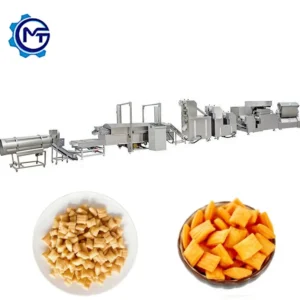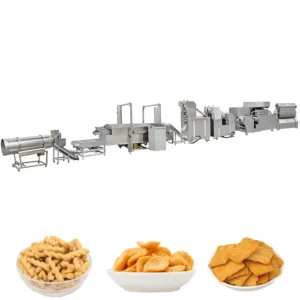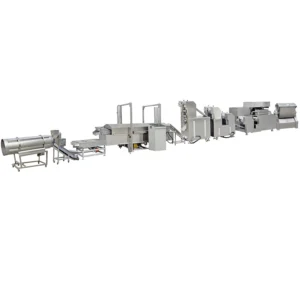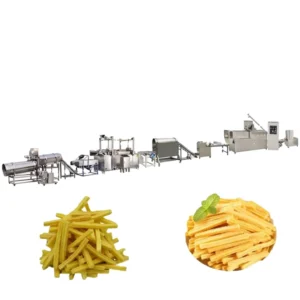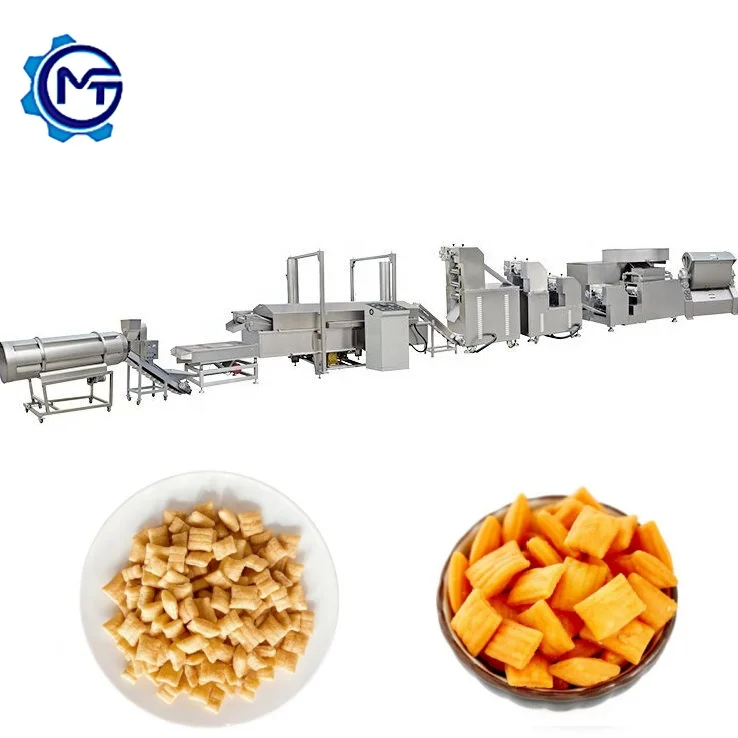
Full-Line Throughput Alignment — every station from extruder to fryer to flavouring drum is sized against the same capacity calculation so no single machine bottlenecks the snack line.
Technical Specifications
| Parameter | Value |
|---|---|
| Product Type | Continuous Deep Fryer for Snack Food Production Line |
| Heating Tube Power | 60 kW |
| Rated Power | 2.6 kW (drive and control circuits) |
| Voltage & Frequency | 380 V / 50 Hz (configurable per market) |
| Control System | PLC with touch-screen interface |
| Overall Dimensions (L × W × H) | 6 700 × 2 200 × 1 200 mm |
| Net Weight | 2 000 kg |
| Oil Tank Capacity | 320 L |
| Output Capacity | 100–1 000 kg/h (basis not stated in source — confirm product type, moisture content, frying time) |
| Heating Method | Electric or gas (coal option available) |
| Construction Material | Food-grade 304 stainless steel |
| Mesh Belt | Upper and lower double-layer, frequency-controlled stepless speed |
| Oil Filtration | Continuous circulation filtration system |
| Slag Discharge | Bottom-mounted automatic slag discharge |
| Lifting System | Automatic hood and mesh-belt lift for cleaning |
| Warranty | 1 year on machine and core components |
Application Suitability
| Application | Material or Output |
|---|---|
| Fried extruded corn snacks (Bugles-style shapes) | Corn grits or corn flour dough, extruded then fried to target crunch |
| Industrial corn chip production | Masa or corn-based sheeted dough, cut and fried continuously |
| Fried dough snack formats | Wheat or mixed-grain extruded dough pieces requiring uniform oil immersion |
| Integration within full snack lines | Positioned downstream of extruder and upstream of de-oiling, seasoning, and cooling stations |
What Happens When Fryer Capacity Is Quoted Without Context
A continuous deep fryer for sale is only as useful as the throughput data behind the number.
In my years running snack-line projects across the Middle East, I have watched entire production floors stall because the fryer could not keep pace with the extruder. The belt piles up with product, oil temperature drops when cold dough floods the tank, and operators end up running the fryer empty just to recover heat. That is not a capacity problem the spec sheet warned anyone about. [NEED_CITE: matching extruder output to downstream frying throughput in snack food lines]
A rated capacity figure means little until it is tested against the buyer’s actual dough formulation, piece size, and target moisture loss. Without that context, you are buying a number, not a production solution.
Mesh Belt Design That Follows the Product, Not a Fixed Timer
Frying time for extruded snacks varies by piece geometry and dough density. A small corn curl needs seconds less immersion than a thick Bugles-style tube. The double-layer mesh belt on this fryer uses frequency-controlled stepless speed regulation, so operators dial in residence time without mechanical gear changes. This matters when a snack manufacturer runs multiple SKUs on the same continuous deep fryer for sale — changeover is a speed adjustment on the PLC screen, not a belt swap.
Oil Quality as a Production Variable, Not an Afterthought
Edible oil degrades with every batch. Acid value climbs, colour darkens, and the snack absorbs off-flavours that customers notice. The continuous circulation filtration system on this industrial frying machine manufacturer unit pulls oil through a filter bed throughout the shift, removing fine particulate before it carbonises. The bottom-mounted automatic slag discharge works alongside it, keeping the tank floor clear without stopping the line. For buyers running eight-hour shifts on corn-based doughs that shed fines into the oil, this is the difference between consistent golden product and a mid-shift oil dump.
Power, Heating, and the Voltage Conversation
The 60 kW heating load and 2.6 kW drive load together define the electrical infrastructure the buyer must prepare. On a 380 V / 50 Hz supply the heating tubes reach target oil temperature within the warm-up window, but that calculation changes if the destination market runs 415 V / 60 Hz or 220 V / 60 Hz. [NEED_CITE: industrial voltage and frequency standards across Middle East and African markets] The PLC control panel and heating method — electric, gas, or coal — are configurable before production starts, so the fryer arrives matching the buyer’s utility reality rather than forcing an on-site retrofit. Food-grade 304 stainless steel contact surfaces handle the thermal cycling and acidic oil environment without corrosion concerns that would shorten service life in a food-safe production area.
When the Fryer Arrives but the Line Does Not Fit Together
I once stood in an Abu Dhabi plant where the customer had sourced a fryer separately from the extruder. The fryer belt ran faster than the extruder could feed it, so half the belt ran empty while oil burned at full temperature. The other scenario is worse: the extruder pushes more dough than the fryer can absorb, product backs up on the conveyor, and operators hand-shovel pieces into the tank. [NEED_CITE: production line bottleneck analysis for sequential food processing equipment] Neither problem shows up on a machine spec sheet. They show up on commissioning day, when the cost of re-engineering the layout has already multiplied.
Sourcing the Full Equipment Range from One Catalogue
The value of surveying the complete machine catalogue is seeing how every station connects. This fryer sits within a range that includes mixing and batching systems, extruders, dryers, flavouring drums, cooling conveyors, and packing lines — all sized by the same capacity calculation. Throughput matching across stations means the continuous deep fryer for sale is specified against the actual extruder output, not a standalone brochure number. Screw and die configuration on the upstream extruder determines the dough density entering the fryer, which in turn determines frying time and oil uptake; having one supplier across both stations keeps that chain consistent. Pre-shipment trial runs on the buyer’s raw material in an in-house testing workshop confirm frying behaviour before the equipment leaves the factory. Documentation — line layout, capacity calculation, electrical schematics, CE declaration — ships with the machines so the buyer’s engineering team and customs broker both have what they need. [NEED_CITE: CE machinery directive documentation requirements for food processing equipment exports]
Documentation & Verification
- Line layout drawing showing fryer position relative to extruder, de-oiling, and seasoning stations
- Capacity calculation sheet matching fryer throughput to upstream extruder output on your product format
- Electrical schematic confirming voltage, frequency, and heating method for your local supply
- Factory test record on your raw material covering oil uptake, colour, and texture before dispatch
- CE declaration of conformity and ISO certificate included in the shipping documentation package
Installation, Commissioning & Support
- Floor space planning around the 6 700 × 2 200 mm footprint with clearance for hood lifting
- Dedicated electrical circuit sized for the combined 62.6 kW load at confirmed voltage and frequency
- Machine ships in a strong plywood case; on-site assembly covers hood, belt, and filtration connections
- PLC parameter setting during commissioning — belt speed, oil temperature setpoint, filtration cycle timing
- Operator training on mesh-belt speed adjustment, automatic slag discharge, and hood-lift cleaning procedure
- Wear parts list covering mesh belt sections, heating elements, and filtration media with replacement intervals
What to Share When You Open an Enquiry
To match this fryer to your line, the most useful details are your upstream extruder model and its actual output rate, the snack format you intend to fry, and the target finished moisture or oil content. Include your site voltage and frequency, available heating fuel, and whether the fryer must integrate with existing downstream seasoning or cooling equipment. If you have a specific raw material formulation, a sample can be tested before the quotation is finalised.
Frequently Asked Questions
Q: How is fryer capacity verified against my actual extruder output and product format?
A: Capacity is calculated against your extruder’s real throughput on the specific dough formulation, then validated during a trial run in the testing workshop. The test covers oil temperature stability at full feed rate, frying time to target colour, and oil uptake percentage, so the number you receive reflects your product, not a generic benchmark.
Q: Can the voltage, frequency, and control language be confirmed for my market before production?
A: Yes. The electrical schematic is confirmed during the specification stage, including supply voltage, frequency, and PLC interface language. This step happens before production begins, so the fryer arrives with the correct heating elements, motor ratings, and control labels for your local infrastructure and operators.
Q: Is a trial run on my raw material possible before shipment, and what does the report cover?
A: A trial run in the in-house testing workshop uses your actual raw material to confirm frying results. The test report documents oil temperature profile, belt speed used, frying time, final product colour and texture, and oil absorption rate, giving you a verified baseline before the line ships.
Q: How does this fryer integrate with upstream extruders and downstream seasoning stations?
A: The fryer is specified as part of the full equipment range, so its belt speed and oil volume are matched to extruder output and downstream flavouring drum capacity. Connection heights, conveyor interfaces, and control signal links are defined in the line layout before production starts.
Q: What spare wear parts are included, and what is the replacement schedule for belts and heating elements?
A: The wear parts list shipped with the machine covers mesh belt sections, heating tubes, and filtration media. Replacement intervals depend on shift length and product type; the operation manual provides guidance based on typical production conditions, and parts can be ordered for future shipments.