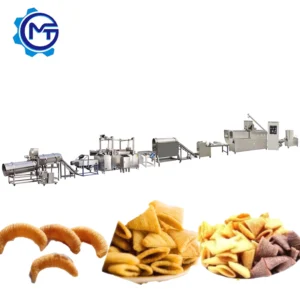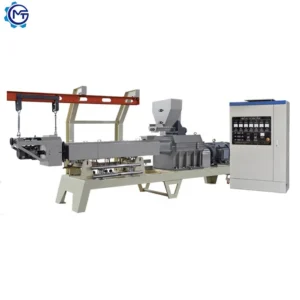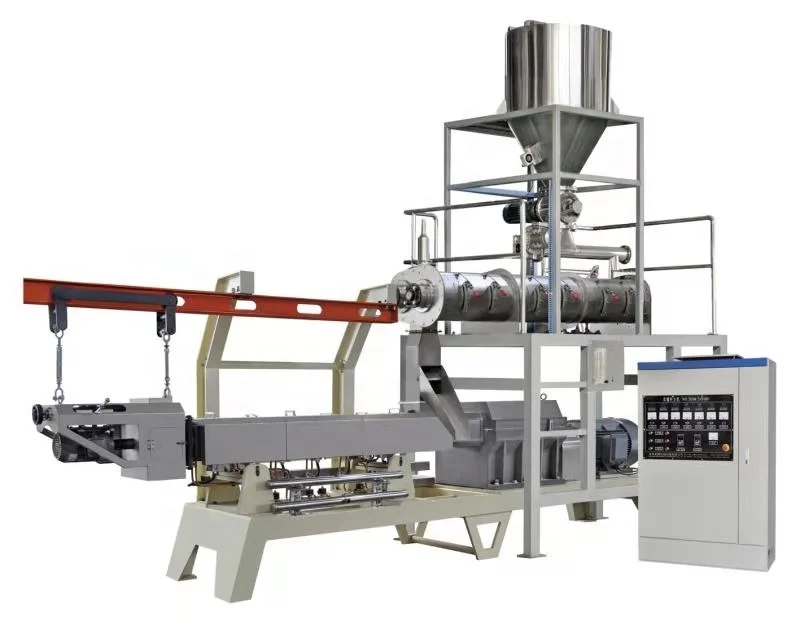
Integrated Throughput Matching — every station from the MT65/MT70/MT70c/MT75 extruder through the fryer and double-drum flavoring is sized to the same output basis, preventing the bottleneck where one machine runs idle waiting for the next.
Technical Specifications
| Parameter | Value |
|---|---|
| Model | MT65 / MT70 / MT70c / MT75 |
| Product Type | Twin Screw Extruder for Fried Snack Production Line |
| Screw Type | Twin screw |
| Main Power | 22 kW (MT65) / 30 kW (MT70) / 45 kW (MT70c) / 55 kW (MT75) |
| Real Power | 22 kW (MT65) / 30 kW (MT70) / 55 kW (MT70c) / 55 kW (MT75) |
| Output Capacity | 100–150 kg/h (MT65) / 150–200 kg/h (MT70) / 200–250 kg/h (MT70c) / 200–300 kg/h (MT75) (basis to be confirmed) |
| Overall Dimensions | 22000×1200×2200 mm (MT65) / 25000×1500×2200 mm (MT70) / 30000×3500×4300 mm (MT70c) / 33000×3500×4300 mm (MT75) |
| Screw Material | Alloy 38CrMoAl, nitriding process, self-cleaning |
| Main Motor | Siemens brand |
| Control System | Speed adjusted converter on feeding, extrusion and cutting systems |
| Gearbox | Automatic lubrication function |
| Feeding System | Food-grade stainless steel twin screw feeder |
| Cooling | Increased radiator on driving part for forced cooling |
| Cutting | Rotary cutting knife fixed in die head seat, V-belt drive |
| Line Stations | Extruder → shaper → hot air texturing → frying → double drums flavoring |
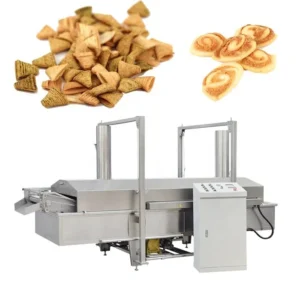
| Fryer Energy Options | Electric / diesel / gas |
| Flavoring System | Double drums with powder hopper, automatic flavoring |
| Warranty | 1 year (from equipment arrival at customer site) |
| Assembly State | Complete line |
| Certification | CE |
Application Suitability
| Application | Material or Output |
|---|---|
| Corn flour puff snacks | Corn flour, corn grits blends |
| Nacho chips | Corn masa, corn flour formulations |
| Tortilla chips | Corn-based dough sheets |
| Doritos-style triangular snacks | Corn and seasoning base formulations |
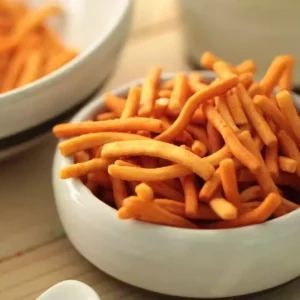
| Bugles | Corn flour extruded and fried |
| Fried snack production from corn powder | Corn powder raw material with moisture adjustment |
When a Frying Chips Making Machine Manufacturer Misses the Dryer Match
A line rated for a certain extruder output can still deliver far less finished product when the fryer or flavoring drums cannot keep pace.
I saw this firsthand last year when a Middle East customer placed an order based on nominal line capacity. Their actual corn flour blend had lower starch content than the standard test material, which meant the product did not expand properly after frying, and the line produced roughly sixty percent of the design output. The extruder was pushing material at the expected rate, but the downstream hot air texturing station and fryer were tuned for a different product density. The mismatch only became visible once the oil temperature and residence time failed to produce the crunch the market expected. That situation reinforced why every frying chips making machine manufacturer should confirm the full material profile before locking in station sizes [NEED_CITE: impact of raw material starch content on extrusion expansion and fryer throughput].
Matching Every Station from Extruder to Flavoring
A complete fried snack line runs through extrusion, shaping, hot air texturing, frying, and double-drum flavoring in sequence. If any station undershoots, the upstream extruder idles and operators batch smaller loads to compensate. The MT65 through MT75 range covers capacity bands from smaller pilot-scale runs to sustained production, and each downstream station — the continuous fryer available with electric, diesel, or gas heating, the double-drum automatic flavoring system — is specified against the same throughput baseline as the extruder itself.
Why Fryer Energy Source Changes the Line Footprint
The choice between electric, diesel, or gas fryer heating affects more than operating cost. Gas-fired fryers typically need dedicated exhaust ducting and combustion air supply, which influences how the line sits inside the production hall. Diesel units require fuel storage and filtration. Electric fryers simplify installation where sufficient three-phase power is available but draw substantial current at the MT70c or MT75 scale, where real power reaches 55 kW. A frying chips making machine manufacturer that does not confirm the buyer’s available utility supply before building the fryer will face delays at commissioning [NEED_CITE: industrial fryer utility requirements for gas versus electric heating].
Reading the Screw and Motor Specs for Snack Extrusion
The 38CrMoAl alloy screws with nitriding treatment and self-cleaning geometry matter directly for corn flour processing. Corn-based formulations are abrasive and tend to leave residue between batches; self-cleaning screw profiles reduce downtime for washout when switching from Nacho to Tortilla chip dies. The Siemens main motor paired with speed-adjusted converters on feeding, extrusion, and cutting allows operators to fine-tune the shear and residence time — critical variables when the target product shifts from a thin, crisp Bugle shape to a thicker, denser triangular chip. The increased radiator on the driving part provides forced cooling so that sustained runs do not overheat the gearbox oil, which would otherwise degrade and shorten service intervals. The automatic lubrication function on the gearbox further reduces the risk of missed maintenance during high-volume production periods.
The Hidden Cost of a Generic Screw Configuration
An extruder built with a screw and die setup copied from a standard template will run, but it may produce the wrong texture. For fried corn snacks, the expansion ratio before frying determines how much oil the product absorbs and how the final crunch develops. If the screw pitch and die aperture are not matched to the buyer’s specific corn flour blend and moisture content, the line will produce chips that are either too dense — absorbing excess oil and becoming greasy — or too open-structured, breaking during flavoring. This is not a defect visible at factory acceptance; it only appears once production starts on the buyer’s actual raw material [NEED_CITE: twin screw configuration impact on snack oil absorption and texture].
Why Buyers Source This Range from One Supplier
Every station from the twin screw feeder through the double-drum flavoring system comes from a single equipment source, so throughput calculations use consistent assumptions rather than relying on separate vendors to coordinate. The in-house testing workshop runs trial batches on the buyer’s own corn flour formulation before shipment, catching expansion and density issues early. Screw configuration and die design are documented per order, not pulled from a generic build sheet. The line arrives with CE documentation and a full machine specification sheet that matches what was quoted. Operator training covers the speed-adjusted converter settings across feeding, extrusion, and cutting so the crew can adjust for raw material variation without stopping the line.
Documentation & Verification
- Line layout drawing with throughput matching across extruder, fryer, and flavoring stations
- Machine specification sheet per model with screw and die configuration record
- Trial run report on customer corn flour raw material before shipment
- CE declaration of conformity for export compliance
- Electrical schematic with voltage and frequency confirmation for target market
Installation, Commissioning & Support
- Foundation must support up to 33000×3500×4300 mm footprint for the MT75 line with fryer and flavoring stations
- Three-phase power supply sized for 55 kW real power on the MT70c and MT75 extruder motor
- Line arrives in modular sections for on-site assembly and station-by-station alignment
- First-run commissioning includes screw speed, barrel temperature, and fryer residence time calibration
- Operator training covers speed-adjusted converter settings across feeding, extrusion, and cutting systems
- Spare wear parts list includes 38CrMoAl screws, die plates, and rotary cutting knives
What to Prepare Before Requesting a Quotation
Send the specific corn flour or corn grits formulation you plan to run, including typical moisture percentage at the mixer output. Confirm the target snack format — Nacho, Tortilla, Bugles, or a custom shape — along with the die profile if one already exists. State the available voltage, frequency, and whether gas, diesel, or electric fryer heating fits the production hall. If existing upstream mixers or downstream packing equipment must integrate, provide their throughput range so the line stations can be matched accordingly.
Frequently Asked Questions
Q: What raw material basis applies to the output capacity figures for each model?
A: The listed capacity ranges for the MT65 through MT75 are nominal values. Actual output depends on the corn flour formulation, moisture content at the feeder, and die configuration. A trial run on your specific raw material in the testing workshop confirms the achievable throughput before the line is finalized.
Q: How is the fryer energy source selected for different markets?
A: Electric fryers suit facilities with sufficient three-phase power capacity and simplify installation. Gas-fired units are common where natural gas is inexpensive but require exhaust ducting. Diesel units serve locations without reliable gas infrastructure. The choice affects the line footprint and utility connections at your site.
Q: What documentation confirms voltage and control language before shipment?
A: An electrical schematic is prepared per order showing the confirmed voltage, frequency, and control panel language for the target market. This document is reviewed and signed off before production begins so that commissioning is not delayed by mismatched electrical standards or unreadable HMI screens.
Q: How is the extruder model matched to a target production rate and snack format?
A: Model selection starts from your required output on the actual raw material, not the nominal rating. The screw configuration and die design are then specified to produce the correct pre-fry expansion for your snack shape. The fryer and flavoring drums are sized to the same throughput so no station becomes a bottleneck.