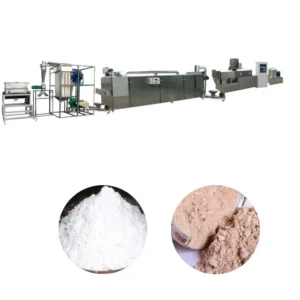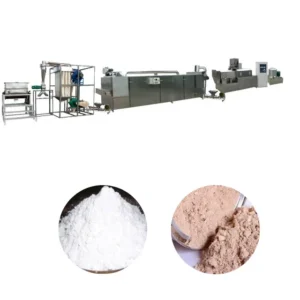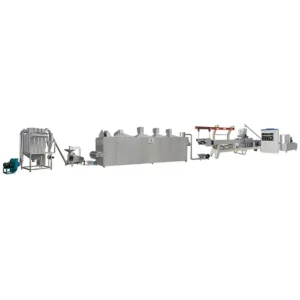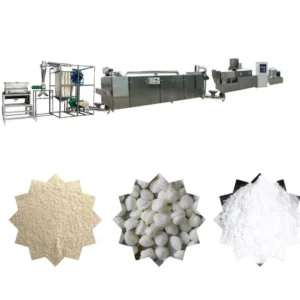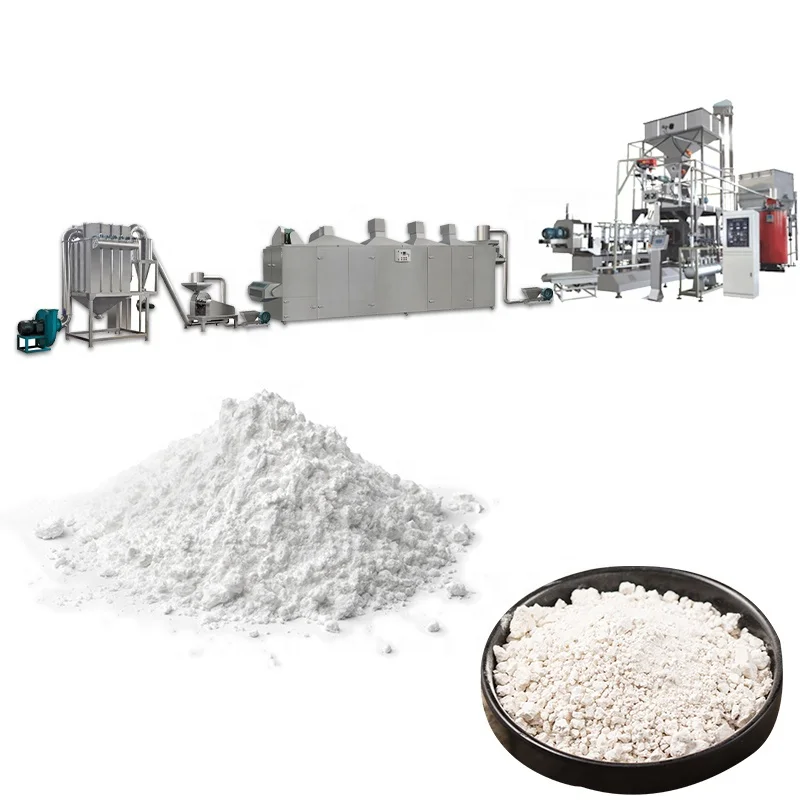
Integrated Line Matching — every station from mixing through packaging is throughput-balanced for your specific starch type, preventing the bottlenecks that occur when extruders and dryers are sourced from separate vendors.
Technical Specifications
| Parameter | Value |
|---|---|
| Product Type | Modified Starch Processing Line |
| Model | MT75 / MT70 / MT70C |
| Installed Power | MT75: 180 kW; MT70: 120 kW; MT70C: 150 kW |
| Power Consumption | MT75: 135 kW; MT70: 120 kW; MT70C: 125 kW |
| Output Capacity | MT75: 200–250 kg/h (basis not stated in source); MT70: 100–150 kg/h (basis not stated in source); MT70C: 250–300 kg/h (basis not stated in source) |
| Overall Dimensions (L×W×H) | MT75: 32000×3500×4300 mm; MT70: 30000×1500×2200 mm; MT70C: 34000×3500×4300 mm |
| Voltage & Frequency | 380 V, 50 Hz, Three Phase |
| Screw Type | Twin-screw extruder |
| Control System | Frequency conversion speed regulation; PLC and MCC available |
| Mixer Capacity & Power | 20–30 kg / 4 kW; 70–80 kg / 7.5 kW; 170–180 kg / 15 kW |
| Mixer Material | Stainless steel 201 or 304 (optional) |
| Dryer Type | Multi-layer mesh belt, double pitch roller chain transmission |
| Grinder | Pulse grinder, 15 kW drive, 100–120 mesh |
| Packaging Machine | Linear structure, automatic pneumatic and electrical operation |
| Assembly State | Complete line: mixing → extrusion → drying → grinding → packaging |
| Standards | CE certified, ISO certified |
Application Suitability
| Application | Material or Output |
|---|---|
| Pregelatinized starch production | Corn starch, maize starch |
| Modified starch for food industry | Cassava starch, tapioca starch, potato starch |
| Denatured starch powder | Oil drilling fluid loss agent base, stable at elevated temperatures |
| Industrial starch derivatives | Water-based drilling fluid additives, non-toxic formulations |
Why Matching Extruder Output to Dryer Capacity Matters on a Modified Starch Processing Line
A line is only as fast as its slowest station, and starch processing exposes every mismatch.
I have watched processors source a twin-screw extruder from one supplier and a dryer from another, only to discover during commissioning that the dryer cannot handle the extruder’s actual discharge rate. Wet starch accumulates on the belt, gelatinisation quality degrades, and the quoted throughput never materialises. On a modified starch processing line full equipment range, every station — mixer, extruder, dryer, grinder, and packaging unit — must be evaluated together before a layout is finalised. [NEED_CITE: throughput matching principles in continuous food processing lines]
How Twin-Screw Extrusion Controls Starch Gelatinisation
The twin-screw extruder applies controlled shear and heat to raw starch, breaking hydrogen bonds within the granule structure and driving gelatinisation. Frequency conversion speed regulation across the feeding, driving, and rotary cutting systems lets operators fine-tune residence time and shear intensity, which directly determines the degree of starch modification. This level of control is what separates consistent pregelatinized starch output from batches with uneven cold-water solubility.
Mesh Belt Drying and Pulse Grinding for Final Powder Quality
After extrusion, the product enters the multi-layer mesh belt dryer where round-trip drying and double pitch roller chain transmission keep material moving without jamming. Dried starch then passes through the pulse grinder, where a 100–120 mesh sieve ensures uniform particle fineness. The integrated dedusting system on the grinder prevents powder loss and maintains workshop air quality — a practical concern that affects both yield and operator safety on any modified starch processing line. [NEED_CITE: industrial dust control standards for starch powder handling]
What the Power Ratings Mean for Your Electrical Infrastructure
The MT75 draws 180 kW installed with approximately 135 kW in operation, while the MT70C reaches 150 kW installed and 125 kW running. These figures determine transformer sizing, dedicated circuit requirements, and whether the local grid can sustain continuous load without voltage drop. The 380 V, 50 Hz, three-phase configuration is standard for the source market, but export installations require voltage and frequency confirmation before production begins. A mixer pulling 4 kW to 15 kW adds to the total connected load, and the pulse grinder’s 15 kW drive motor plus its 1.5 kW air circulating motor must be accounted for in the main panel design.
The Hidden Cost of Generic Screw and Die Configurations
Different starch sources behave differently under heat and shear. Corn starch gelatinises at a different temperature profile than cassava starch, and potato starch has a markedly different viscosity curve. When a screw configuration is copied from a generic build rather than matched to the buyer’s actual raw material, the result is often incomplete gelatinisation, inconsistent expansion, or excessive energy consumption. [NEED_CITE: starch gelatinisation temperature differences across botanical sources]
Why Sourcing the Full Equipment Range Under One Supplier Reduces Risk
Each station on this modified starch processing line is specified so that throughput aligns from batching through packing. The screw configuration and die design are set to the buyer’s raw material and target product, not pulled from a generic catalogue. An in-house testing workshop allows trial runs on customer-supplied starch before shipment, so processing parameters are validated — not guessed at during commissioning. CE and ISO documentation accompanies every line, and voltage, frequency, and control language are confirmed against the target market before production begins. Spare wear parts including screws, dies, and grinder sieves are listed and available from the first replacement cycle onward.
Documentation & Verification
- Screw and die configuration record matched to your starch type and target modification degree
- Trial run report on your raw material demonstrating gelatinisation quality before dispatch
- Electrical schematic confirming voltage, frequency, and control panel language for your market
- CE declaration of conformity and ISO certificate for customs and regulatory compliance
- Wear parts list covering screws, dies, grinder sieves, and mesh belt sections
Installation, Commissioning & Support
- Foundation planning for line footprints up to 34000×3500 mm including dryer and grinder stations
- Dedicated three-phase circuits sized to the installed power rating of the selected model
- Twin-screw barrel and screw assembly on-site with alignment verification before first run
- Frequency conversion parameters set and logged for each starch type during commissioning
- Operator training covering mixer batching ratios, extruder feed rate, and dryer temperature zones
- Spare screws, dies, and 100–120 mesh grinder sieves shipped with initial spare parts package
What to Include in Your Inquiry
Specify the starch type you are processing — corn, cassava, potato, tapioca, or a blend — along with the target modification or gelatinisation specification. Provide your local voltage, frequency, and preferred control panel language. Share your workshop floor dimensions and ceiling height so the line layout can account for the dryer’s multi-layer footprint and the grinder’s dedusting duct routing.
Frequently Asked Questions
Q: How do I match mixer capacity to extruder throughput on a starch line?
A: The available mixer sizes range from 20–30 kg per batch at 4 kW up to 170–180 kg per batch at 15 kW. The correct size depends on the extruder model selected and the batch cycle time needed to sustain continuous feeding. Matching is confirmed during the line layout phase before equipment is built.
Q: Which extruder model suits different starch types and volumes?
A: The MT70, MT70C, and MT75 differ in installed power, overall footprint, and output capacity range. Cassava and potato starches have different gelatinisation behaviours than corn starch, which affects which model and screw configuration deliver stable results. A trial run on your material determines the right fit.
Q: Can the voltage and control language be adapted for international installations?
A: The standard source configuration is 380 V, 50 Hz, three-phase. Voltage and frequency must be confirmed against your local grid before production. PLC and MCC control systems are available, and the control panel language is set to your preference during the specification confirmation stage.
Q: What raw material differences affect the processing line configuration?
A: Corn, cassava, potato, maize, and tapioca starches each have distinct gelatinisation temperatures, viscosity profiles, and moisture absorption rates. These differences directly affect screw configuration, barrel temperature zones, and dryer settings, which is why trial runs on your specific material are standard before shipment.
Q: Are spare wear parts available when the first replacement is needed?
A: Yes. A complete wear parts list is provided with every line, covering twin-screw elements, die plates, grinder sieves, and mesh belt sections. Parts are specified and stocked so replacements are available from the first maintenance cycle onward.