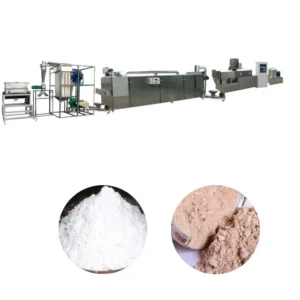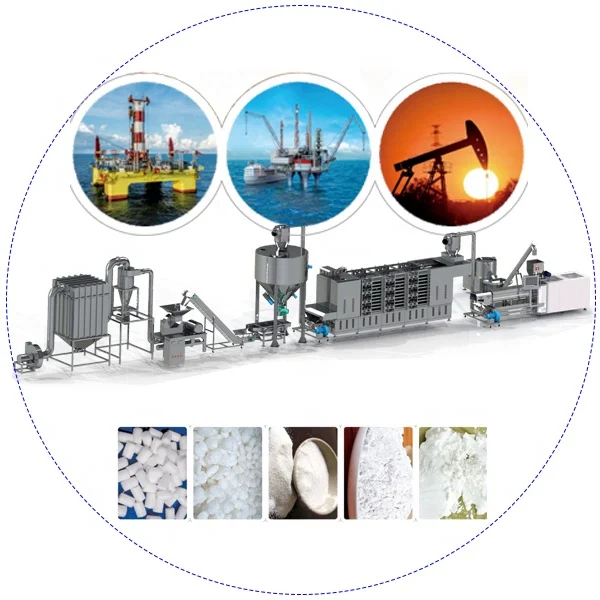
Integrated Line Sizing — every station from the mixer through the dryer is matched to the extruder’s actual throughput so the modified starch processing line full equipment range runs without bottlenecks.
Technical Specifications
| Parameter | Value |
|---|---|
| Model | MT65 / MT70 / MT85 |
| Product Type | Modified Starch Extrusion Processing Line |
| Screw Type | Twin-screw, co-rotating sectional modules |
| Installed Power | MT65 — 72 kW; MT70 — 92 kW; MT85 — 108 kW |
| Power Consumption | MT65 — 50 kW; MT70 — 65 kW; MT85 — 75 kW |
| Output Capacity | MT65 — 140–160 kg/h (basis not stated in source); MT70 — 240–260 kg/h (basis not stated in source); MT85 — 500–600 kg/h (basis not stated in source) |
| Overall Dimensions (L×W×H) | MT65 — 2200×1000×2300 mm; MT70 — 2600×1000×2300 mm; MT85 — 4500×1000×2600 mm |
| Control System | PLC and MCC automated control |
| Barrel & Screw Structure | Modular sectional design |
| Line Stations | Mixer, twin-screw extruder, dryer, conveying, cooling |
| Mixer Features | Stainless steel contact parts, safety interlock switch |
| Dryer Features | Adjustable net belt speed, controllable temperature |
| Standards | CE, ISO certified |
Application Suitability
| Application | Material or Output |
|---|---|
| Pre-gelatinised starch production | Corn starch, cassava starch, tapioca starch |
| Denatured starch for textile sizing | Natural starch sources requiring viscosity modification |
| Modified starch for papermaking | Starch bases requiring specific gelatinisation degrees |
| Industrial starch for building materials | Cassava and corn starch converted for adhesive functions |
| Modified starch for oil drilling fluids | Starch sources processed for thermal stability |
| Starch modification for casting binders | Natural starch requiring denaturation for binding properties |
What Capacity Figures Leave Out in Starch Extrusion
Actual output depends entirely on the raw material source, its initial moisture content, and the target modification degree — not on a generic nameplate rating.
When a starch processor evaluates a modified starch processing line full equipment range, the extruder nameplate often masks the real story. A line rated for corn starch may deliver noticeably less throughput when the feedstock shifts to cassava or tapioca, because gelatinisation temperatures, shear sensitivity, and moisture absorption all change. I have visited sites where the extruder ran at half its rated output simply because the incoming starch moisture was higher than the configuration assumed. That mismatch then forces the dryer to work beyond its design envelope, backing material up on the belt and degrading the final modification degree. [NEED_CITE: relationship between starch source and extrusion throughput]
Screw Module Configuration for Targeted Starch Modification
The twin-screw extruder in this modified starch processing line full equipment range uses co-rotating sectional modules that can be rearranged along the barrel. This adjustability lets the screw profile shift between high-shear zones for aggressive gelatinisation and gentler conveying sections for denaturation without breaking the starch granule structure entirely. Each configuration is recorded against the buyer’s specific raw material so that repeat orders produce consistent modification results across production campaigns.
Dryer Sizing Against Extruder Output
A frequent failure point in starch extrusion projects is an undersized dryer that cannot handle the moisture load the extruder puts into the product. The dryer in this line features an adjustable net belt speed and controllable temperature zones, allowing residence time to be tuned so that the moisture leaving the extruder is reduced to the specification required by downstream packaging or further processing. When belt speed and temperature are correctly matched, the line maintains continuous flow without material accumulating at the dryer inlet. [NEED_CITE: drying residence time requirements for pre-gelatinised starch]
Reading the Power and Dimension Data
The installed power differences across the MT65, MT70, and MT85 reflect not just motor size but the thermal energy needed for barrel heating across the modular sections. Higher installed power on the MT85 supports the additional barrel zones required for longer residence times when processing starches that demand higher gelatinisation temperatures. Overall dimensions scale accordingly, with the MT85 occupying nearly double the length of the MT65 to accommodate the extended barrel and larger dryer footprint. For starch modification, barrel length-to-diameter ratio directly influences the degree of gelatinisation achievable in a single pass.
The Cost of Skipping a Pre-Shipment Trial
When a modified starch line ships without a trial run on the buyer’s actual raw material, commissioning becomes the first real test. I have seen installations where the screw configuration was based on a generic corn starch build, only to discover during startup that the buyer’s cassava starch required a completely different shear profile. The extruder then needs new screw elements flown in while the rest of the line sits idle, and the dryer settings must be recalibrated from scratch because the moisture profile exiting the extruder was never what the original layout assumed. [NEED_CITE: typical commissioning delays from unverified starch extrusion configurations]
Why Source the Full Range from One Supplier
Line throughput depends on every station matching the extruder’s actual output rather than its nameplate figure. Screw and die configurations are specified to the buyer’s starch source and target modification type before production begins. An in-house testing workshop allows trial runs on customer-supplied raw material so that gelatinisation degree and moisture exit are confirmed before the line ships. Electrical schematics and voltage specifications are validated against the buyer’s site standard to avoid commissioning delays. Pre-sales consultation extends through on-site installation, operator training, and ongoing wear parts supply.
Documentation & Verification
- Line layout showing throughput matching between mixer, extruder, dryer and cooling stations
- Screw and die configuration record matched to your starch source and modification target
- Trial run report conducted on your raw material in the testing workshop
- Electrical schematic with voltage and frequency confirmed to your site standard
- Factory test record documenting actual output before dispatch
- Operation and maintenance manual covering screw changeover and dryer belt adjustment
Installation, Commissioning & Support
- Foundation and floor space planning based on the specific model dimensions from MT65 through MT85
- Dedicated electrical circuit sized to the model’s installed power, up to 108 kW for the MT85
- Pre-assembled extruder modules with dryer shipped for on-site connection to utility lines
- First-run parameter setting covering barrel temperature profile and dryer belt speed calibration
- Operator training on screw module changeover for different starch sources and modification targets
- Wear parts inventory covering screw elements, barrel liners, and dryer belt sections
- Scheduled maintenance intervals aligned to PLC control system operating hour counters
Preparing Your Inquiry
To size the line correctly, share your starch source — corn, cassava, tapioca or a blend — along with the incoming moisture content and the target modification type such as pre-gelatinisation or denaturation. Confirm your site voltage, frequency, and preferred control language so that the PLC and MCC panels are configured before production. If you have an existing mixer or downstream packing system, provide its throughput rating so the new stations can be matched to it.
Frequently Asked Questions
Q: How is the output capacity of each model verified before shipment?
A: Each model’s output is verified through a trial run in the in-house testing workshop using the buyer’s actual raw material. The trial confirms throughput at the specific moisture content and modification degree required, rather than relying on a generic nameplate rating that may not reflect your starch source.
Q: Which screw and die configuration suits my specific starch source?
A: Screw elements and die geometry are selected based on your starch type — corn, cassava, or tapioca — and the target modification such as pre-gelatinisation or denaturation. The sectional modular design allows the screw profile to be adjusted during the pre-shipment trial until the correct shear and residence time balance is achieved.
Q: How is dryer capacity matched to the extruder to prevent bottlenecks?
A: Dryer belt length, speed range, and heating zones are calculated against the moisture load the extruder puts into the product at your confirmed throughput. This ensures the dryer can reduce moisture to your target specification without material accumulating at the inlet or requiring a second drying pass.
Q: Can a trial run be performed on my raw material before the line ships?
A: Yes. The in-house testing workshop runs your supplied raw material through the configured extruder and dryer to verify gelatinisation degree, moisture exit, and throughput. The trial run report becomes part of the shipping documentation and serves as the baseline for on-site commissioning parameters.