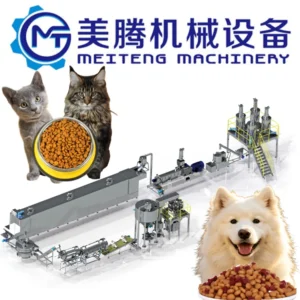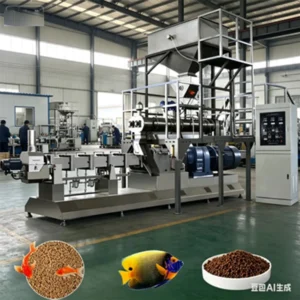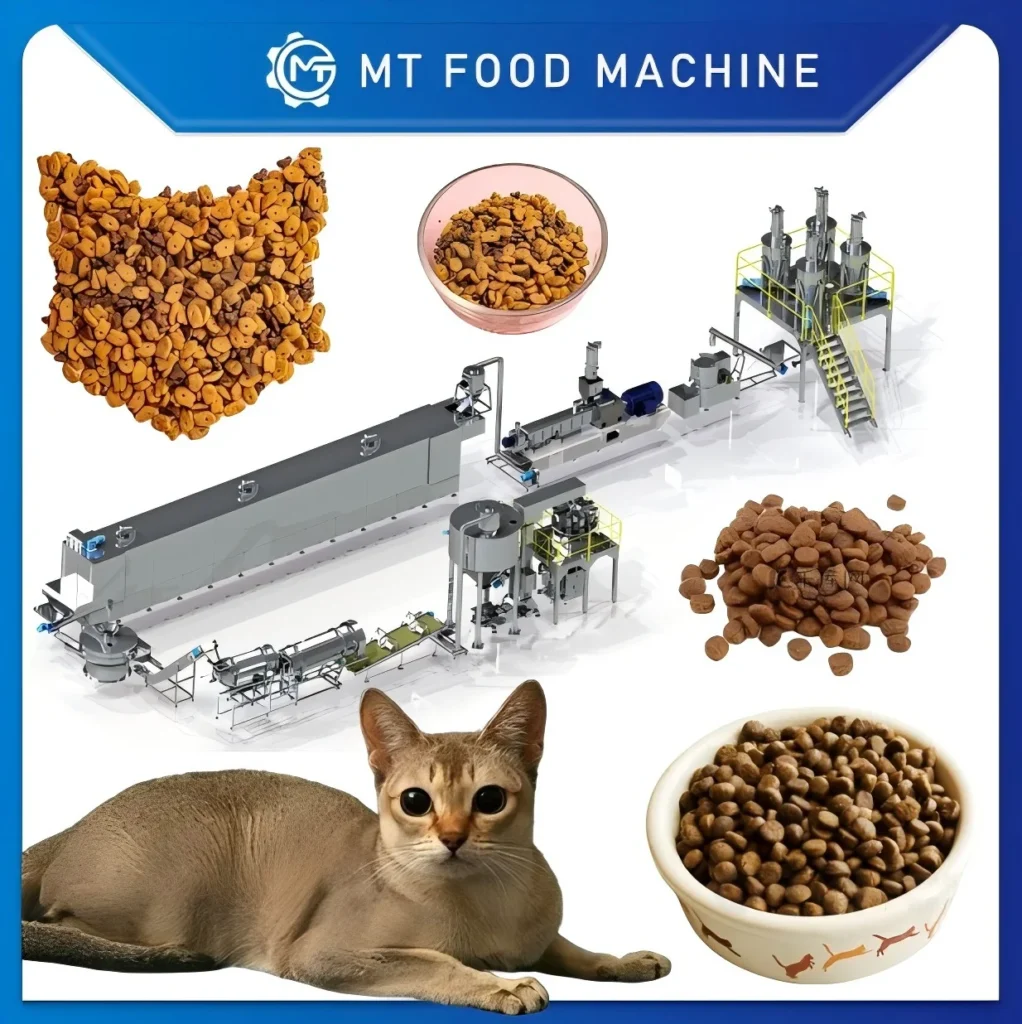
Matching Throughput Across Every Station — The MT-70 line packages mixing, extrusion, drying, coating, cooling, and packing as one coordinated system so no single station bottlenecks the others during continuous dog, cat, or fish food production.
Technical Specifications
| Parameter | Value |
|---|---|
| Model | MT-70 |
| Product Type | Multi-Species Dog Food Processing Line |
| Output Capacity | 200–250 kg/h (basis not stated in source — confirm raw material formulation, moisture content, kibble size and density target) |
| Extruder Type | Twin-screw |
| Control System | PLC Controlled |
| Application Scope | Fish, dog, and cat food production |
| Line Configuration | Complete line from mixing to packing (station list to be confirmed per project) |
| Warranty | 1 year |
| Certification | CE (verify against product-specific certificate) |
Application Suitability
| Application | Material or Output |
|---|---|
| Dry dog kibble production | Corn, meat meal, poultry by-product, grain blends at target moisture and density |
| Dry cat kibble production | High-protein formulations including fish meal and animal fat coatings |
| Floating and sinking aquatic feed | Soybean meal, fish meal, starch binders for catfish, tilapia, and shrimp pellets |
| Multi-species feed runs on one platform | Variable raw material formulations switched through screw and die adjustment |
Why "200–250 kg/h" Means Nothing Without Your Raw Material
Capacity only becomes real when measured against the buyer’s actual formulation, moisture level, and kibble density target.
I once watched a Middle Eastern client receive a line quoted at a nominal throughput, only to discover that his meat meal carried a protein content far above the standard test sample. The extruder ran, but the kibble came out dense and under-expanded. Dogs in his market rejected it within the first field trial. That failure had nothing to do with the machine’s motor or screw speed — it came from quoting a number without anchoring it to the material that would actually run through the barrel [NEED_CITE: raw material variability and extrusion output correlation]. When sourcing a pet food making machine full equipment range, the first question should always be whether the supplier will test your specific recipe before the line ships.
Every Station Sized to the Extruder Output
A common failure in assembled lines is the dryer or coating drum falling behind the extruder, forcing operators to slow the entire process. The MT-70 configuration addresses this by specifying downstream equipment — drying, flavouring, cooling, and packing — to handle the extruder’s peak output continuously. The PLC controlled system coordinates parameter changes across stations so a temperature adjustment in the barrel does not create a backlog at the coating drum.
Multi-Species Flexibility Through Screw and Die Selection
The twin-screw platform allows operators to change screw profile and die geometry between production runs. A kibble formula for adult dogs requiring a specific crunch density uses a different screw arrangement than a high-protein cat food needing greater expansion. Aquatic feed producers switching between floating and sinking pellets adjust the same parameters plus barrel moisture and temperature zones [NEED_CITE: twin-screw configuration adjustment for pellet density control]. This flexibility means one pet food making machine full equipment range can serve several product categories without purchasing a second extruder.
Reading the Specs That Actually Matter
The twin-screw design gives operators control over shear, residence time, and mixing intensity inside the barrel — variables that directly determine starch gelatinisation and final kibble texture. PLC control stores repeatable recipes so batch-to-batch density stays within the range your market expects, rather than drifting as operators manually adjust dials. The stated 200–250 kg/h output must be validated against your raw material’s moisture content and protein level, because high-protein formulations expand less and move through the die differently than starch-heavy mixes. Line station configuration should be confirmed station-by-station: a five-station dryer may be sufficient for standard kibble, but fat-coated premium recipes require extended cooling before packing to prevent condensation inside the bag.
The Cost of Skipping Pre-Shipment Trials
When a line ships without a trial run on the buyer’s raw material, product development begins after installation — on the factory floor, with the buyer’s production schedule on hold. Screw combinations that worked on the supplier’s test sample may produce the wrong texture or density on the buyer’s formulation, leading to weeks of adjustment and wasted raw material [NEED_CITE: post-installation commissioning delays in extrusion lines]. Operators trained on a working product from day one make fewer errors than those learning through trial and error during the first production week.
Why This Line Holds Up in Real Production
Complete station matching under one supplier means throughput calculations account for every transfer point rather than treating the extruder, dryer, and coater as independent purchases. Screw configuration and die design are specified to the buyer’s raw material and target product, not copied from a generic template used across all clients. The in-house testing workshop runs the buyer’s actual formulation before shipment, producing a trial run report that becomes the baseline for commissioning. Pre-sales engineering covers line layout and capacity calculation, while post-installation support includes operator training and a documented wear parts list for screws, dies, and barrel sections.
Documentation & Verification
- Line layout and capacity calculation based on your raw material formulation and target kibble density
- Screw and die configuration record matched to your specific product texture and expansion requirement
- Electrical schematic with voltage, frequency, and PLC control language confirmed for your facility
- Trial run report on your raw material documenting output rate, kibble density, and moisture content
- Operation and maintenance manual covering daily checks, lubrication intervals, and screw replacement procedure
- Wear parts list with part numbers for screws, dies, and barrel sections for reorder planning
Installation, Commissioning & Support
- Floor plan and utility layout provided before foundation work, accounting for the MT-70 footprint and dryer length
- Dedicated electrical circuit specified for the PLC controlled system and main drive motor power requirement
- Line arrives in modular sections for staged assembly, allowing dryer and cooler alignment after extruder positioning
- First production run supervised on-site with parameter logging across barrel temperature zones and screw speed
- Operator training covers recipe storage in the PLC, screw changeover procedure, and daily barrel inspection routine
- Wear parts inventory recommendation based on expected production hours between screw and die replacement cycles
What We Need Before Quoting
Before preparing a line proposal, share your target kibble size, raw material formulation including protein and moisture content, and daily or shift-based production target. Confirm your facility’s voltage, frequency, and preferred PLC control language so the electrical package matches local standards. If you have existing upstream mixers or downstream packing equipment, provide their throughput ratings so the pet food making machine full equipment range can be sized to integrate without bottlenecks. A sample of your raw material allows us to run a trial in the testing workshop and anchor the capacity figure to your actual recipe.
Frequently Asked Questions
Q: How do I verify the 200–250 kg/h capacity against my raw material?
A: Request a trial run using your actual formulation in the supplier’s testing workshop. The resulting report documents real output rate, kibble density, and moisture content at the die exit. Compare those figures against your daily production target and market specification before confirming the order.
Q: Which supporting stations are matched to the MT-70 extruder throughput?
A: The line includes mixing, conveying, drying, flavouring, cooling, and packing stations sized to handle the extruder’s peak output without bottlenecking. Each station’s capacity is calculated against your specific kibble size and coating requirement rather than selected from a standard catalogue.
Q: How are voltage, frequency, and control language confirmed before shipment?
A: During the specification confirmation stage, the electrical schematic is reviewed with the buyer to verify local voltage and frequency. The PLC control interface language is set to match the operator team. Both items are documented in the electrical schematic delivered before the line ships.
Q: How is screw and die configuration selected for different kibble textures?
A: The screw profile and die geometry are chosen based on your raw material’s protein content, starch level, and target kibble density. High-protein formulations typically require different shear and residence time settings than starch-heavy recipes, and the twin-screw platform allows adjustment between runs.