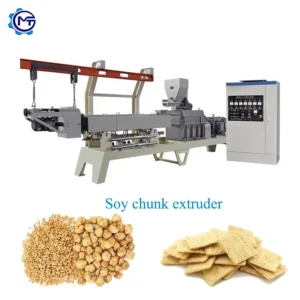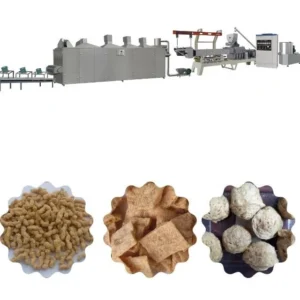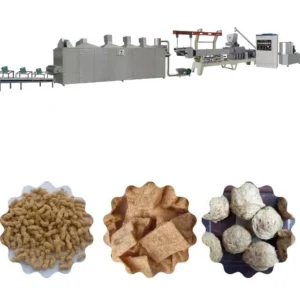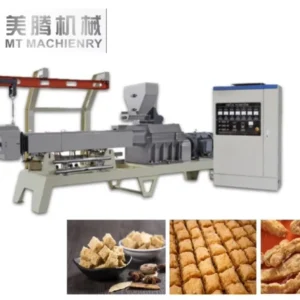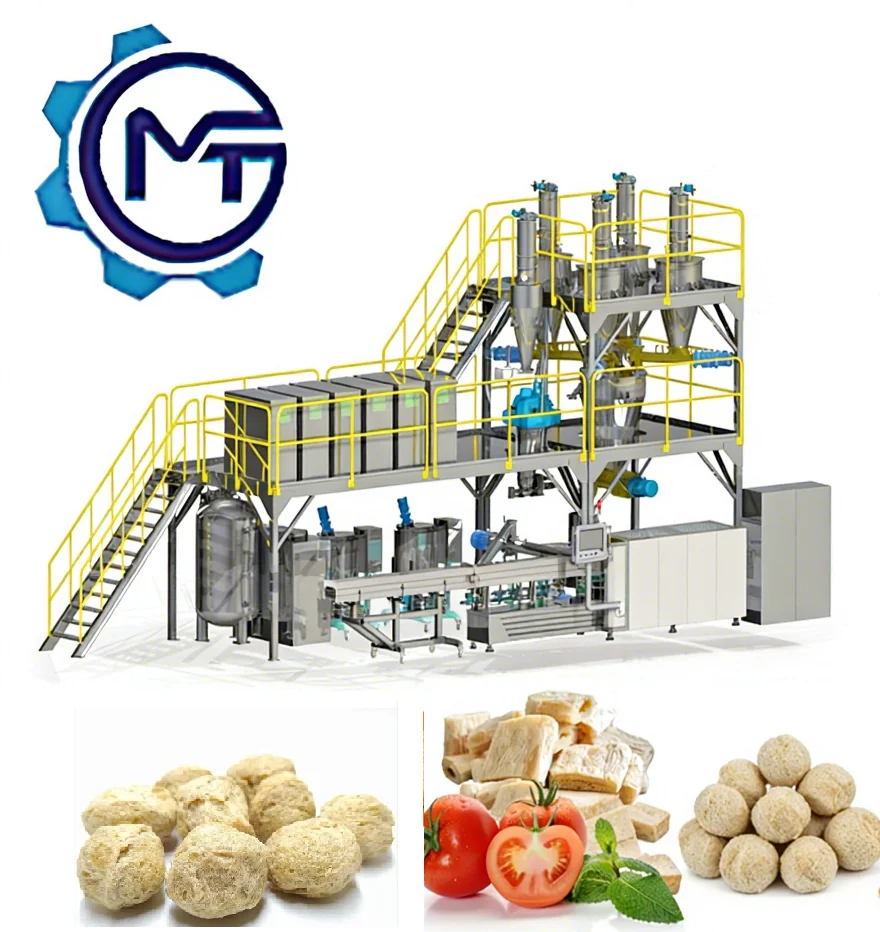
Station-by-Station Matching — throughput across every TSP/TVP processing stage is calculated against the buyer’s raw material formulation, not quoted from a generic catalog.
Technical Specifications
| Parameter | Value |
|---|---|
| Product Type | Textured Soy Protein (TSP/TVP) Extrusion Line |
| Model Options | MT65, MT70, MT75, MT85 |
| Screw Configuration | Twin Screw |
| Output Capacity (MT65) | 100-150 kg/h (basis not stated in source — confirm raw material formulation / moisture content) |
| Output Capacity (MT70) | 150-200 kg/h (basis not stated in source — confirm raw material formulation / moisture content) |
| Output Capacity (MT75) | 150-200 kg/h (basis not stated in source — confirm raw material formulation / moisture content) |
| Output Capacity (MT85) | 250-300 kg/h (basis not stated in source — confirm raw material formulation / moisture content) |
| Installed Power (MT65 / MT70 / MT75 / MT85) | 84 kW / 160 kW / 190 kW / 210 kW |
| Power Consumption (MT65 / MT70 / MT75 / MT85) | 59 kW / 120 kW / 140 kW / 140 kW |
| Overall Dimensions (L×W×H, MT65 to MT85) | 40000–45000 × 1200–1500 × 2200–3500 mm |
| Main Motor Power (Extruder) | 22 kW / 30 kW / 45 kW |
| Screw Length Options | 1050 mm / 1520 mm |
| Mixer Type | Vertical, stainless steel 304 mixing ruler |
| Mixer Capacity Options | 20-30 kg / 70-80 kg / 170-180 kg |
| Mixer Power Options | 4 kW / 7.5 kW / 15 kW |
| Dryer Drive | Double pitch roller chain drive, round-trip drying |
| Dryer Energy Options | Fuel / Gas / Electricity (buyer configurable) |
| Dryer Temperature & Time | Adjustable |
| Line Sequence | Mixer → Screw Conveyor → Twin Screw Extruder → Air Conveyor → Multi-layer Dryer → Cooling Machine |
| Assembly & Testing | Complete line, factory tested before shipment |
| Delivery Lead Time | 15-35 working days after deposit |
| Certification | CE (corporate level; confirm per-line declaration) |
Application Suitability
| Application | Material or Output |
|---|---|
| Textured soy protein (TSP/TVP) production | Defatted soy flour, low-temperature soy flakes |
| Soy chunk and soy nugget manufacturing | Soy protein concentrate with variable moisture profiles |
| Meat analogue and plant-based meat products | Soy-based formulations requiring fibrous texture |
| Vegetarian and vegan snack processing | High-protein dough from soy and cereal blends |
| Breakfast cereal and puffed snack production | Adjusted screw configuration and die setup for cereal grains |
Why Dryer Capacity Can Silently Bottleneck Your Textured Soy Protein Extrusion Line
Matching the dryer to the extruder output prevents the most common hidden constraint in TSP processing.
Buyers often focus on extruder capacity and overlook the drying stage. When a multi-layer dryer cannot remove moisture fast enough, the product downstream is either too wet to cool properly or gets held back in batches, dragging the entire line below its expected throughput. I have reviewed setups where the extruder ran comfortably, but operators had to stop and wait for the dryer to catch up, losing productive hours every shift [NEED_CITE: throughput matching across extrusion and drying stations].
Sizing the Textured Soy Protein Extrusion Line full equipment range against your actual soy flour formulation and target moisture drop ensures every station holds pace from the mixer through to the cooling machine.
From Batch Infeed to Finished Chunks
A TSP line begins with the vertical mixer, where defatted soy flour and any minor ingredients are blended into a uniform feed. The stainless steel 304 mixing ruler handles high-protein formulations without contaminating the batch, and the three capacity tiers (20-30 kg, 70-80 kg, 170-180 kg) let you match batch size to the extruder model you select.
The screw conveyor then meters this blend into the twin-screw extruder at a controlled rate. Consistent infeed is what keeps the barrel fill stable and the protein structuring uniform across every run.
Extrusion Mechanics for Soy Protein Structuring
Inside the twin-screw extruder, the combination of shear, heat, and pressure denatures the soy protein and re-aligns it into a fibrous matrix. The screw length options (1050 mm and 1520 mm) give different residence times — the longer configuration provides extended conditioning for high-procentage soy concentrates that need more dwell time to fully texturize [NEED_CITE: twin-screw extrusion mechanics for plant protein structuring].
Die selection at the discharge end determines the shape and density of the extrudate, whether you are running soy chunks, nuggets, or granular TVP.
Reading the Specs That Actually Matter
The installed power figures across the four models — from 84 kW on the MT65 up to 210 kW on the MT85 — reflect not just motor size but the total thermal and mechanical load, including barrel heating zones. Actual consumption sits lower (59 kW to 140 kW), so your electrical supply must be sized for the installed figure, not the running average.
Motor options on the extruder (22 kW, 30 kW, 45 kW) correspond to the torque demand of different screw configurations. A formulation with higher protein density requires the upper motor tier to maintain screw speed under load without stalling. The multi-layer dryer’s round-trip chain drive and adjustable temperature and time settings must then be dialed to remove the specific moisture differential your recipe introduces.
What Happens When Stations Are Mismatched
An undersized air conveyor fails to carry extrudate to the dryer fast enough, causing material to pile up at the die face and requiring frequent line stops. An incorrectly configured dryer — wrong energy source or insufficient belt length — leaves product above target moisture, leading to spoilage in storage or rejection at packing. These problems rarely appear in factory trials because trials often run at reduced rates [NEED_CITE: common line bottleneck causes in food extrusion].
I have walked into plants where operators accepted slow output as normal, not realizing the bottleneck was a single undersized station that could have been corrected before the line shipped.
Procurement Advantages for This Equipment Range
Every station in the Textured Soy Protein Extrusion Line full equipment range is sourced and matched under one supplier, so throughput calculations account for the actual interaction between the mixer batch cycle, extruder output, dryer belt speed, and cooling capacity.
Screw and die configuration is specified to the buyer’s raw material — not copied from a generic build — ensuring the protein fiber structure meets your target product specification. An in-house testing workshop allows trial runs on your actual defatted soy flour or soy flakes before shipment, confirming output and texture against agreed parameters.
Pre-sales consultation covers line layout and utility planning, with on-site installation, commissioning, operator training, and ongoing wear parts support included in the project scope.
Documentation & Verification
- Line layout and capacity calculation matching every station to your target throughput
- Machine specification sheet for each station in the TSP line
- Screw and die configuration record matched to your soy flour formulation
- Trial run report on your raw material before dispatch
- Electrical schematic with voltage and frequency confirmation for your market
- CE declaration of conformity documentation package
Installation, Commissioning & Support
- Floor plan review based on the MT85 footprint of 45000×1500×3500 mm for utility routing
- Dedicated electrical circuit sized to the selected model’s installed power up to 210 kW
- Factory-assembled stations shipped for on-site sequential line installation
- Commissioning with screw speed, barrel temperature, and dryer time dialed to your recipe
- Operator training on die changes, mixer batch cycles, and dryer temperature adjustment
- Wear parts list covering screws, dies, and mixer rulers with recommended reorder intervals
Preparing Your Inquiry
Share your raw material specification — soy flour protein content, moisture level, and any additive ratios — along with your target daily output and product format (chunks, nuggets, granules). Confirm your workshop voltage, frequency, and preferred control language, plus whether gas, electric, or fuel heating suits your dryer. If you can send a sample of your soy flour, a trial run in the testing workshop gives both sides a data-backed baseline before commitment.
Frequently Asked Questions
Q: How do I match throughput between the extruder, dryer, and cooling machine?
A: Throughput matching starts with your raw material moisture content and the target moisture after drying. The extruder output determines the dryer belt speed and residence time needed, and the cooling machine must then handle that same mass flow. Requesting a capacity calculation based on your specific formulation ensures every station is sized correctly before the line is built.
Q: What is the difference between MT65, MT70, MT75 and MT85?
A: The four models differ in installed power, motor capacity, overall dimensions, and output range. The MT65 suits smaller batches and lower power supplies, while the MT85 handles higher-volume production with a larger footprint. Choosing between them depends on your daily production target, available workshop space, and the electrical infrastructure at your facility.
Q: Can the dryer be configured for my local energy source?
A: Yes. The multi-layer dryer is available with fuel, gas, or electric heating, selected to match what is most practical and cost-effective at your site. The round-trip chain drive and adjustable temperature settings work the same across all three energy options, so product quality is not compromised by the heating method chosen.
Q: Which mixer capacity pairs correctly with each extruder model?
A: The vertical mixer comes in three capacity tiers: 20-30 kg, 70-80 kg, and 170-180 kg. Smaller extruder models like the MT65 typically pair with the 20-30 kg or 70-80 kg mixer, while the MT75 and MT85 require the 170-180 kg tier to sustain continuous feed. The correct pairing prevents the mixer from becoming the rate-limiting step.
Q: Do you supply individual stations or only complete lines?
A: Individual stations — mixers, twin-screw extruders, multi-layer dryers, cooling machines — can be specified separately for phased installations or line upgrades. However, matching throughput across stations is more straightforward when the full sequence is configured together, as each unit’s capacity is then calculated against the others in the chain.