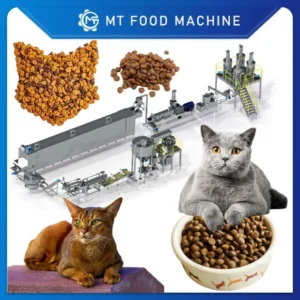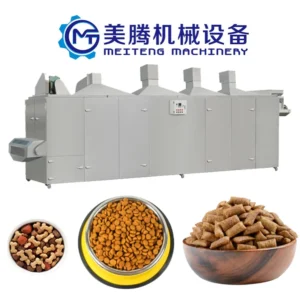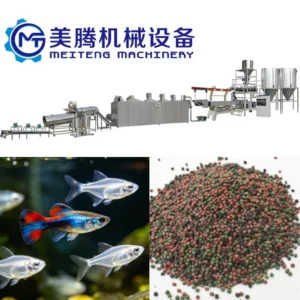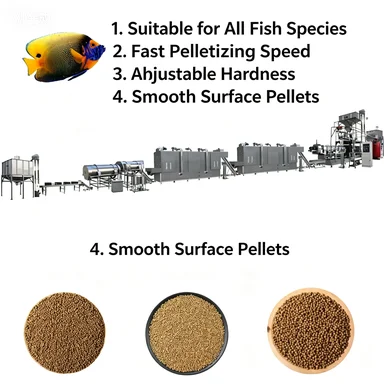
Integrated Line Stations — Every station from feeding through pelletizing is matched for throughput so no single unit bottlenecks the twin screw aquatic feed extruder full equipment range you are surveying.
Technical Specifications
| Parameter | Value |
|---|---|
| Product Type | Twin Screw Aquatic Feed Extrusion Production Line |
| Output Capacity | 500 kg/h (basis not stated in source — confirm raw material formulation, moisture content, pellet size) |
| Screw Type | Twin screw |
| Pellet Size Range | 0.5 mm – 12 mm (adjustable die) |
| Control System | PLC |
| Production Mode | Fully automatic, continuous operation |
| Main Structure Material | Stainless steel (food-grade contact parts) |
| Line Stations Integrated | Feeding, mixing, extruding, pelletizing |
| Product Types Supported | Floating and sinking aquatic feed pellets |
| Certifications | CE, ISO |
Application Suitability
| Application | Material or Output |
|---|---|
| Floating feed for catfish and tilapia | Starch-based formulations with protein meal, extruded at high moisture for low-density pellets |
| Sinking feed for shrimp and bottom-feeding species | High-protein formulations with controlled gelatinisation for dense, water-stable pellets |
| Juvenile fish starter feed | Fine particle formulations producing 0.5 mm – 2 mm micro pellets |
| Grow-out and broodstock feed | Coarse formulations with lipid and vitamin premixes, pelletized at 6 mm – 12 mm |
Why Extruder Capacity Means Nothing Without Downstream Matching
A twin screw aquatic feed extruder full equipment range is only as reliable as its weakest downstream station.
I once watched a feed plant in the Emirates lose an entire shift because the extruder pushed out wet pellets faster than the dryer could handle them. Material piled up on the conveyor, cooled unevenly, and had to be scrapped. The extruder itself was running perfectly — the problem was that nobody had checked whether the dryer and cooler were rated for the same throughput. When you survey a twin screw aquatic feed extruder full equipment range, the first question should never be about the extruder alone [NEED_CITE: line throughput matching principles in continuous feed manufacturing].
Every Station in the Catalogue and Where It Fits
The feeding station meters raw material into the mixer at a controlled rate, setting the pace for everything downstream. The mixer blends dry ingredients and preconditions moisture before the material enters the extruder barrel. The twin screw extrusion unit then applies shear, heat, and pressure to gelatinise starch and form the pellet matrix. After extrusion, the pelletizing station cuts the extrudate to the target length. Understanding this sequence is essential when you evaluate a twin screw aquatic feed extruder full equipment range, because each station must be capable of handling the volume the extruder produces.
How Wet Extrusion Changes the Station Balance
Wet extrusion introduces steam or water injection directly into the barrel, which raises the moisture content of the extrudate significantly compared to dry processing. That extra moisture must be removed downstream, placing heavier demands on drying and cooling capacity. A line configured for dry extrusion may not cope if the buyer later switches to a wet formulation for higher-value floating pellets. The PLC control system helps here — it allows operators to adjust barrel temperature profiles and screw speed in real time, maintaining consistent expansion across different moisture levels [NEED_CITE: wet versus dry extrusion moisture management in aquatic feed production].
Reading the Specs That Actually Matter
The twin-screw configuration gives this line an advantage in processing diverse raw materials — from high-starch grain blends for floating feed to high-protein fish meal formulations for sinking pellets. The adjustable die supports pellet sizes from 0.5 mm to 12 mm, covering juvenile starter feed through grow-out rations without requiring a separate machine. The stainless steel construction on food-grade contact parts resists corrosion from the high-moisture, high-salt formulations typical in aquatic feed, and it simplifies washdown between product changeovers. The PLC control system ties all integrated stations together, so speed adjustments at the extruder automatically propagate downstream rather than requiring manual recalibration at each unit.
The Hidden Cost of Skipping Station Verification
When a buyer orders an extruder based on nameplate capacity without verifying that the dryer, cooler, and pelletizer can keep pace, the result is a line that runs at a fraction of its paid-for output. Wet pellets accumulate, block conveyors, and degrade in quality before they ever reach the packing station. I have seen this pattern repeat across aquaculture feed projects in the Gulf region — the capital was spent, the floor space was allocated, but the line never reached its designed throughput because one station was undersized [NEED_CITE: bottleneck analysis in integrated feed processing lines]. The fix always costs more than specifying matched capacity from the start.
Why Source the Full Range From One Supplier
Sourcing every station from Meiteng means throughput calculations are performed across the entire line, not just at the extruder. Screw configuration and die design are specified against your actual raw material and target pellet density, rather than copied from a generic build. The in-house testing workshop runs trial production on your formulation before shipment, so you see real pellet samples rather than theoretical outputs. PLC and MCC control systems are programmed together, ensuring communication between stations works on day one. Pre-sales engineering covers layout planning, utility requirements, and installation sequencing so that the twin screw aquatic feed extruder full equipment range arrives as a coordinated system.
Documentation & Verification
- Line layout drawing showing station spacing and throughput matching for your target pellet size
- Screw and die configuration record matched to your raw material formulation
- Electrical schematic with voltage and frequency confirmed for your facility
- Trial run report on your aquatic feed formulation from the testing workshop
- CE declaration of conformity and ISO certificate for export compliance
- Operation and maintenance manual with PLC parameter reference tables
Installation, Commissioning & Support
- Foundation layout provided based on the integrated line footprint and station weights
- Power distribution plan specifying dedicated circuits for the PLC-controlled extruder motor
- Stations shipped in matched modules for sequential assembly on your factory floor
- First-run parameter setting covering barrel temperature zones, screw speed, and die pressure
- Operator training on PLC interface navigation and alarm response for continuous production
- Wear parts list covering screws, dies, and barrel liners with recommended replacement intervals
What to Share Before Requesting a Quotation
To size a twin screw aquatic feed extruder full equipment range correctly, start by providing your target pellet types — floating, sinking, or both — along with the raw material formulation you plan to run. Share your daily or hourly production target, your facility voltage and frequency, and the control language your operators need. If you have existing upstream milling or downstream packing equipment, include those specifications so the new line can be integrated without gaps.
Frequently Asked Questions
Q: What is the difference between each station in a complete aquatic feed extrusion line and how do they connect?
A: The feeding station meters raw material, the mixer blends and preconditions it, the twin screw extruder gelatinises and forms the pellet matrix, and the pelletizer cuts extrudate to length. Each station’s capacity must match the extruder output so material flows continuously without accumulation or starvation at any point.
Q: How do I choose between single-screw and twin-screw extruders for floating versus sinking feed pellets?
A: Twin-screw extruders handle a wider range of raw materials and moisture levels, making them suitable for both floating and sinking formulations. Single-screw units are simpler but may struggle with high-fat or high-protein mixes. The choice depends on your formulation diversity and the pellet density your market requires.
Q: What specifications should I compare when surveying extruders before specifying a production line?
A: Focus on screw diameter, L:D ratio, barrel zone count, die configuration options, and control system type. Verify that the rated capacity is stated with a specific raw material basis. Confirm voltage, frequency, and PLC language match your facility to avoid commissioning delays.
Q: How are screw configuration and die design matched to different aquatic feed raw materials?
A: Screw element arrangement controls shear intensity and residence time, which determine starch gelatinisation and protein denaturation. Die geometry sets pellet shape and expansion ratio. Both are adjusted based on your raw material composition and whether you need low-density floating pellets or high-density sinking pellets.
Q: What supporting equipment is needed to avoid line bottlenecks?
A: Beyond the extruder and pelletizer, you need a dryer sized for the moisture load of wet extrusion, a cooler to stabilise pellet temperature before packing, and optionally a coating drum for lipid or flavour application. Each unit must be rated for the same throughput as the extruder to prevent bottlenecks.