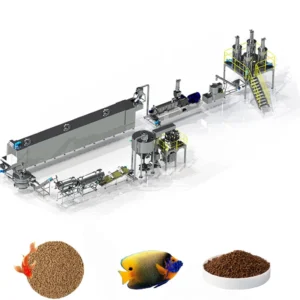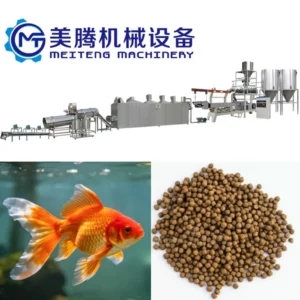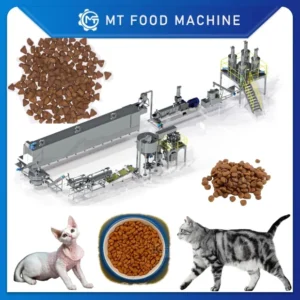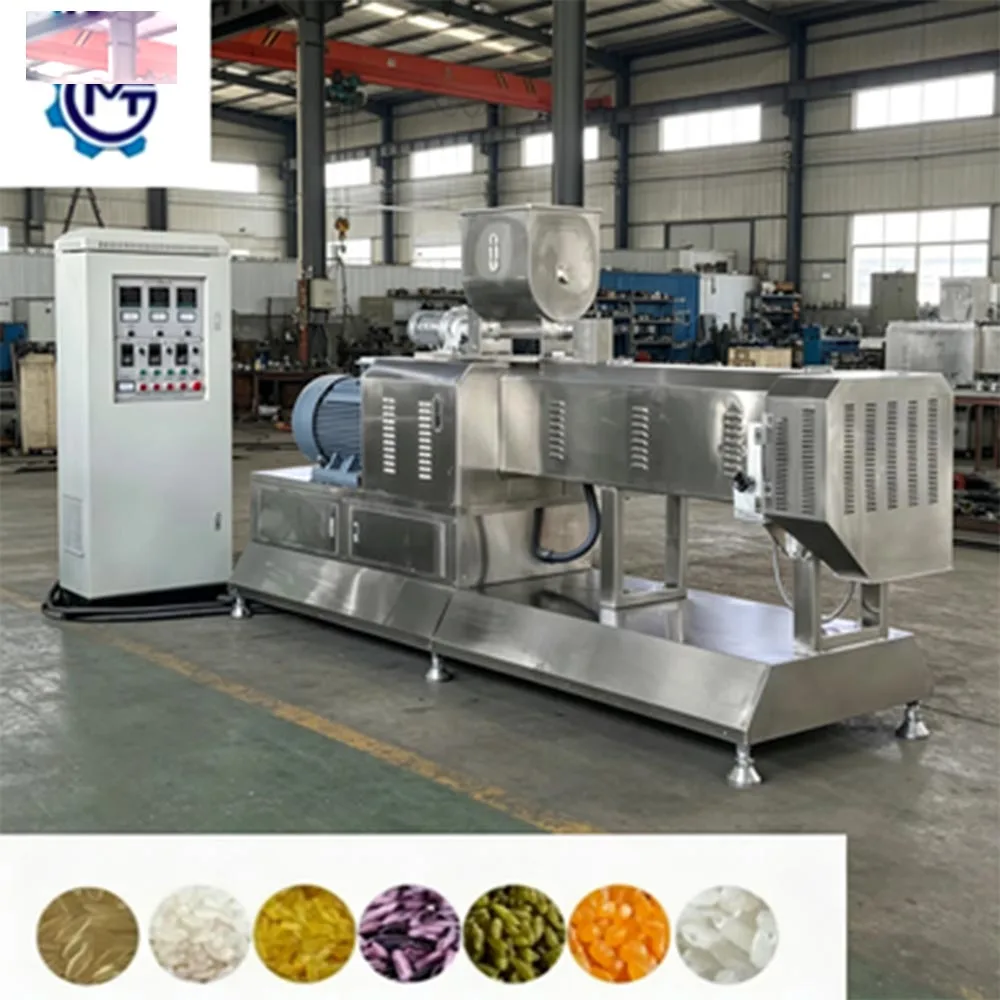
Station-by-station throughput matching — Every unit from the raw material mixer through the drying and seasoning coating stages is sized to the twin screw extruder’s actual output, so no single node restricts the line’s continuous flow.
Technical Specifications
| Parameter | Value |
|---|---|
| Product Type | Twin Screw Fish Feed Extruder Production Line |
| Extruder Type | Twin screw |
| Control System | Intelligent PLC automatic control |
| Machine Body Material | Food-grade 304 stainless steel |
| Material Contact Parts | Food-grade 304 stainless steel |
| Pellet Adjustability | Size, hardness, buoyancy (floating and sinking) |
| Line Stations | Raw material mixer, extruder, dryer, seasoning coating machine, vibrating sieve, conveyor equipment |
| Operation Mode | Full continuous automatic production |
| Output Capacity | (basis to be confirmed — depends on raw material formulation, pellet size, and moisture content) |
| Screw Diameter | (basis to be confirmed) |
| L:D Ratio | (basis to be confirmed) |
| Rated Power | (basis to be confirmed) |
| Voltage & Frequency | (basis to be confirmed — configurable to target market) |
| Certifications | CE / ISO (status to be confirmed with manufacturer) |
Application Suitability
| Application | Material or Output |
|---|---|
| Koi and goldfish feed production | Fish meal, soybean meal, corn powder, compound additives |
| Tropical fish pellet manufacturing | Blended starch and protein formulations for slow-sinking pellets |
| Freshwater aquaculture feed | Compound feed for catfish, tilapia, and carp using local grain and meal sources |
| Floating aquatic feed extrusion | High-starch formulations requiring maximum expansion at the die face |
| Sinking aquatic feed extrusion | Dense, high-protein formulations requiring controlled compression and minimal expansion |
Why Matching Dryer Capacity to the Extruder Matters More Than You Think
The bottleneck almost never appears in the brochure — it shows up on the factory floor when the extruder outpaces every downstream station.
I once watched an aquaculture feed line stall because the buyer ordered a sinking fish feed extruder rated for a certain hourly throughput without confirming the dryer’s evaporation capacity. The extruder pushed material faster than the dryer could remove moisture, and wet pellets piled up on the conveyor, deforming under their own weight. Three weeks of downtime followed while a second dryer was sourced and installed. When evaluating any twin screw fish feed extruder complete equipment range, the capacity figure on the extruder nameplate means little unless the dryer, coating drum, and screening stations are each confirmed to handle that same volume on your specific formulation. [NEED_CITE: industrial drying capacity calculations for extruded aquatic feed]
How Each Station Connects in a Continuous Flow
A twin screw fish feed extruder complete equipment range starts well before the extrusion barrel. The raw material mixer must deliver a homogeneous blend at the exact moisture level the screw configuration expects; uneven hydration causes density variation that no downstream station can correct. Material then moves via conveyor into the extruder, where twin-screw shear and barrel temperature zones gelatinise starch and condition the protein matrix. From the die face, pellets enter the dryer, where residence time and air temperature determine final moisture and buoyancy characteristics.
The Role of the Coating and Screening Stages
After drying, pellets pass through the seasoning coating machine, where fat or flavour slurry is applied in a rotating drum. The coating drum’s volume and rotational speed must match the dryer’s discharge rate; an undersized drum causes pellet backlog, while an oversized one leaves product tumbling too long and breaking apart. The vibrating sieve then separates on-spec pellets from fines and oversize fragments before the finished product moves to packing. Every station in this twin screw fish feed extruder complete equipment range must be reviewed as a connected chain rather than a list of independent machines. [NEED_CITE: throughput balancing methodology in continuous food processing lines]
Reading the Specs That Actually Affect Pellet Quality
The twin-screw configuration gives processors control over shear intensity and residence time, two variables that directly shape pellet density. A higher L:D ratio extends the barrel’s processing length, allowing more gradual temperature ramping for formulations sensitive to thermal shock — important when working with high-fat fish meal blends that can scorch under aggressive heat profiles. The screw diameter determines the volume of material each flight can carry per revolution, which sets the baseline throughput before the die restricts flow. Die geometry — hole diameter, land length, and pattern — governs expansion at the moment the pellet exits the pressurised barrel. Moisture content entering the extruder interacts with barrel zone temperatures to define the degree of starch gelatinisation; too little moisture and the pellet emerges dense and brittle, too much and it collapses after cooling. The PLC control system ties these variables together, allowing operators to store and recall temperature and speed profiles for each formulation, which matters when a single line produces both floating and sinking pellets on different shifts.
What Happens When Stations Are Sized Independently
Buyers who source the extruder from one supplier and the dryer from another often discover the mismatch only during commissioning. The extruder’s hourly output may be achievable in isolation, but if the dryer’s belt length and airflow cannot extract enough moisture within the available residence time, pellets leave the line above the safe storage threshold — inviting mould growth in the warehouse. An undersized coating drum forces operators to reduce the extruder’s feed rate, leaving capacity unused and extending shift hours to meet daily tonnage targets. These are not theoretical risks; they are the most common reasons a newly installed aquatic feed line fails to reach its quoted output within the first month of operation. [NEED_CITE: post-installation throughput shortfalls in extruded feed production]
Why Buyers Review This Equipment Range Before Committing
The complete line approach means throughput calculations are performed across every station before any unit is built, not after individual machines arrive on site. Screw and die configurations are specified against the buyer’s actual raw material formulation and target pellet buoyancy, not pulled from a generic build. Food-grade 304 stainless steel is used across the machine body and all material contact parts, reducing corrosion risk from the salt and fat content common in aquatic feed ingredients. The intelligent PLC control system supports continuous production from mixing through screening, with programmable recipes so operators can switch between floating and sinking formulations without manual recalibration. An in-house testing workshop allows trial runs on the buyer’s raw material before shipment, so screw speed, barrel temperature, and die selection are validated — not guessed — before the line is crated. [NEED_CITE: CE machinery directive compliance for extrusion processing equipment]
Documentation & Verification
- Line layout drawing showing station-by-station throughput calculations for your target pellet size
- Screw and die configuration record matched to your raw material formulation and buoyancy requirement
- Electrical schematic with voltage and frequency confirmed for your facility’s supply
- Factory trial run report on your raw material before dispatch
- Operation and maintenance manual covering every station in the line
- Wear parts list identifying screws, dies, seals, and screening meshes by part number
Installation, Commissioning & Support
- Foundation and floor loading plan based on the full line’s weight distribution and vibration points
- Dedicated electrical circuit specification matching the PLC-controlled extruder and dryer motor loads
- Station-by-station assembly sequence with conveyor alignment checkpoints
- First-run parameter setting for barrel zone temperatures and screw speed on your formulation
- Operator training covering recipe recall, die changes, and daily sanitation procedures
- Spare screw elements, die plates, and seal kits catalogued and shipped with the initial order
What to Prepare Before Requesting a Quotation
To configure a line that matches your actual production conditions, share your target pellet species and size range, the raw material formulation you intend to run, and the daily tonnage your facility needs to sustain. Confirm your local voltage, frequency, and any PLC language requirements for your operators. If you have existing upstream milling or downstream packing equipment, provide its capacity so the new line can be integrated without creating a new bottleneck upstream or downstream.
Frequently Asked Questions
Q: How is the capacity of each station matched to prevent bottlenecks across the full line?
A: Throughput is calculated station by station based on your formulation’s moisture content and pellet size. The mixer batch cycle, extruder screw speed, dryer belt speed, and coating drum volume are each sized so material flows continuously without accumulation or starvation at any transfer point.
Q: What screw diameter and barrel configuration is available for different aquatic feed formulations?
A: Screw diameter, L:D ratio, and barrel zone count are selected according to your raw material’s fat, starch, and protein ratios. High-protein sinking feeds typically require a longer barrel with gentler shear, while high-starch floating feeds benefit from aggressive mixing zones near the die.
Q: Which voltage and frequency options are supported for the PLC control system?
A: The electrical system is configured to your facility’s supply before production. Voltage, frequency, and PLC interface language are confirmed during the specification stage so the control panel is ready for your operators upon commissioning.
Q: How do the dryer and coating stations differ between floating and sinking pellet production?
A: Floating pellets exit the extruder at higher moisture and require a longer dryer residence time to reach safe storage levels. Sinking pellets are denser and may need a slower coating drum speed to prevent surface damage during fat application.
Q: How are spare wear parts catalogued and supplied for each station?
A: Every screw element, die plate, seal, and screen mesh is listed by part number in the wear parts documentation shipped with the line. Replacement components can be ordered individually, and the initial shipment typically includes a first-service spare kit.