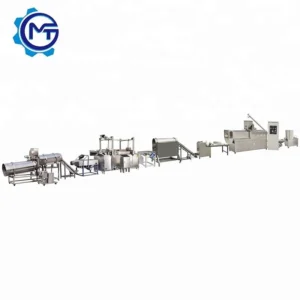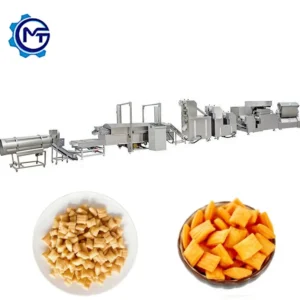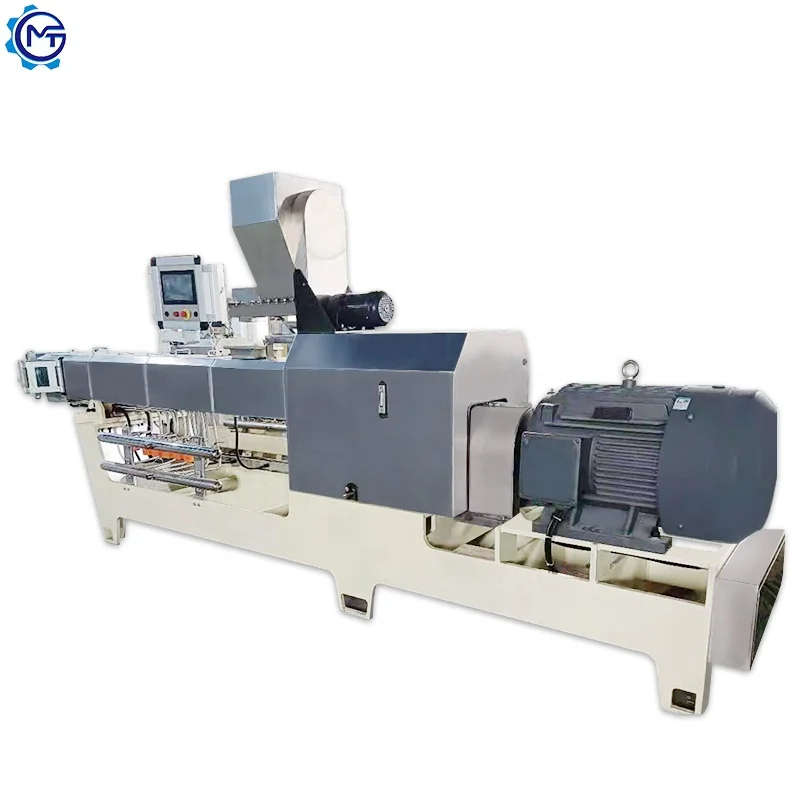
Matched Throughput Across Every Station — Each fryer, flavoring drum, and extruder in this frying chips making machine lineup is sized against the others so the line runs without bottlenecks or product pile-ups.
Technical Specifications
| Parameter | Value |
|---|---|
| Product Type | Twin Screw Extruder Corn Flour Puff Snack Nacho Chips Tortilla Doritos Making Machine |
| Available Models | MT65 / MT70 / MT70c / MT75 |
| Screw Type | Twin screw |
| Screw Material | Alloy (38CrMoAl), nitriding process |
| Main Motor | Siemens brand |
| Feeding System | Food grade stainless steel twin screw feeding machine |
| Control System | Speed adjusted converter on feeding, extrusion, and cutting systems |
| Gearbox | Automatic lubrication function |
| Cooling | Increased radiator on driving part for forced cooling |
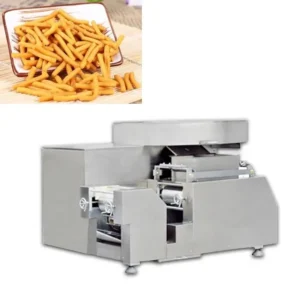
| Cutting System | Cutting knife fixed in die head seat, rotary cutting by V-belt drive |
| Die Configuration | High pressure double crank to control die opening and closing |
| Self-Cleaning | Self-cleaning screw and barrel |
| Frying System | Fully automatic fryer with electric, diesel, or gas energy options |
| Flavoring System | Double drums flavoring system with powder hopper, conveyor, and sprayer |
| Assembly State | Complete production line (extruder, fryer, flavoring system) |
| Warranty | One year from equipment arrival at customer’s site |
| Standards | CE, ISO |
Application Suitability
| Application | Material or Output |
|---|---|
| Nacho chips and tortilla chips | Corn flour base processed through extrusion, frying, and seasoning |
| Doritos-style triangular snacks | Corn powder with die-cut shaping and rotary cutting |
| Bugles and cone-shaped puffed snacks | Corn grits extruded through specialized die configurations |
| Savory extruded snack formats | Corn-based blends with varying moisture content and particle size |
What the Line Layout Reveals Before the Order Ships
Every station from the twin screw extruder to the double-drum flavoring system is capacity-matched on paper before it is matched on the factory floor.
When an extruder runs faster than the fryer can handle, half-formed chips stack up on the conveyor, cooling and sticking together before they ever reach the oil bath. I once spent four days at a Middle East plant adjusting inverter frequencies and belt speeds because the frying chips making machine upstream and downstream stations were never properly synchronized during the quoting phase. That kind of mismatch does not show up in a brochure — it shows up as lost tonnage on the first production week [NEED_CITE: throughput balancing methodology for extruded snack lines].
How Twin-Screw Geometry Shapes the Chip
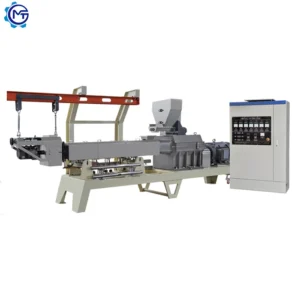
The 38CrMoAl nitrided alloy screws inside this Twin Screw Extruder Snack Production Line for sale generate the shear and residence time that corn flour demands. Twin-screw configuration allows operators to adjust screw element sequencing so that starch gelatinization happens at the right barrel zone rather than too early or too late. A properly configured screw set converts raw corn moisture into the expansion and crispness the market expects, and the self-cleaning barrel design means material changeovers between flavors happen without disassembling the barrel sections.
Matching Fryer Capacity to Extruder Output
The fully automatic fryer that sits downstream from the extruder is available with electric, diesel, or gas heating, which matters because local energy costs and utility reliability vary significantly by market. A Twin Screw Extruder Snack Production Line for sale that ships with an undersized fryer will force the extruder to idle periodically, creating uneven product density batch to batch. The conveyor between cutting and frying must carry the exact chip load the oil bath can absorb per minute, and this is where line layout calculations done before shipment prevent costly field adjustments [NEED_CITE: industrial fryer sizing relative to extruder throughput].
Reading the Specs That Actually Matter
The four model variants — MT65, MT70, MT70c, and MT75 — separate primarily on main motor rating and overall footprint, and those two parameters tell you more about real-world installation requirements than almost anything else. The MT65 at 22 kW main power fits standard workshop electrical panels, while the MT75 at 55 kW may require a dedicated transformer and heavier-gauge supply cabling. Overall line length stretches from 22 meters on the smallest model to 33 meters on the largest, which directly dictates the clear floor space and ceiling height needed before the line arrives. The speed adjusted converter on feeding, extrusion, and cutting systems allows operators to fine-tune each section independently, so the die head output rate stays synchronized with rotary cutting speed even when raw material moisture shifts between batches.
The Cost of Skipping the Fryer-Flavoring Handshake
When the double-drum flavoring system receives chips that have not cooled to the correct surface temperature after frying, seasoning powder clumps rather than coating evenly, and the product reaches the packing station with inconsistent flavor distribution. This is not a defect the operator can adjust away on the fly — it requires repositioning the cooling conveyor length or modifying the drum rotation speed, both of which take production days offline [NEED_CITE: seasoning adhesion and product surface temperature relationship]. Buyers who discover this mismatch after installation end up bearing the commissioning delay themselves.
Why the Full Equipment Range Matters Here
The complete machine catalogue approach means the mixing and batching station, the twin screw extruder, the automatic fryer, and the double-drum flavoring system all ship under one specification review rather than assembled from separate vendors who have never communicated. Screw configuration and die design are specified against the buyer’s actual corn flour blend and target chip geometry, not pulled from a generic build library. The in-house testing workshop runs trial production on customer-supplied raw material before shipment, so expansion ratio, oil absorption, and seasoning adhesion are documented before the line leaves Jinan. Pre-sales consultation covers line layout and capacity calculation across every station, and post-delivery support extends through on-site installation, operator training, and wear parts sourcing for screws, dies, and cutting knives.
Documentation & Verification
- Machine specification sheet listing screw element sequence and die bore matched to your chip format
- Line layout drawing showing throughput matching between extruder, fryer, and flavoring stations
- Electrical schematic with voltage, frequency, and control language confirmed for your market
- Factory test record and trial run report produced on your actual corn flour sample
- Wear parts list identifying screws, dies, and cutting knives with replacement intervals
Installation, Commissioning & Support
- Foundation plan accounts for the 22-to-33-meter line length and dynamic loads from the extruder gearbox
- Dedicated electrical circuit sized for the specific model’s 22 kW to 55 kW main motor draw
- Twin screw feeding system and cutting head assembled on site with alignment verification before first run
- Speed adjusted converter parameters set during commissioning using your raw material under load
- Operator training covers screw configuration changes, fryer temperature profiles, and drum seasoning rates
- Spare screws, dies, and cutting knives shipped with initial order for first replacement cycle
What to Include in Your Inquiry
Provide the specific corn flour type and moisture content you plan to run, your target daily output volume, and the finished chip format including shape, thickness, and seasoning profile. Confirm your facility voltage and frequency, available floor space with clear ceiling height, and whether existing upstream mixing or downstream packing equipment needs to interface with the new line. If you have raw material samples available, shipping them ahead allows a trial run in the testing workshop before your line enters production.
Frequently Asked Questions
Q: How is output capacity verified against the buyer’s actual corn flour blend and moisture content?
A: The testing workshop conducts trial runs on customer-supplied raw material before shipment, documenting expansion ratio, chip density, and frying behavior under controlled conditions. Capacity figures are then confirmed against those results rather than quoted from a generic baseline, so the line you receive has already produced your target product at the stated throughput.
Q: What voltage, frequency, and control language options are available for each model?
A: Electrical schematics are prepared after the buyer confirms local supply specifications, and the speed adjusted converter on feeding, extrusion, and cutting systems is configured accordingly. Control panel labeling and PLC interface language are set to match the operator team’s requirements before the line leaves the factory.
Q: How do the fryer and flavoring stations match throughput with the selected extruder model?
A: Line layout and capacity calculations are completed during the proposal stage, sizing the fryer oil bath volume and the double-drum flavoring system to the specific extruder model’s output rate. This prevents the upstream-downstream mismatches that cause product pile-ups and uneven seasoning on poorly integrated lines.
Q: What spare wear parts are included and how are replacements sourced?
A: Initial shipments include spare screws, dies, and cutting knives matched to the configured screw element sequence and die bore. Replacement parts are produced from the same 38CrMoAl nitrided alloy, and wear parts lists with reorder references ship with the operation and maintenance manual.
Q: Is a trial run on the buyer’s raw material conducted before shipment?
A: Yes, the in-house testing workshop runs the buyer’s actual corn flour through the configured extruder, fryer, and flavoring sequence before the line is packed for dispatch. The trial run report documents product geometry, oil absorption, and seasoning adhesion so that commissioning on site starts from a proven baseline rather than from scratch.