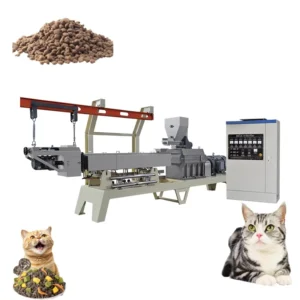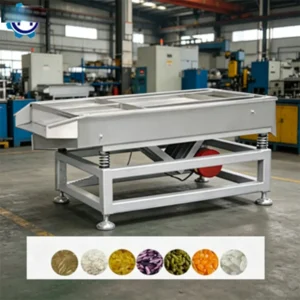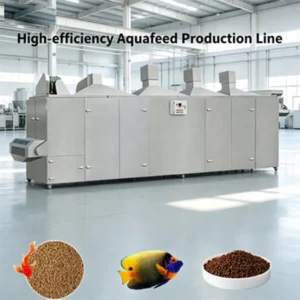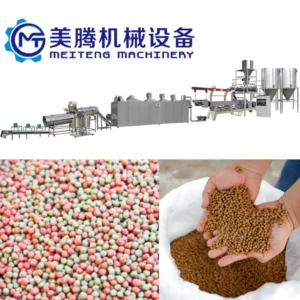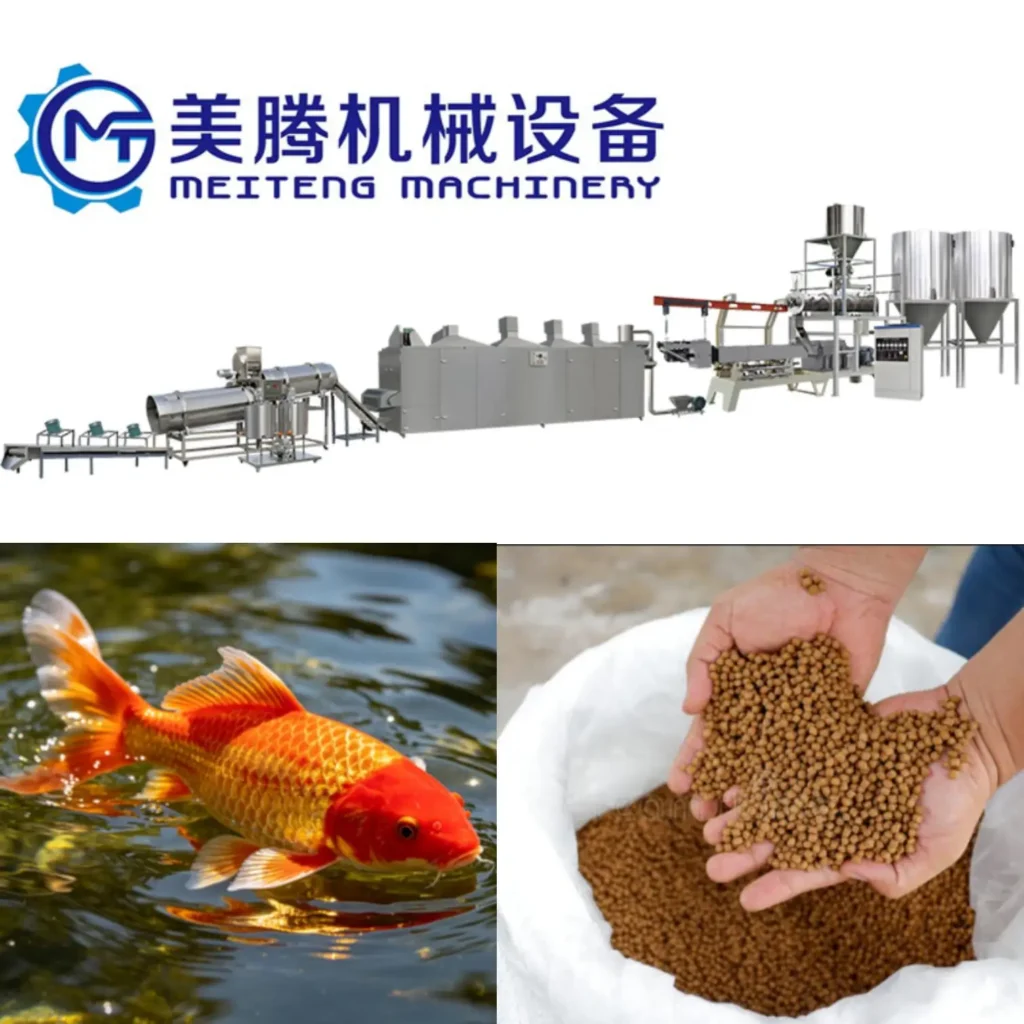
Integrated Line Engineering — every station from mixing through extrusion to packing is supplied under one manufacturer, so throughput across the fish feed processing line is matched rather than assembled from separate vendors.
Technical Specifications
| Parameter | Value |
|---|---|
| Product Type | Twin Screw Fish Feed Extrusion Production Line |
| Output Capacity | 1.0–1.5 t/h (basis not stated in source — confirm raw material formulation, moisture content, pellet size and species) |
| Extruder Type | Twin-screw |
| Construction Material | 304 stainless steel on food-contact surfaces |
| Application Range | Trout, salmon, catfish and multi-species aquaculture feed |
| Control System | Available with PLC, MCC or manual control (to be confirmed with buyer) |
| Voltage & Frequency | Configurable to buyer’s market standard (to be confirmed) |
| Line Configuration | Full processing line (mixer, extruder, dryer, cooler, coating, packing stations to be specified) |
Application Suitability
| Application | Material or Output |
|---|---|
| Floating pellet production for trout and salmon farming | High-protein formulations with fish meal, soy concentrate and starch binders |
| Sinking pellet production for catfish operations | Grain-based formulations with soybean meal, corn and wheat middlings |
| Multi-species aquaculture feed lines | Variable formulations across species requiring density and diameter adjustment |
| Aquatic feed contractors building turnkey plants | Complete line integration from raw material batching to finished pellet packing |
Why Pellet Density Drifts When Raw Materials Change on a Fish Feed Processing Line
Density is a function of screw geometry, die design and moisture — not just barrel temperature.
I have watched lines that ran perfectly on a standard test formula produce sinking pellets when the buyer switched to locally sourced soybean meal with different fat content. The extruder was never reconfigured for the new formulation. Starch gelatinisation shifted, expansion dropped, and an entire production run of floating feed sank. A fish feed processing line manufacturer that does not test with your actual raw material is handing you a machine calibrated to someone else’s recipe. [NEED_CITE: starch gelatinisation behaviour in twin-screw extrusion with varying lipid content]
How Screw Configuration Determines Pellet Buoyancy
The twin-screw extruder at the heart of this fish feed processing line relies on a specific screw element arrangement to control shear, residence time and pressure build-up before the die. Forward-conveying elements move material quickly with less mechanical energy input, while kneading blocks generate the intense shear needed for complete starch gelatinisation. For floating pellets aimed at trout or salmon, the configuration must achieve full gelatinisation at a moisture level that allows sufficient expansion at the die face. Sinking pellets for catfish require a different balance — more compression, less expansion — which is achieved by adjusting the ratio of kneading blocks to conveying elements.
Die Geometry and the Expansion Ratio at the Cut-Off Point
The die plate is where the theoretical screw profile meets physical product reality. Each die orifice diameter, combined with the land length inside the die, governs how much the extrudate expands as it exits the pressurised barrel into ambient conditions. A longer land length restricts expansion, producing denser pellets suited to sinking applications. Shorter lands allow greater radial expansion for floating feed. On this fish feed processing line, the die specification is matched to the target pellet diameter and buoyancy requirement, and the cut-off mechanism is set to produce uniform pellet length across the production run. [NEED_CITE: die land length influence on extrudate expansion in aquatic feed production]
Reading the Specs That Actually Matter for Pellet Quality
The twin-screw extruder on this line handles formulations ranging from high-starch grain blends to high-protein, high-fat mixtures used in salmonid diets. The 304 stainless steel construction on all food-contact surfaces prevents corrosion from the salts and oils common in aquatic feed formulations — a detail that matters when processing fish meal at sustained temperatures over long production shifts. Output capacity is rated at 1.0–1.5 t/h, though this figure depends entirely on the raw material formulation, target moisture content and pellet diameter. A line producing 2 mm starter feed for trout fry will run at a different mass throughput than one producing 6 mm grower pellets for catfish. The control system — available as PLC, MCC or manual — determines how consistently barrel temperature zones and screw speed are maintained across batches, directly affecting pellet-to-pellet density uniformity. Voltage and frequency must be confirmed to the buyer’s local supply before electrical panels are built, because a mismatch discovered at commissioning costs weeks of downtime.
What Happens When the Extruder and Dryer Are Mismatched
A twin-screw extruder pushing pellets faster than the downstream dryer can handle creates a bottleneck that forces operators to throttle the extruder or accept pellets with excess surface moisture. Wet pellets entering the coating drum absorb fat unevenly, leading to rancidity in storage. On a line assembled from separate vendors, nobody takes responsibility for the throughput gap between stations. The extruder supplier points at the dryer, the dryer supplier points at the cooler, and the buyer absorbs the cost of an unbalanced fish feed processing line that never reaches its nameplate output. [NEED_CITE: moisture content targets for extruded aquafeed before fat coating]
Why Sourcing the Full Line From One Manufacturer Matters
Every station on this fish feed processing line — mixing, extrusion, drying, cooling, coating and packing — is specified so that throughput is balanced across the entire sequence, not just at the extruder. Screw configuration and die design are documented against your specific raw material formulation and target pellet type, not pulled from a generic build sheet. Before shipment, your actual raw material runs through the in-house testing workshop, producing a trial run report that confirms pellet density, expansion ratio and dimensional consistency. Electrical schematics, voltage and control language are confirmed during the specification phase, eliminating the most common cause of commissioning delays. Pre-sales consultation covers line layout, utility planning and phased installation scheduling, extending through on-site commissioning, operator training and ongoing wear parts supply.
Documentation & Verification
- Line layout drawing with capacity calculation matched to your raw material formulation and pellet size
- Screw and die configuration record specific to your target floating or sinking pellet type
- Trial run report from in-house testing workshop using your actual raw material
- Electrical schematic with voltage, frequency and control language confirmed to your site standard
- Operation and maintenance manual covering daily, weekly and monthly service intervals
- Wear parts list with part numbers for screws, dies and barrel liners
Installation, Commissioning & Support
- Foundation and floor space plan sized to the full line footprint including dryer and cooler sections
- Dedicated electrical circuit specification matching the confirmed voltage, frequency and total connected load
- Extruder barrel and screw assembly verified on-site after transit to confirm alignment
- First-run parameter logging across all barrel temperature zones and screw speed settings
- Operator training on die changeover procedures and screw element replacement sequencing
- Initial spare wear parts package including replacement screw elements and die plates
What to Include in Your Inquiry
Provide your target pellet diameter and whether the application requires floating or sinking feed, along with the primary raw materials in your formulation — including protein source, starch base and fat content. Specify your local voltage, frequency and preferred control language so electrical panels and HMI screens are built to match. Confirm your daily production target in tonnes and whether existing upstream batching or downstream packing equipment will be integrated into the line.
Frequently Asked Questions
Q: How is the 1.0–1.5 t/h capacity verified and what raw material assumptions does it depend on?
A: The rated output range depends on your specific formulation moisture content, protein-to-starch ratio and target pellet diameter. A trial run on your actual raw material in the testing workshop establishes the real throughput before the line is shipped, so the capacity figure you receive reflects your product, not a generic test formula.
Q: Can the line produce both floating and sinking feed pellets, and how is density controlled?
A: Both floating and sinking pellets are achievable on the same twin-screw extruder by adjusting screw element configuration, die land length and barrel temperature profile. The screw and die setup is specified and documented for each pellet type you intend to produce, and changeover procedures are covered during operator training.
Q: Is a trial run on my specific raw material available before shipment?
A: Yes. Your raw material is processed in the in-house testing workshop before the line ships. The trial run confirms pellet density, expansion ratio and dimensional tolerances against your specification. A written report accompanies the shipment, so you have a documented baseline for comparison when the line starts production at your facility.
Q: How are throughput levels matched between the extruder, dryer, coating drum and packing station?
A: Each station is sized based on the extruder’s confirmed output on your formulation, so the dryer capacity, coating drum volume and packing speed are calculated to handle the actual mass flow. This prevents the common bottleneck where one station forces the entire line to run below its potential.
Q: What spare wear parts are included and what is the lead time for replacements?
A: The initial shipment includes a wear parts package with replacement screw elements and die plates matched to your configuration. A documented wear parts list with part numbers is provided so reorders can be placed directly. Replacement lead times are confirmed at the time of order based on current production scheduling.