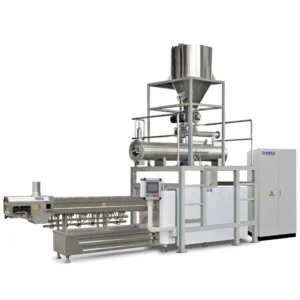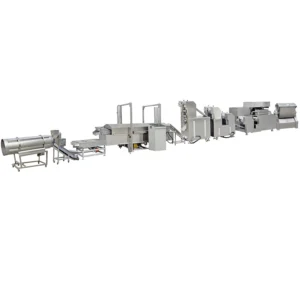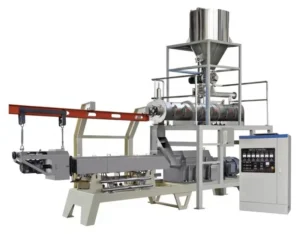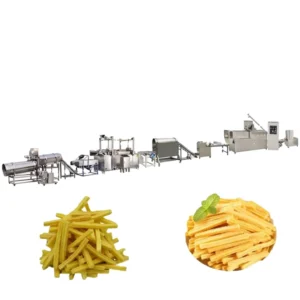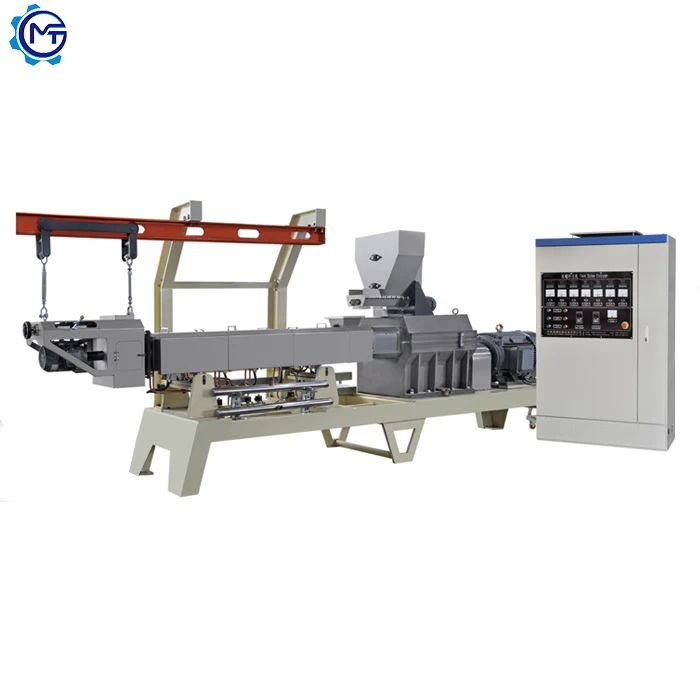
Integrated Line Sizing — Every station from mixer through fryer is throughput-matched by one manufacturer, preventing the bottleneck effect of assembling separate vendor machines into a single fried snack line.
Technical Specifications
| Parameter | Value |
|---|---|
| Model | MT100/MT120 |
| Product Type | Fried Wheat Flour Snack Processing Line |
| Extruder Type | Single Screw Extruder |
| Raw Materials | Wheat Flour, Corn Starch, Potato Starch |
| Output Capacity | 120 kg/h (basis not stated in source — confirm raw material formulation / moisture content) |
| Total Power (Electric) | 50–70 kW (rated or peak not specified in source) |
| Voltage & Frequency | Three Phase 380V/50Hz, Single Phase 220V/50Hz (customizable) |
| Energy Options | Electricity / Gas / Diesel / Steam |
| Overall Dimensions (L×W×H) | 12000–26000 × 1200 × 2200 mm |
| Material | Food Grade Stainless Steel 201 / 304 |
| Control System | Inverter by Delixi or Delta; motors Siemens (China) or domestic top brand |
| Process Flow | Mixer → Screw Conveyor → Single Screw Extruder → Pulling & Cutting Machine → Automatic Fryer → Automatic Flavoring Line → Cooling |
| Die Configuration | Multiple shapes via interchangeable dies |
| Certifications | CE, ISO 9001 |
Application Suitability
| Application | Material or Output |
|---|---|
| Golgappa / Pani Puri pellets | Wheat flour and starch blends |
| Screw shell and tube crisps | Corn starch and potato starch formulations |
| Ring and cartoon-shaped fried snacks | Mixed grain flour with secondary puffing |
| Fortified fried pellet snacks | Starch base with nutritional additives |
What "120 kg/h" Actually Means on Your Flour
Capacity claims on a frying chips making machine manufacturer brochure only hold when tested on your specific flour formulation.
Wheat flour varies widely in gluten content, ash level, and moisture absorption. A line rated at a given throughput on one formulation can drop noticeably when switched to a higher-gluten or higher-moisture flour. I once watched a line stall at roughly half its nameplate output because the local flour produced a denser extrudate that fried unevenly and jammed the flavoring drum. The extruder was fine; the downstream stations were simply not sized for what the material actually produced. [NEED_CITE: wheat flour gluten variation and extrusion behavior]
Die Geometry and Pellet Integrity in Fried Snack Lines
The interchangeable die system on the MT100/MT120 covers screw shells, round tubes, square tubes, rings, and cartoon shapes. Die selection is not just about appearance — wall thickness and internal cavity geometry determine how the pellet expands during frying and whether it holds shape or fractures. A thin-walled tube die on a high-gluten flour can collapse in the fryer, while a thick-walled ring die on a low-starch blend may not puff sufficiently.
Matching Fryer Residence Time to Extruder Output
The automatic fryer in this line is specified to match the extruder’s actual throughput rather than a theoretical maximum. Oil temperature zoning and belt speed together control residence time, which directly affects final moisture, color, and oil uptake. When fryer capacity lags behind extruder output, pellets queue up, cool down, and absorb oil unevenly. [NEED_CITE: fryer residence time and oil uptake in secondary puffing snacks]
Single Screw Behavior Across Starch Blends
Single screw extruders rely on friction between the barrel wall and the material to convey and cook the dough. Wheat flour with higher gluten develops more elastic resistance, requiring different screw pitch and barrel temperature profiles compared to a pure potato starch blend. The screw configuration must be selected based on the buyer’s actual raw material, not copied from a generic build. This is where trial runs before shipment separate functional lines from problem lines.
Voltage, Frequency, and the Commissioning Delay No One Plans For
A frying chips making machine manufacturer ships equipment to markets with different electrical standards. If the motor nameplate reads 380V/50Hz but the buyer’s facility runs 440V/60Hz, the extruder motor will overspeed, the fryer heating elements will overfire, and the inverters may fault on startup. I have seen entire commissioning schedules pushed back weeks because voltage was assumed rather than confirmed. The MT100/MT120 line supports customizable voltage and frequency, but only if the buyer’s local supply is documented before production begins. [NEED_CITE: voltage and frequency standards by export market]
When One Undersized Station Breaks the Whole Line
An extruder running at full output feeds into a fryer that cannot keep pace. Pellets accumulate on the conveyor, surface moisture drops, and the product enters the fryer at inconsistent temperature. The result is uneven oil absorption, color variation, and a texture that does not match the sample the buyer approved. The flavoring drum then receives surges rather than steady flow, leaving some pieces over-coated and others bare. These are not equipment defects — they are line integration failures. [NEED_CITE: line balancing principles in food processing]
Why Buyers Spec the Full Range from One Source
Every station in this fried snack production line for sale is sourced and matched by the same engineering team, so throughput calculations span from mixer to cooling conveyor rather than stopping at each vendor’s delivery flange. Screw configuration and die design are specified to the buyer’s raw material and target pellet shape, not pulled from a standard library. The in-house testing workshop allows trial runs on the buyer’s actual flour before the line ships, catching formulation issues at the factory instead of on the buyer’s floor. Stainless steel food-grade contact materials run throughout, meeting hygiene expectations in export markets. Energy options — electric, gas, diesel, or steam — are confirmed during the design phase so the fryer and dryer match available utilities at the installation site.
Documentation & Verification
- Line layout and capacity calculation confirming station-to-station throughput match
- Machine specification sheet with screw and die configuration matched to buyer’s flour
- Electrical schematic with confirmed voltage, frequency, and panel language
- Trial run report on buyer’s raw material from in-house testing workshop
- CE declaration of conformity and ISO 9001 certificate for export compliance
Installation, Commissioning & Support
- Overall line length up to 26,000 mm requires clear floor space and utility trench planning
- Three-phase 380V supply with dedicated circuit for 50–70 kW total connected load
- Modular station delivery allows phased installation matching site readiness
- First-run parameter setting covers barrel zones, fryer temperature, and belt speed
- Operator training on die changeover, screw cleaning, and inverter adjustment
- Wear parts list covering screws, dies, and fryer belt sections for first replacement cycle
What to Include with Your Inquiry
Share your raw material specification — flour type, gluten range, and any starch blending ratios — along with the target pellet shape and daily production volume. Confirm your facility voltage, frequency, and available energy source for heating. If you have existing upstream mixers or downstream packing equipment, note their throughput so the line can be sized to integrate rather than replace.
Frequently Asked Questions
Q: How is the 120 kg/h output capacity verified, and on which raw material formulation?
A: The stated capacity is based on internal testing and varies with flour gluten content, moisture level, and starch blend ratio. We recommend a trial run on your actual raw material in our testing workshop before shipment. The trial run report documents throughput, pellet density, and fryer performance on your specific formulation.
Q: What voltage, frequency, and control panel language options are confirmed before shipment?
A: The line supports three-phase 380V/50Hz and single-phase 220V/50Hz as standard, with customization for other voltages and frequencies. Control panel language is confirmed during the design phase. Electrical schematics and a voltage confirmation document are provided before production starts to prevent commissioning delays.
Q: How are fryer and flavoring drum capacities matched to the extruder to avoid line bottlenecks?
A: Each downstream station is sized based on the extruder’s actual output on your raw material, not a generic nameplate figure. Fryer belt speed, oil volume, and flavoring drum diameter are calculated to handle steady-state flow plus startup surge. Line layout documentation shows the throughput match at every station.
Q: What shapes and die configurations are available, and can custom dies be produced?
A: Standard dies cover screw shells, round tubes, square tubes, rings, and cartoon shapes. Custom dies can be produced based on buyer drawings or samples. Die selection considers wall thickness and cavity geometry relative to your flour formulation to ensure proper expansion during frying.
Q: Is a trial run on my raw material performed before shipment, and what does the report cover?
A: Yes. We run your actual flour and starch blend through the line in our in-house testing workshop. The trial run report covers extruder throughput, pellet dimensions, fryer oil uptake, final moisture, and flavoring uniformity. This allows formulation or die adjustments before the equipment leaves the factory.