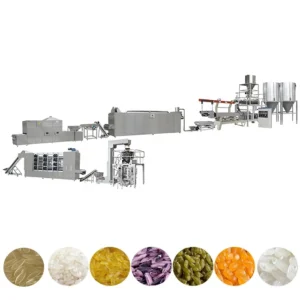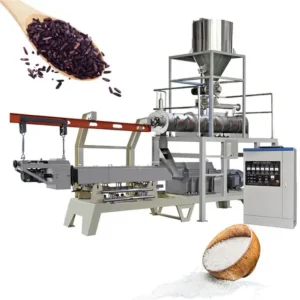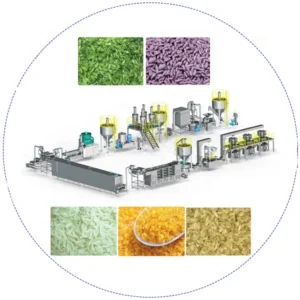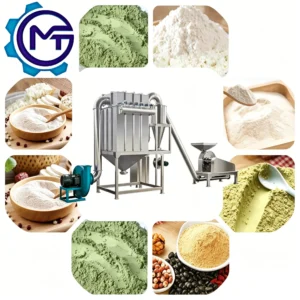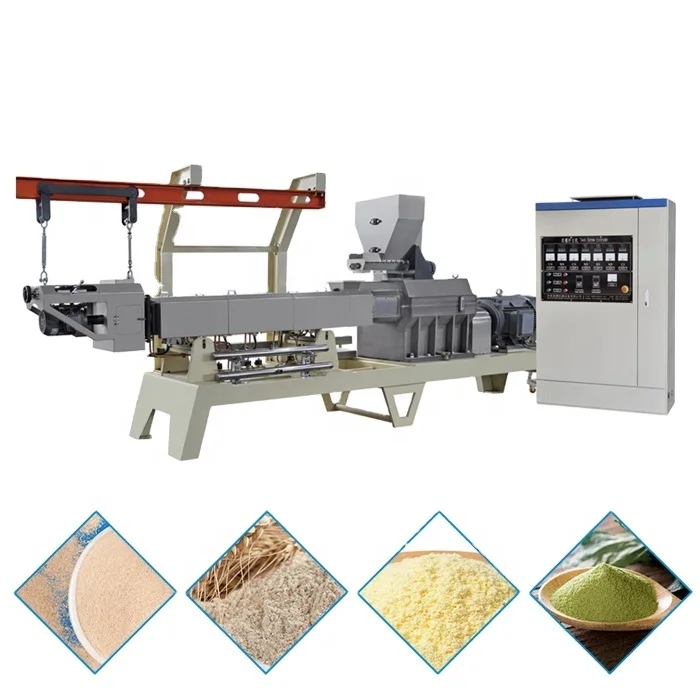
Integrated line matching — every station from batching to packing is rated and balanced against your actual raw material before the nutritional powder processing line ships.
Technical Specifications
| Parameter | Value |
|---|---|
| Product Type | Nutritional Powder Processing Line |
| Available Models | MT65 / MT70 / MT85 |
| Extruder Type | Twin-screw |
| Installed Power | 85 kW (MT65); 120 kW (MT70); 195 kW (MT85) |
| Real Power Consumption | 65 kW (MT65); 90 kW (MT70); 165 kW (MT85) |
| Output Capacity | 150–200 kg/h (MT65, basis to be confirmed); 200–300 kg/h (MT70, basis to be confirmed); 600–800 kg/h (MT85, basis to be confirmed) |
| High-Temperature Roaster Output | 300–400 kg/h (basis to be confirmed — product moisture and dwell time dependent) |
| High-Temperature Roaster Effective Belt Length | 3.5 m |
| High-Temperature Roaster Heater | Far infrared, 3.9 kW × 24 elements |
| High-Temperature Roaster Gas Consumption | 6.8 m³ (basis to be confirmed — heating value and gas type dependent) |
| High-Temperature Roaster Dimensions (L×W×H) | 4500 × 1500 × 1600 mm |
| Powder Mixer Tank Volume | 150 kg |
| Powder Mixer Rotary Speed | 385 rpm |
| Powder Mixer Power | 4 kW |
| Powder Mixer Output | 300–600 kg/h (basis to be confirmed — batch density and mixing time dependent) |
| Air Conveyor Power | 1.1 kW |
| Line Stations | Mixing & batching, air conveying, twin-screw extrusion, high-temperature roasting/drying, smashing/milling, powder mixing, packing |
| Control System | PLC and MCC |
| Contact Materials | Food-grade stainless steel |
| Voltage & Frequency | Configurable per buyer market |
| Assembly State | Complete line, pre-shipment trial run available |
| Certifications | CE; ISO |
Application Suitability
| Application | Material or Output |
|---|---|
| Nutritional and infant formula powder | Rice, corn, soybean, sesame and grain blends with added whey protein, dietary fibre or vitamin premix |
| Meal replacement and dietary supplement powder | Oat, quinoa and mixed grain bases with protein and fibre fortification |
| Instant corn paste and baby rice powder | Corn grits, rice flour and pregelatinised starch bases |
| Modified and pregelatinised starch | Corn, tapioca and potato starch for textile, papermaking, building materials, casting and oil drilling applications |
| Soybean powder and sesame paste powder | Whole soybean, roasted sesame and legume bases |
What "Nominal Capacity" Hides From Powder Line Buyers
A rated output figure means nothing until the extruder, dryer, roaster and mixer are all balanced against your specific formula.
I have watched buyers commit to a nutritional powder processing line full equipment range quoted at a headline capacity, only to discover during commissioning that the roaster could not keep pace because the actual moisture content coming out of the extruder was higher than the generic trial assumed. The extruder ran fine. The roaster bottlenecked. The packing station sat idle half the shift. [NEED_CITE: throughput balancing across extrusion line stations] When whey protein or soluble fibre makes up a large share of the formula, gelatinisation temperature shifts, expansion drops and the drying load changes entirely. That is why every station in this catalogue carries its own rated output with the raw material assumption stated, so you can verify balance before signing off.
Every Station Catalogued With Its Own Throughput Rating
This page lays out the complete nutritional powder processing line full equipment range station by station. The MT65, MT70 and MT85 extruder models cover a broad output span, while the high-temperature roaster, powder mixer and air conveyor each list their own rated capacity. Buyers surveying equipment before specifying a line can see exactly where each machine fits and confirm that no single station will bottleneck the rest.
Matching Roaster Dwell Time to Your Formula Moisture
The roaster section uses far infrared heating elements rated at 3.9 kW across 24 positions along a 3.5 m effective belt length, with gas heating available as an alternative. Dwell time on the belt determines how thoroughly moisture is driven off after extrusion. [NEED_CITE: far infrared drying principles for extruded food products] A formula that exits the extruder at higher moisture requires longer belt residence, which in turn caps the line’s sustainable throughput regardless of extruder speed. Checking roaster capacity against your actual post-extrusion moisture figure prevents downstream surprises.
How Screw Configuration and Die Design Shape Powder Quality
Twin-screw extrusion gives the operator independent control over shear, residence time and barrel temperature profile — variables that directly determine starch gelatinisation and final powder solubility. The MT65, MT70 and MT85 models share the same twin-screw architecture but differ in screw diameter and motor power, so the screw configuration and die design are specified to the buyer’s raw material rather than copied from a standard build. Consistent gelatinisation across batches depends on matching screw element sequencing to the starch, protein and fibre ratios in the actual formula, and the PLC and MCC control system holds those parameters steady once they are set.
The Cost of Skipping a Pre-Shipment Trial Run
I once saw a meal replacement powder producer install a line that had been tested only on standard rice flour. Their actual formula contained a heavy share of whey protein isolate and inulin, which changed the melt viscosity inside the barrel completely. Expansion collapsed, the powder came out dense and insoluble, and the drying section could not reduce moisture to specification. [NEED_CITE: effect of protein and fibre on extrusion expansion] The entire line had to be reconfigured on-site — new screw elements, new die, revised barrel temperature zones and adjusted roaster belt speed. A trial run on the customer’s own raw material before shipment eliminates that class of risk entirely.
Why Source the Full Equipment Range From One Supplier
Line throughput depends on every station matching the one before it. When the extruder, roaster, cooler, mixer and packing system come from separate vendors, each supplier guarantees only their own machine and throughput gaps become the buyer’s problem. Sourcing the nutritional powder processing line full equipment range from a single supplier means the capacity calculation covers every station, not just the extruder. The screw and die configuration is specified to your raw material and documented. An in-house testing workshop runs your actual formula before the line ships. PLC and MCC controls are programmed in the language and voltage your operators expect. Pre-sales consultation, on-site installation, commissioning and ongoing maintenance all come from one responsible party.
Documentation & Verification
- Line layout drawing with throughput calculation at every station
- Screw and die configuration record matched to your raw material formula
- Trial run report produced on your actual ingredients before dispatch
- Machine specification sheet confirming voltage, frequency and control language
- Electrical schematic and PLC program documentation for local maintenance
- CE declaration of conformity and ISO certificate
Installation, Commissioning & Support
- Overall line footprint up to 24 m length requires level concrete floor and adequate overhead clearance for the roaster section
- Power supply must support up to 195 kW installed load with dedicated circuit and confirmed voltage and frequency before wiring
- Line ships in sectional modules; air conveyor and roaster belt are assembled on-site to the confirmed floor plan
- Commissioning includes barrel temperature profiling and roaster dwell-time tuning against your actual formula
- Operator training covers PLC parameter adjustment, screw element replacement and daily sanitation procedures
- Wear parts list provided with recommended screw and die replacement intervals
What to Prepare Before Requesting a Quote
To configure a nutritional powder processing line full equipment range that actually holds its rated output, we need your formula composition with approximate ratios of starch, protein, fibre and fat, your target daily or hourly production volume, the voltage and frequency standard in your facility, and the control language your operators require. If you have existing upstream milling or downstream packing equipment that the line must connect to, share the interface dimensions and throughput. Buyers who can supply a sample of their raw material for a pre-shipment trial run get a configuration validated against real behaviour, not generic assumptions.
Frequently Asked Questions
Q: How is output capacity verified across every station in the nutritional powder line?
A: Each station — extruder, roaster, powder mixer and air conveyor — carries its own rated capacity with the raw material or moisture assumption stated. A line capacity calculation is prepared showing throughput at every station based on your specific formula, so you can confirm the full line is balanced before committing to production.
Q: What supporting equipment sits between the extruder and the packing station?
A: After twin-screw extrusion, product passes through the high-temperature roaster for moisture reduction, then through a smashing or milling stage to achieve powder fineness. The powder mixer blends in heat-sensitive nutrients or flavour components before the product moves to packing. Each station’s position and throughput rating are documented in the line layout.
Q: Can the same extruder handle both nutritional powder and modified starch production?
A: The twin-screw extruder models listed can process both food-grade nutritional powders and industrial modified starches, provided the screw configuration and barrel temperature profile are adjusted to the material. A separate screw and die configuration record is maintained for each product type you intend to run.
Q: What utility requirements should the buyer prepare before installation?
A: The buyer must confirm local voltage and frequency for motor and control sizing, provide a gas supply connection if the roaster is specified with gas heating, and ensure compressed air is available for pneumatic conveying and control actuators. A detailed utility requirement sheet is included in the quotation documentation.
Q: Is a pre-shipment trial run on the buyer’s raw material available?
A: Yes. The in-house testing workshop runs your actual raw material through the extruder and supporting equipment before the line ships. The trial run report documents screw configuration, barrel temperature profile, expansion behaviour, moisture at each stage and final powder quality, giving you a validated baseline before installation.