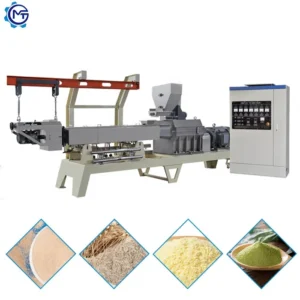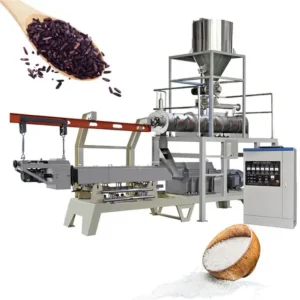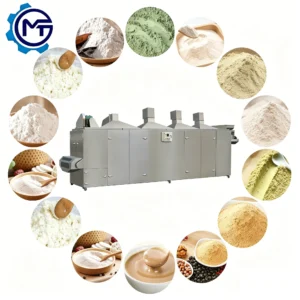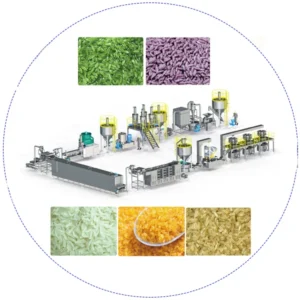
Complete Line Matching — every station from batching to packing is catalogued with throughput alignment, so no single machine bottlenecks the fortified rice processing flow.
Technical Specifications
| Parameter | Value |
|---|---|
| Product Type | Fortified Rice Processing Line |
| Models Available | MT65, MT70, MT85, MT75, MT95 |
| Extruder Type | Twin-screw (single or double screw feeding selectable) |
| MT65 Installed Power | 85 kW |
| MT65 Power Consumption | 60 kW |
| MT65 Capacity | 80–100 kg/h (basis not stated in source — confirm raw material formulation and moisture content) |
| MT65 Overall Dimensions | 28 × 1.2 × 2.2 m |
| MT70 Installed Power | 120 kW |
| MT70 Power Consumption | 85 kW |
| MT70 Capacity | 100–120 kg/h (basis not stated in source — confirm raw material formulation and moisture content) |
| MT70 Overall Dimensions | 30 × 1.5 × 2.2 m |
| MT85 Installed Power | 235 kW |
| MT85 Power Consumption | 165 kW |
| MT85 Capacity | 200–300 kg/h (basis not stated in source — confirm raw material formulation and moisture content) |
| MT85 Overall Dimensions | 34 × 3.5 × 4.3 m |
| MT75 Installed Power | 180 kW |
| MT75 Power Consumption | 135 kW |
| MT75 Capacity | 300–500 kg/h (basis not stated in source — confirm raw material formulation and moisture content) |
| MT75 Overall Dimensions | 32 × 3.5 × 4.3 m |
| MT95 Installed Power | 260 kW |
| MT95 Power Consumption | 195 kW |
| MT95 Capacity | 800–1000 kg/h (basis not stated in source — confirm raw material formulation and moisture content) |
| MT95 Overall Dimensions | 36 × 3.5 × 4.3 m |
| Control System | Frequency speed controlling with high automation |
| Lubrication | Automatic lubricating and cooling system |
| Drying Oven Heating | Electric or gas |
| Drying Oven Belt Control | Frequency motor-controlled mesh belt speed |
| Production Procedure | Mixing → Extruding → Vibrating → Low Temperature Drying → Cooling → High Temperature Roasting → Cooling → Packing |
| Standards | CE |
Application Suitability
| Application | Material or Output |
|---|---|
| Fortified rice kernel production | Broken rice, rice bran with added vitamins and minerals |
| Artificial rice manufacturing | Corn, millet, wheat flour blended with starch |
| Nutritional rice porridge base | Oats, buckwheat, bean flour with micronutrient premix |
| Instant rice product processing | Rice and starch blends for quick-cooking formats |
| Food fortification program supply | Multi-grain formulations with iron, zinc, and vitamin A |
What Happens When the Dryer Cannot Keep Up With the Extruder
Throughput matching across every station prevents the most common bottleneck in a Fortified Rice Processing Line full equipment range.
I watched a line in Southeast Asia stall every forty minutes because the drying oven could not handle the extruder output. The operator kept stopping the feed screw, waiting for the mesh belt to clear. The extruder barrel temperature drifted during each pause, and the kernels coming out after restart were a different density. That kind of inconsistency ruins a batch when you are producing fortified rice for a nutrition program where every kernel must carry the same micronutrient load. [NEED_CITE: throughput balancing in multi-station food extrusion lines]
How the Full Equipment Range Eliminates Station Mismatches
A Fortified Rice Processing Line full equipment range is not just a list of machines — it is a sequence where each station has a defined throughput envelope. The mixing system must feed the extruder at a rate that matches screw capacity, the vibrating conveyor must spread kernels evenly before they enter the dryer, and the cooling belt must match the roasting oven discharge rate. When any station is undersized, the entire line runs below its design output.
Why Raw Material Trials Matter Before the Line Ships
Last year a customer sent us a standard rice flour sample and we ran trials on our MT70. The kernels shaped well and dried evenly. Then the customer revealed their actual formulation included thirty percent bean protein. The gelatinisation temperature shifted entirely, and the screw speed and barrel heating profile we had dialled in became useless. We spent two weeks on-site re-tuning. Since then I ask every buyer to send their real raw material blend first, even if it slows the pre-sales process. [NEED_CITE: effect of legume protein on starch gelatinisation temperature in extrusion]
Reading the Extruder Specifications for Fortified Rice
The twin-screw design across the MT65 through MT95 range matters because fortified rice formulations often include sticky starches and fine vitamin premixes that do not feed cleanly through a single screw. The automatic lubricating and cooling system keeps the gearbox stable during long runs where barrel temperatures cycle between low-temperature drying and high-temperature roasting phases. The selectable single or double screw feeding system lets you match feed consistency to your material — a uniform rice flour blend works fine with single screw feeding, while a coarse multi-grain mix with bean fragments benefits from double screw forcing. Frequency speed control on both the extruder and the drying oven mesh belt means you can adjust residence time without stopping the line.
The Hidden Cost of Ordering Stations From Separate Vendors
When you source the extruder from one supplier and the dryer from another, nobody takes responsibility for the gap between them. The extruder vendor says their machine meets capacity. The dryer vendor says their oven handles the load. But the connecting conveyor is too short, the kernel temperature entering the dryer is wrong, and the moisture gradient across the bed is uneven. [NEED_CITE: integration risks in multi-vendor food processing lines]
Why Buyers Source the Full Range Here
Every machine in this Fortified Rice Processing Line full equipment range is documented with its station position and throughput relationship to adjacent equipment. Screw configuration and die design are recorded against your specific raw material blend, not copied from a generic build. The in-house testing workshop runs your actual formulation before the line ships, so you see kernel shape, density, and drying behaviour before committing to installation. Voltage and control language are confirmed against your local supply before production begins. Wear parts lists include screws, dies, and mesh belt segments so replacements are on hand when the first change is due.
Documentation & Verification
- Line layout drawing showing throughput calculation between mixing, extrusion, drying, and packing stations
- Machine specification sheet for each model with installed power, consumption, and footprint
- Screw and die configuration record matched to your grain blend and target kernel shape
- Electrical schematic with voltage and frequency confirmed against your local supply
- Trial run report on your raw material showing kernel density and moisture after drying
- Factory test record documenting continuous run stability before dispatch
Installation, Commissioning & Support
- Foundation planning based on the MT85 footprint of 34 × 3.5 × 4.3 m and dryer length requirements
- Dedicated power circuit sizing for MT95 installed power of 260 kW with startup surge allowance
- Assembly sequence for twin-screw extruder barrel sections and die plate alignment on site
- First-run parameter setting for barrel temperature zones matched to your starch gelatinisation point
- Operator training on frequency drive adjustment for extruder screw speed and mesh belt drying time
- Wear parts inventory covering screws, dies, and dryer belt segments for the first replacement cycle
What We Need to Configure Your Line
To specify the right combination from this Fortified Rice Processing Line full equipment range, share your base grain formulation and the percentage of any protein or starch additions. Tell us your target kernel dimensions and whether the end product is sold dry or as an instant porridge mix. Confirm your workshop voltage, frequency, and the control language your operators read. [NEED_CITE: voltage and frequency standards by export market]
Frequently Asked Questions
Q: How is capacity verified across all stations to prevent bottlenecks?
A: Each station in the fortified rice line is calculated against the extruder output. The mixer batch size and cycle time are set to feed continuously, the vibrating conveyor width matches the dryer belt, and the cooling conveyor matches the roasting oven discharge rate. We provide a line layout document showing these calculations.
Q: What supporting equipment sits between the extruder and packing station?
A: After extrusion, kernels pass through a vibrating conveyor for separation, a low-temperature dryer to reduce surface moisture, a cooling belt, a high-temperature roasting oven for final texture, and a second cooling stage before packing. Each station is included in the full equipment range.
Q: How are screw and die designs matched to different grain materials?
A: We run your raw material in our testing workshop and adjust screw element sequence, compression ratio, and die hole geometry until the kernel shape and density meet your specification. The configuration record is documented and shipped with the machine.
Q: What voltage and frequency options are available?
A: Voltage and frequency are confirmed against your facility supply before production. The electrical schematic and motor ratings are adjusted accordingly, and the control panel language is set to match your operators.
Q: Can individual stations be ordered separately?
A: Yes. Individual machines such as the drying oven, cooling conveyor, or flavouring station can be supplied to upgrade an existing line. We match the throughput of the new station to your current extruder output to avoid bottlenecks.