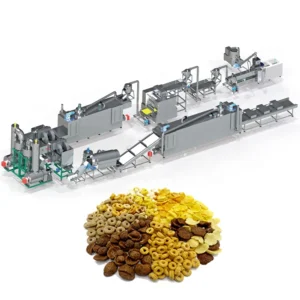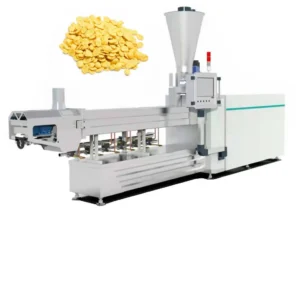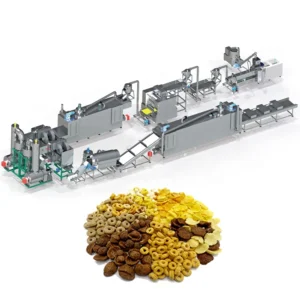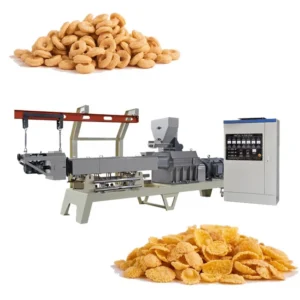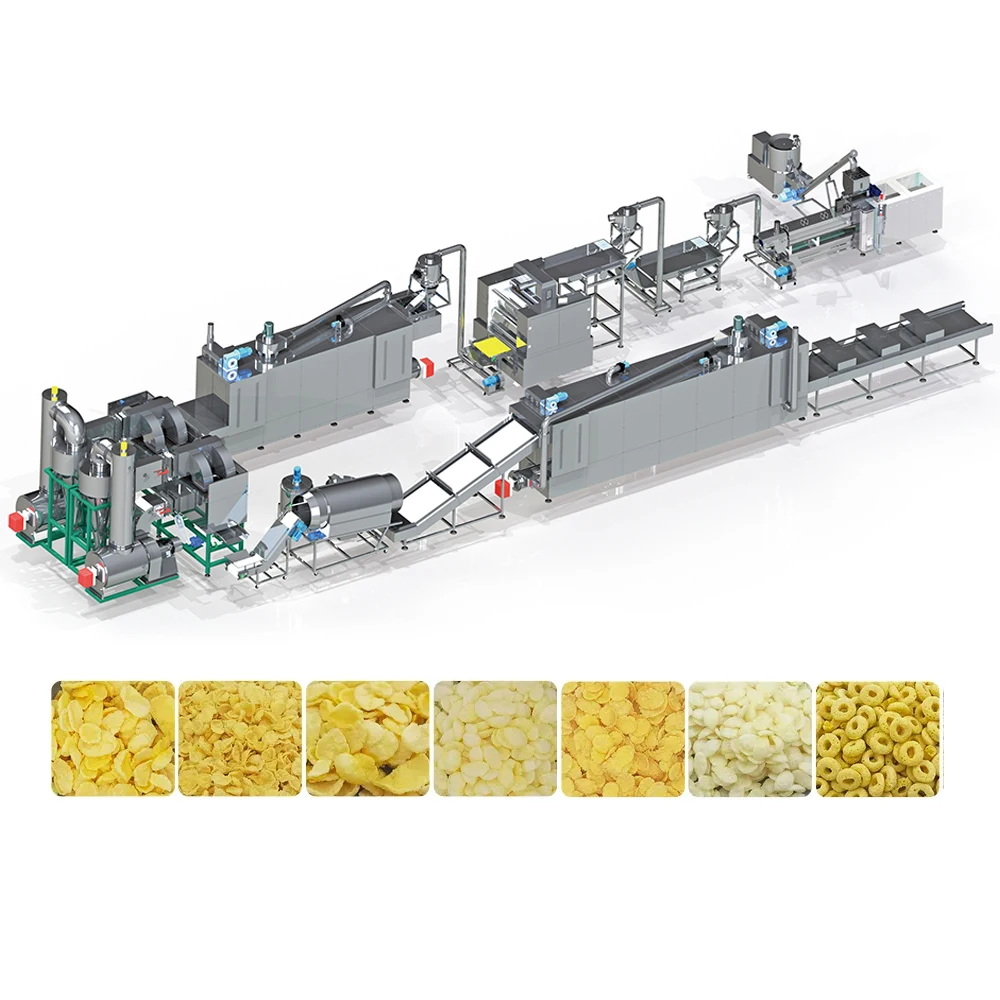
Integrated Throughput — Every station from mixing to packing is matched to the extruder’s real output on your grain formulation, not assembled from isolated vendors.
Technical Specifications
| Parameter | Value |
|---|---|
| Product Type | Corn Flakes Production Line / Twin Screw Extruder System |
| Model Options | MT70 / MT75 / MT85 |
| Extruder Screw Type | Twin Screw with automatic lubricating and cooling function |
| MT70 Installed Power | 160 kW |
| MT70 Power Consumption | 120 kW |
| MT70 Capacity | 150–200 kg/hr (basis not stated in source — confirm raw material and moisture content) |
| MT70 Overall Dimensions | 41 × 1.5 × 2.2 m |
| MT75 Installed Power | 210 kW |
| MT75 Power Consumption | 150 kW |
| MT75 Capacity | 300–500 kg/hr (basis not stated in source — confirm raw material and moisture content) |
| MT75 Overall Dimensions | 45 × 1.5 × 3.5 m |
| MT85 Installed Power | 190 kW |
| MT85 Power Consumption | 140 kW |
| MT85 Capacity | 300–400 kg/hr (basis not stated in source — confirm raw material and moisture content) |
| MT85 Overall Dimensions | 43 × 1.5 × 3.2 m |
| Flaking Machine Control | PLC control system |
| Flaking Machine Roller Drive | Hydraulic system for double rollers; double motors for separate driving |
| Flaking Temperature Monitoring | Infrared sensor |
| Dryer Heating Source | Gas or Electric |
| Roasting Oven Features | Hot air roasting with vibrating pan, conciliation burner, dual circulating fans, cyclone dust removal |
| Coating System | Double tumble for sugar melting, elevator, coating drum, spraying nozzle |
| Key Features | Automatic screw lubrication, hydraulic flaking control, PLC automation, hot air circulation roasting |
Application Suitability
| Application | Material or Output |
|---|---|
| Natural breakfast corn flakes | Corn powder, maize grits, multi-grain blends |
| Sugar-coated corn flakes | Corn or oat base with sugar glaze coating |
| Extruded multi-grain cereal shapes | Rice, wheat, oat, barley powder (ball, tube, ring, star, fruit loop) |
| Fortified breakfast cereals | Grain blends with added vitamin and mineral premix |
Why Nominal Capacity Figures Mislead Cereal Buyers
A corn flakes production line rated for a certain hourly output on paper often delivers far less once your specific corn variety and moisture content enter the extruder.
I worked on a project years ago in Jinan where a client signed for a breakfast cereal equipment line based on catalogue capacity. When their corn flour arrived with higher moisture than the standard test batch, expansion dropped sharply, flake texture turned hard, and actual output fell noticeably below the contract number. The bottleneck was not the extruder alone — the dryer and roasting oven were also undersized for the real throughput. That experience shaped how we handle every corn flakes project now: raw material trial runs in our testing workshop come before any machine leaves the factory floor. [NEED_CITE: moisture content impact on twin-screw extrusion expansion rate]
How the Extrusion and Flaking Sequence Defines Flake Quality
The corn flakes production line starts with the twin-screw extruder cooking and forming the grain dough under controlled temperature and shear. The screw configuration determines residence time and gelatinisation degree, which directly influences how well the pellet holds together when it reaches the flaking rollers.
Our PLC-controlled flaking machine uses a hydraulic double-roller system with infrared temperature monitoring. The hydraulic pressure keeps roller gap consistent across the full width, so flake thickness stays uniform whether you run corn, oat, or a multi-grain blend. Separate motors driving each roller prevent slippage at higher feed rates.
Why Throughput Matching Across Stations Matters More Than Extruder Power
A powerful extruder pushing dough into an undersized dryer creates a bottleneck that no amount of motor capacity can solve. The roasting oven must handle the same mass flow with enough hot air volume and residence time to achieve proper blister formation and crispness.
This breakfast cereal equipment line is configured so that mixing batch size, extruder output, dryer belt length, roasting pan area, and coating drum volume all align. The hot air roasting oven uses a conciliation burner with two separate circulating fans and a cyclone dust removal device to maintain even temperature distribution. [NEED_CITE: heat transfer requirements for cereal roasting uniformity] When one station falls short, the entire line slows to match the weakest link.
Reading the Specification Sheet for Real Production Conditions
The twin-screw design gives operators independent control over screw speed and barrel temperature zones, which is critical when switching between corn varieties or introducing oat and barley into the formulation. Different grains gelatinise at different temperatures and moisture thresholds.
The MT75 model draws 210 kW installed power and runs at 150 kW consumption, suited for higher-volume cereal production. The MT70 at 160 kW installed serves smaller batch operations. The flaking machine’s hydraulic roller system maintains pressure that mechanical spring systems cannot sustain over long production runs. Infrared temperature sensors on the flaking station provide real-time feedback, preventing dough overheating that would cause sticking and uneven sheet thickness. These parameters together determine whether your flakes emerge with the crisp, blistered surface the breakfast cereal market expects.
The Hidden Cost of Skipping Pre-Shipment Trial Runs
When a cereal line ships without testing on the buyer’s actual grain formulation, the first weeks of production become an expensive experiment. Screw and die configurations set for generic corn meal may produce the wrong density on your specific supplier’s material. Flakes may sink instead of floating in milk, or the roast colour may come out uneven because the oven was calibrated for a different moisture profile. [NEED_CITE: post-installation commissioning delays in food extrusion projects] Operator training extends from days into weeks, and raw material waste accumulates while parameters are dialled in from scratch.
Why Source the Full Line from One Manufacturer
Every station on this corn flakes production line — mixing, extruding, flaking, drying, roasting, coating, cooling, and packing — is supplied and capacity-matched under one configuration. This eliminates the interface gaps that appear when equipment arrives from separate vendors.
The screw configuration and die design are specified to your raw material and target product before production begins. An in-house testing workshop runs your actual grain blend through the extruder to validate expansion, texture, and throughput before shipment. Electrical schematics, voltage, and frequency are confirmed against your facility’s supply before assembly starts. Twin-screw expertise covers corn flakes as well as multi-grain cereal shapes on the same platform, giving producers flexibility without purchasing a second extruder. Pre-sales consultation extends through on-site installation, commissioning, and ongoing maintenance support.
Documentation & Verification
- Line layout and capacity calculation with throughput matched across every station
- Screw and die configuration record matched to your grain formulation
- Trial run report on your actual raw material from the testing workshop
- Electrical schematic with voltage and frequency confirmation for your facility
- CE declaration of conformity and ISO certificate included in shipping documents
- Operation and maintenance manual with wear parts list and replacement intervals
Installation, Commissioning & Support
- Foundation plan provided based on MT75 line footprint of 45 × 1.5 × 3.5 m for largest configuration
- Dedicated electrical circuit sized to 210 kW installed power for MT75 model confirmed before shipment
- Extruder and flaking station arrive partially assembled; roller alignment verified during on-site commissioning
- PLC control system programmed in your preferred language with parameter recipes for each grain blend
- Initial trial production run conducted with your raw material under engineer supervision
- Wear parts including screws, dies, and roller surfaces catalogued with lead times for reorder
What We Need to Configure Your Line
To size the extruder and match downstream stations, share your target grain formulation with moisture content, daily output requirement, and the specific flake dimensions or cereal shapes you intend to produce. Your facility’s available floor area and ceiling height determine the line layout. Confirm local voltage and frequency standards along with your preferred PLC operating language so the electrical package is built correctly from the start.
Frequently Asked Questions
Q: How is line capacity verified on my specific raw material before shipment?
A: We run your actual grain formulation through the extruder in our testing workshop, measuring expansion rate, flake density, and throughput across the flaking and roasting stages. A trial run report documents the screw configuration, barrel temperature profile, and moisture settings that produced acceptable results. These parameters ship with the machine as the baseline recipe.
Q: How do you ensure throughput matching between the extruder, flaking machine, and roasting oven?
A: Each station is sized during the line configuration phase based on the validated extruder output from your trial run. The dryer belt length, roasting oven pan area, and coating drum volume are calculated to handle the same mass flow without accumulation points. This prevents situations where one station forces the entire line to slow down.
Q: What voltage, frequency, and PLC language options are available?
A: Electrical systems are configured to match your facility’s supply before production begins. The PLC control interface can be set to your preferred operating language. Voltage and frequency confirmation is part of the specification approval step, documented in the electrical schematic that ships with the equipment.
Q: What spare wear parts are included and how are replacements supplied?
A: The initial shipment includes a wear parts set covering screws, dies, and flaking roller contact surfaces. A complete wear parts list with part numbers and reorder lead times is provided in the documentation package. Replacement components are manufactured to the same specification as the originals installed on your line.
Q: How does screw and die configuration change when producing different cereal shapes?
A: The twin-screw extruder accepts different die plates and cutting setups to produce rings, balls, stars, tubes, and other shapes beyond standard flakes. Each shape requires a specific screw element arrangement to achieve the right dough consistency and expansion. The configuration record documents which setup corresponds to each product format.