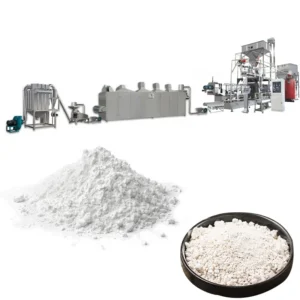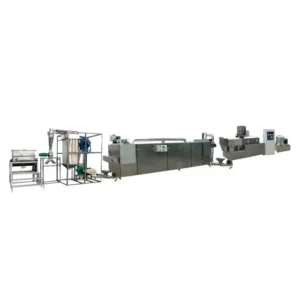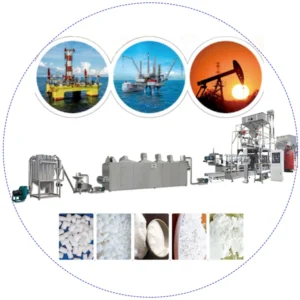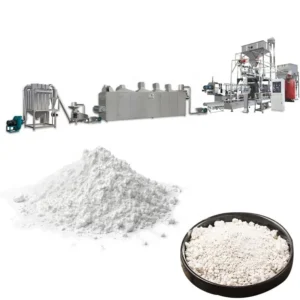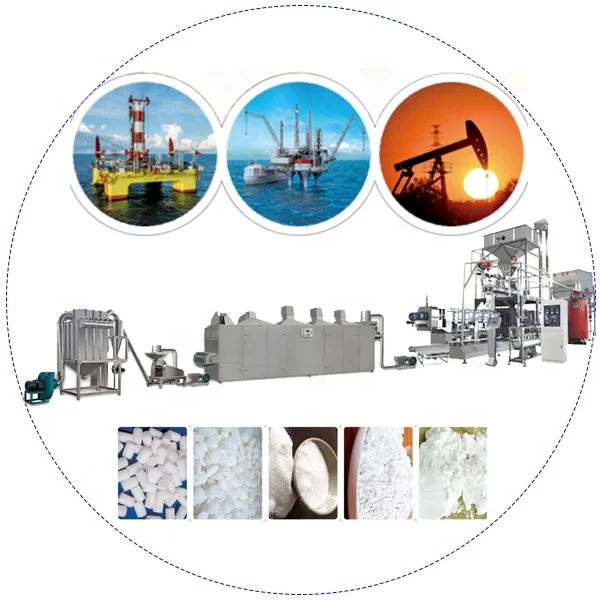
Integrated Line Matching — Every station on this pre-gelatinized starch production line, from the mixer through the twin-screw extruder to the grinder, is throughput-matched under a single supplier to hold its rated output across varying starch chemistries.
Technical Specifications
| Parameter | Value |
|---|---|
| Product Type | Modified Starch Extrusion Production Line |
| Capacity Range | 80–500 kg/h (basis not stated in source — confirm raw material type, moisture content and target gelatinisation degree) |
| Extruder Type | Twin-screw extruder |
| Screw Material | 45 steel (screw element inside barrel) |
| Contact Material | Food-grade stainless steel 304 |
| Frame Material | Stainless steel 201 |
| Mixer Main Motor | 4.0 kW |
| Mixer Batch Output | 3.0–4.0 kg per batch (basis not stated in source — confirm batch time and fill level) |
| Mixer Dimensions | 1.2 × 0.9 × 1.4 m |
| Screw Conveyor Main Motor | 1.1 kW |
| Screw Conveyor Output | 0–150 kg/h (basis not stated in source — confirm material bulk density and moisture) |
| Screw Conveyor Dimensions | 2.5 × 0.6 × 2.3 m |
| Die Configuration | Interchangeable dies for different product shapes |
| Energy Options | Electricity / Gas / Diesel / Steam |
| Total Installed Power (Electric) | approx. 100 kW |
| Total Installed Power (Gas/Diesel) | approx. 50–60 kW |
| Voltage & Frequency | Three-phase 380 V / 50 Hz; Single-phase 220 V / 50 Hz (customisable) |
| Certification | CE |
| Warranty | 1 year |
Application Suitability
| Application | Material or Output |
|---|---|
| Pre-gelatinised starch for instant foods | Corn starch, wheat flour, potato starch |
| Modified starch for paper and textile sizing | Starch bases requiring altered viscosity and gelling |
| Adhesive-grade modified starch | Corn and wheat starch with controlled molecular weight |
| Bakery and noodle functional starch | Pre-gelatinised starch with improved water-binding |
Why Your Actual Starch Formula Decides the Real Throughput
A modified starch processing line quoted at nominal capacity often cannot sustain that figure once your specific raw material enters the barrel.
Buyers evaluating extrusion lines for starch modification tend to compare capacity numbers on paper, yet the behaviour of acetate-esterified tapioca starch differs fundamentally from native corn starch under identical screw speed and barrel temperature. Gelatinisation onset, shear sensitivity and expansion ratio all shift with the degree of substitution. When a line is configured for one starch chemistry and fed another, blockages at the die and inconsistent viscosity in the finished powder follow within the first production run [NEED_CITE: starch gelatinisation behaviour under twin-screw extrusion].
Screw Configuration Dictates Starch Modification Outcome
The twin-screw extruder on this pre-gelatinized starch production line is set up with screw elements and barrel segments selected for the buyer’s declared raw material and target gelatinisation degree. Starch modification depends on controlled mechanical shear and thermal input: too little shear and the granules pass through under-processed, too much and polymer chains degrade, reducing the viscosity that downstream formulators rely on. Interchangeable dies allow adjustment of residence time and expansion ratio to match the product specification.
Matching Every Station to Prevent Bottlenecks in Continuous Starch Processing
A modified starch processing line fails most visibly at the dryer, where insufficient capacity forces the extruder to slow down. This line integrates mixing, screw conveying, twin-screw extrusion, drying, conditioning and grinding with throughput calculations across each handoff point. The screw conveyor delivers material at a controlled rate to maintain steady extruder feed, while the air conveyor between the dryer and grinder prevents moisture re-absorption that would compromise powder flowability [NEED_CITE: continuous starch processing line design considerations].
Reading the Specifications That Matter for Starch Extrusion
The 4.0 kW mixer motor paired with a 3.0–4.0 kg batch output sets the batching rhythm — buyers should confirm whether this matches the extruder’s continuous feed requirement at their intended running rate. The twin-screw design provides the shear and mixing intensity necessary for uniform gelatinisation across different starch granule sizes, something a single-screw configuration struggles to achieve with high-moisture or chemically modified starches. Energy options spanning electricity, gas, diesel and steam let the line adapt to local utility economics: a 100 kW electric heating setup may suit regions with stable grid power, while gas or diesel heating at roughly 50–60 kW installed power serves sites where fossil fuel is cheaper. Food-grade stainless steel 304 on all contact surfaces prevents iron contamination that would discolour the finished starch powder.
The Cost of Skipping a Trial Run on Your Starch Material
Commissioning a starch extrusion line without a prior trial run on the buyer’s actual formula exposes the operation to unplanned downtime. Screw elements and die geometry chosen for generic corn starch may produce excessive die-face buildup when processing esterified or cross-linked variants, forcing repeated stoppages for cleaning. Moisture profiles that work in the supplier’s workshop may not translate to a factory running in tropical humidity, where ambient conditions alter drying kinetics and final powder moisture. These issues compound: inconsistent powder moisture leads to viscosity variation that downstream customers reject [NEED_CITE: impact of raw material variability on extrusion line performance].
Why Buyers Source This Starch Line Through a Single Equipment Supplier
Every station from the mixer to the grinder is designed and supplied under one responsibility, so throughput matching is engineered rather than assembled from disconnected vendors. Screw configuration and die design are specified to the buyer’s declared starch type and target modification properties, not copied from a generic build. An in-house testing workshop allows trial runs on the buyer’s actual raw material before shipment, reducing on-site commissioning surprises. The line covers pre-gelatinised starch, modified starch and specialty starch applications with twin-screw expertise across corn, wheat and potato starch bases. Pre-sales consultation extends through engineer-led layout design, on-site installation, commissioning and ongoing maintenance support.
Documentation & Verification
- Line layout and capacity calculation matched to your declared starch type and target output
- Screw and die configuration record specified to your raw material and gelatinisation requirement
- Factory test record from in-house trial run on your actual starch formula before dispatch
- Electrical schematic with voltage and frequency confirmation against your site utility supply
- CE declaration of conformity for the complete modified starch processing line
Installation, Commissioning & Support
- Foundation plan accounts for the extruder’s operating weight and the mixer’s dynamic load at the 4.0 kW motor rating
- Electrical connection verified for three-phase 380 V / 50 Hz or buyer-specified voltage before production begins
- Twin-screw extruder barrel segments and screw elements assembled on-site with alignment checked against the die plate
- First production run parameters — barrel temperature profile, screw speed, feed rate — set during commissioning with buyer present
- Operator training covers die changeover procedures and screw element replacement using the supplied wear parts list
- Ongoing maintenance schedule aligned to stainless steel 304 contact surface inspection and screw element wear monitoring
Preparing Your Inquiry for a Starch Extrusion Line
Share your specific starch raw material — whether native corn, chemically modified tapioca, or potato starch — along with the target gelatinisation degree and viscosity range your downstream customers expect. Confirm your site’s available voltage, frequency and preferred energy source so the line can be configured before production. If your formula includes additives or moisture levels outside standard ranges, request a trial run in the testing workshop on your actual material to validate screw and die selection before shipment.
Frequently Asked Questions
Q: How is the capacity figure verified on my specific starch raw material?
A: The 80–500 kg/h range depends on raw material type, moisture content and target gelatinisation degree. Verification happens through a trial run in the in-house testing workshop using your actual starch formula, with throughput measured and recorded before the quotation is finalised.
Q: Can the voltage, frequency and control language be confirmed before production?
A: Yes. The standard three-phase 380 V / 50 Hz configuration is customisable to your local utility supply. Electrical schematics, voltage confirmation and HMI language options are agreed during the specification stage, before manufacturing begins, to avoid commissioning delays on-site.
Q: Is a trial run on my raw material conducted before shipment?
A: An in-house testing workshop is available for trial runs on the buyer’s actual starch material. This allows screw configuration, die selection and barrel temperature profiles to be validated against your target modification properties, reducing surprises during on-site commissioning.
Q: How are screw and die configurations matched to my starch modification targets?
A: Screw element arrangement and die geometry are specified based on your declared raw starch type, desired degree of gelatinisation and target viscosity. Different starch chemistries — native, esterified, cross-linked — require distinct shear and thermal profiles, which the twin-screw setup accommodates through element selection.
Q: What spare wear parts are supplied and available for reorder?
A: The line ships with a wear parts list covering screw elements, dies and barrel segments most subject to abrasion during starch processing. Reorder availability for these components is confirmed at quotation stage, so replacements are accessible when the first scheduled change falls due.