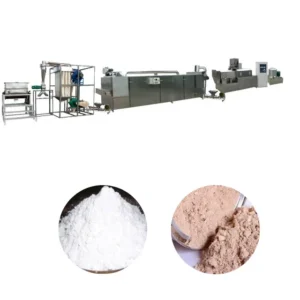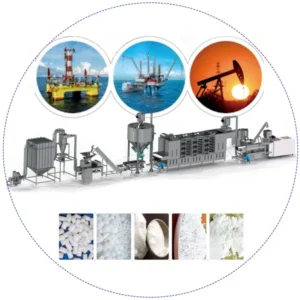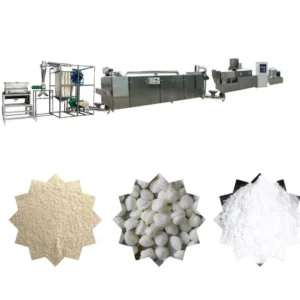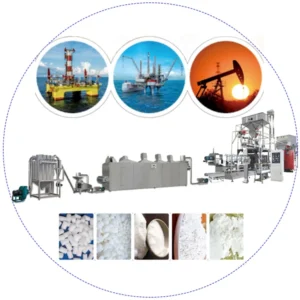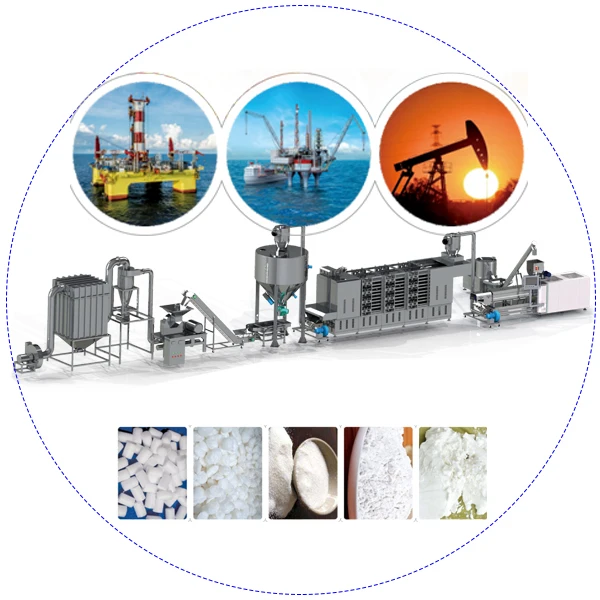
Matched Throughput Across Stations — Every mixer, extruder, and grinder in this modified starch line is sized to the same target output so no single machine chokes the flow.
Technical Specifications
| Parameter | Value |
|---|---|
| Product Type | Modified Starch Production Line |
| Screw Type | Twin-screw |
| Rated Power | 45–200 kW |
| Output Capacity | 100–1500 kg/h (basis not stated in source — confirm raw material type, moisture content and modification process) |
| Net Weight | 1000–5000 kg (source value — verify against manufacturer catalog) |
| Voltage & Frequency | 220–440 V, tri-phase |
| Control System | PLC |
| Line Stations | Mixing and batching system, twin-screw extruder, cooling conveyor, pulse grinder |
| Construction Material | Food-grade stainless steel (contact parts), PVC (selected conveyors) |
| Standards | CE, ISO |
Application Suitability
| Application | Material or Output |
|---|---|
| Food-grade modified starch for texture and stabilization | Cassava starch, potato starch, corn starch |
| Industrial starch for oil drilling fluids | Corn starch, wheat flour |
| Modified starch for paper making and coating | Cassava starch, potato starch, corn starch |
| Fortified and nutritional food ingredients | Wheat flour blended with starch substrates |
What "100–1500 kg/h" Actually Means for Your Starch
Capacity only holds when the extruder, dryer, and grinder are all balanced to your raw material’s gelatinization behavior.
I once watched a starch producer lose nearly half their expected throughput because the line was quoted on generic corn starch data while they were running cassava with a higher gelatinization temperature. The extruder barrel profile never reached the thermal window the material needed, so expansion dropped and the downstream grinder sat idle waiting for usable output. That mismatch is the hidden cost behind every modified starch production line manufacturer quote that skips the raw material conversation. [NEED_CITE: starch gelatinization temperature ranges by botanical source]
How Twin-Screw Geometry Handles Different Starch Types
Twin-screw extrusion gives operators independent control over shear, residence time, and barrel temperature zone by zone. Cassava starch, potato starch, and corn starch each demand a different screw element arrangement — some need aggressive kneading blocks to break crystalline structure, others require gentler conveying elements to prevent molecular degradation. This flexibility is what separates a line that runs one feedstock well from one that adapts across multiple botanical sources.
Downstream Equipment Sizing Prevents Hidden Bottlenecks
After extrusion, the modified starch must cool evenly before grinding, or clumping inside the pulse grinder will force frequent stoppages. The cooling conveyor on this line uses low-power fans combined with a wind knife design that strips the boundary layer of hot air from the material surface without scattering fine particles. When cooling capacity falls short of extruder output, the entire modified starch production line manufacturer proposal unravels at the grinder station. [NEED_CITE: post-extrusion cooling requirements for pregelatinized starch]
Reading the Specification Sheet with a Process Engineer’s Eye
Rated power spanning 45–200 kW reflects the range of extruder sizes available, and the right choice depends on both target throughput and the energy required to gelatinize your specific starch. A higher-amylose corn starch demands more mechanical shear and thermal energy than a waxy variety, which directly affects motor load and barrel heating requirements. The PLC control system stores temperature profiles and screw speed recipes for each product, so operators switching between cassava and potato starch can recall validated parameters rather than starting from scratch each batch. Voltage configurability from 220 V to 440 V tri-phase ensures the line matches local grid standards without adding a transformer as an afterthought. Food-grade stainless steel on all contact surfaces meets hygiene expectations for both food and industrial starch applications, while PVC conveyor sections keep costs contained where product contact is indirect.
The Cost of Skipping the Trial Run
Buyers who approve a line configuration without a factory trial on their own raw material often discover problems only after installation — wrong starch density, inconsistent particle size from the grinder, or a cooling conveyor that cannot keep pace. By that point, re-engineering screw elements or adding a second cooling stage costs far more in downtime and freight than a week of pre-shipment testing would have. Every modified starch production line manufacturer should be willing to run your material before the crate is nailed shut. [NEED_CITE: typical cost of post-installation line modification versus pre-shipment testing]
Why Buyers Specify This Line
Complete station matching from batching through grinding means throughput is calculated as a system, not assembled from independent vendor quotes that each promise peak numbers. Screw configuration and die design are documented against the buyer’s raw material, not copied from a generic starch build. The in-house testing workshop allows trial runs on actual cassava, potato, or corn starch before the line ships, catching thermal or shear mismatches early. PLC control with recipe storage supports producers who run multiple starch types on the same extruder. Electrical schematics and voltage confirmation are finalized before production begins, so commissioning is not delayed by a frequency incompatibility.
Documentation & Verification
- Line layout drawing showing throughput match between mixer, extruder, cooling conveyor, and grinder
- Screw configuration record matched to your starch type and target modification level
- Factory trial report on your raw material documenting output rate and product quality
- Electrical schematic with confirmed voltage and frequency for your facility
- CE declaration of conformity covering the full line assembly
- Operation manual covering PLC recipe setup for each starch product
Installation, Commissioning & Support
- Foundation plan accounts for extruder vibration and grinder footprint at your rated power range
- Dedicated electrical circuit sized for the 220–440 V tri-phase load before equipment arrives
- Modular line stations shipped in sequence for staged assembly within your facility
- First-run parameter tuning on your starch type during on-site commissioning
- Operator training on PLC recipe recall for switching between cassava, potato, and corn starch
- Wear parts list covering screw elements, die plates, and grinder screens with reorder codes
What to Include in Your Inquiry
To move past a generic quote, share the botanical source of your starch, the modification process you intend (pregelatinization, oxidation, cross-linking), and your target daily output. Confirm the voltage and frequency at your plant along with the control language your operators prefer. If you have an existing batching or packaging system that must integrate with the new line, provide its throughput rating so the modified starch production line manufacturer can match station capacities accordingly.
Frequently Asked Questions
Q: How is line capacity verified against my specific starch raw material?
A: We run your actual starch in the testing workshop before shipment, adjusting screw configuration, barrel temperature zones, and grinder settings until output and product quality meet the agreed specification. The trial report documents every parameter so you can replicate results at your facility.
Q: What voltage options are available for different international markets?
A: The line is configurable from 220 V to 440 V tri-phase. We confirm your facility’s voltage and frequency during the specification stage and build the electrical panel to match, so no additional transformer is required on site.
Q: Can the extruder configuration be adjusted for different starch modification processes?
A: Yes. Screw element arrangement, barrel temperature profile, and die geometry are all selected based on whether you are pregelatinizing, oxidizing, or cross-linking the starch. The PLC stores separate recipes for each process and raw material combination.
Q: What supporting equipment is included to ensure no bottlenecks in the line?
A: The line includes a mixing and batching system, twin-screw extruder, cooling conveyor with wind knife design, and pulse grinder with cyclone discharge. Each station is sized so its maximum throughput matches the extruder output on your specific starch type.
Q: Do you provide factory testing before shipment and on-site commissioning?
A: Every line undergoes a trial run on your raw material in our testing workshop, and results are documented before dispatch. On-site installation includes commissioning, parameter fine-tuning, and operator training on the PLC control system.