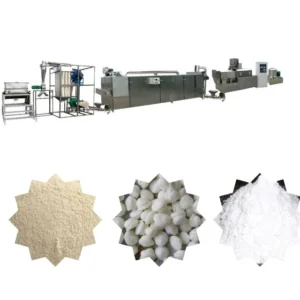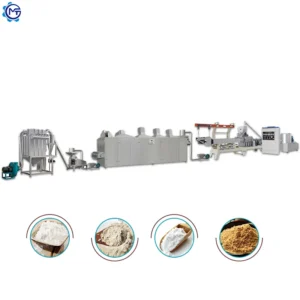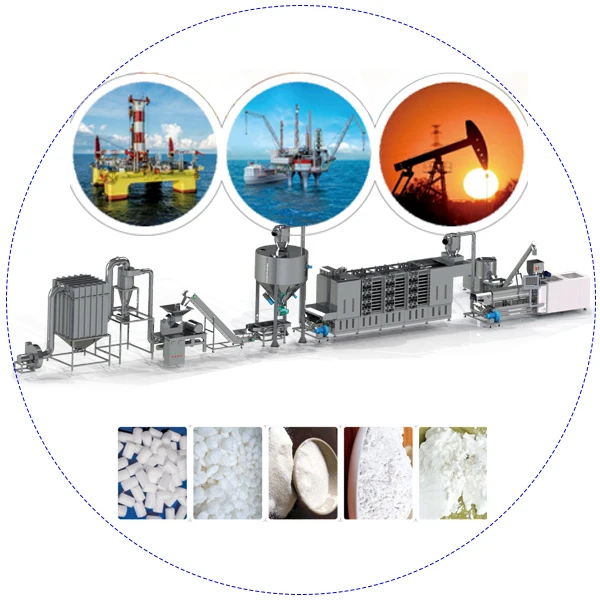
Integrated Line Throughput — every station from the batching hopper to the pulse grinder is sized so the extruder never waits on downstream capacity, verified against your specific starch feedstock before the line ships.
Technical Specifications
| Parameter | Value |
|---|---|
| Product Type | Modified Starch Processing Line |
| Screw Configuration | Twin-screw |
| Drive Power Range | 45–200 kW |
| Output Range | 100–1500 kg/h (basis not stated in source — confirm raw material type, moisture content, and modification degree) |
| Line Weight | 1000–5000 kg |
| Electrical Supply | 220–440 V, tri-phase |
| Control Architecture | PLC-controlled automatic operation |
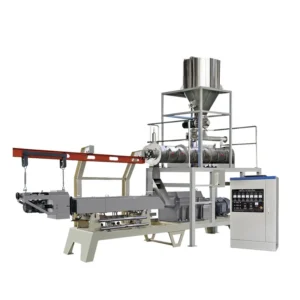
| Core Line Stations | Twin-screw extruder, cooling conveyor, pulse grinder |
| Compatible Raw Materials | Corn starch, wheat flour, rice flour, soybean flour, potato starch |
| Certification | CE |
Application Suitability
| Application | Material or Output |
|---|---|
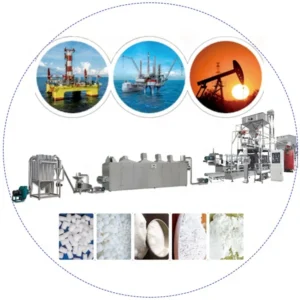
| Oil drilling fluid additives | Pregelatinized corn or potato starch with controlled viscosity and thermal stability |
| Food-grade thickening agents | Cross-linked or esterified wheat and corn starch for sauces, bakery, and dairy |
| Papermaking surface sizing | Oxidized or cationic starch from corn and wheat flour substrates |
| Textile warp sizing | Etherified starch derivatives from corn and rice flour for yarn coating |
| Pharmaceutical tablet binders | Highly purified pregelatinized starch meeting pharmacopoeial specifications |
Why Nominal Capacity Numbers Mislead Starch Buyers
A modified starch processing line manufacturer must declare the raw material, moisture content, and modification target behind every output figure.
I have watched lines quoted at a round number on corn starch lose half their throughput the moment the buyer switched to tapioca or potato feedstock. The screw shear profile, barrel temperature zones, and residence time that gelatinize corn starch cleanly do not translate to higher-amylose or larger-granule starches without reconfiguration. When a Modified Starch Processing Line manufacturer provides a single capacity number with no material qualifier, the buyer is purchasing an assumption rather than a guarantee [NEED_CITE: starch gelatinization temperature variation across botanical sources].
Barrel Zone Control and Starch Modification Precision
The twin-screw extruder in this line carries independently heated and cooled barrel zones. Starch modification demands a specific thermal ramp: hydration in the feed section, controlled gelatinization through the mid-barrel, and reaction completion before the die. Configurable zones let the operator set each segment to match the botanical source and the chemical reagent being introduced. A Modified Starch Processing Line manufacturer that locks barrel zones into a single profile forces the buyer to accept one product recipe at the expense of every other.
Cooling Conveyor and Pulse Grinder Integration
After extrusion, the modified starch strand or sheet must drop below its glass-transition range before grinding to prevent re-agglomeration. The integrated cooling conveyor uses low-power forced air to bring the product temperature down steadily, and the pulse grinder with cyclone discharge and dust collection captures the milled powder without leaving fines suspended in the workshop atmosphere. Matching conveyor length, air volume, and grinder feed rate to the extruder output prevents a bottleneck at the back end of the line [NEED_CITE: post-extrusion cooling requirements for pregelatinized starch].
Reading the Specs That Actually Matter
Drive power spanning 45–200 kW reflects the range of screw diameters and lengths available. Higher modification degrees — heavy cross-linking or dual chemical treatments — require longer barrels and more torque, pushing the selection toward the upper end of that power band. The PLC-controlled system logs barrel temperature, screw speed, and feed rate for every batch, giving the buyer a repeatable parameter set instead of operator guesswork. Voltage configurability from 220 V to 440 V tri-phase means the motor and heating elements are wound or selected for the destination market before the crate leaves the factory. Raw material compatibility across corn starch, wheat flour, rice flour, soybean flour, and potato starch is a function of screw element geometry; the same twin-screw platform accommodates all of them when the screw configuration is specified to the buyer’s actual feedstock.
The Cost of Skipping a Trial Run
Buyers who approve a line on paper and skip pre-shipment trials frequently discover that the screw configuration optimized for the vendor’s demo material cannot deliver the same degree of modification on the buyer’s own starch source. The result is off-spec viscosity, excessive fines after grinding, or throughput that never reaches the contracted number. Correcting this in the field means ordering new screw elements, scheduling a second commissioning visit, and absorbing weeks of lost production [NEED_CITE: field reconfiguration costs for extrusion lines].
Why This Line Is Built Around Your Feedstock
Every station is throughput-matched so the extruder output, cooling conveyor speed, and pulse grinder capacity align without intermediate buffer hoppers. The screw configuration and barrel temperature profile are specified against the buyer’s raw material sample, not copied from a generic build. An in-house testing workshop runs trial batches on the customer’s actual starch before the line is crated, producing a documented trial report. Electrical schematics and voltage confirmation are finalized before production begins, preventing commissioning delays on site. CE certification and a complete wear-parts list ship with every line, so the first screw or die replacement does not become an emergency sourcing exercise.
Documentation & Verification
- Line layout drawing showing throughput balance across extruder, cooling conveyor, and pulse grinder
- Screw configuration record matched to your starch source and modification target
- Trial run report on your raw material documenting output, temperature profile, and product viscosity
- Electrical schematic and voltage confirmation sheet for your local supply standard
- CE declaration of conformity and ISO certificate included with shipping documents
- Wear parts list identifying screws, dies, and grinder consumables with replacement intervals
Installation, Commissioning & Support
- Foundation plan indicating load points for extruder, cooling conveyor, and pulse grinder within your workshop footprint
- Dedicated circuit sizing for 45–200 kW drive and barrel heating loads at your confirmed voltage
- Assembly sequence for twin-screw barrel segments and screw elements upon arrival
- First-run parameter logging via PLC to establish baseline temperature and feed-rate set points
- Operator training covering screw configuration changes between starch feedstocks
- Grinder screen and cyclone filter maintenance schedule aligned to production shifts
What to Include in Your Inquiry
Share the botanical source and grade of starch you plan to process, the modification type you need (pregelatinization, cross-linking, esterification, or a combination), and your target daily output. Specify the available workshop floor area and ceiling height, the local voltage and frequency, and the preferred PLC interface language. If you can send a sample of your raw material, we will run a trial in the testing workshop before finalizing the line configuration.
Frequently Asked Questions
Q: How is the 100–1500 kg/h output range measured and what assumptions apply?
A: The range reflects different line sizes and screw diameters across the series. Actual throughput depends on the starch botanical source, incoming moisture content, and the degree of chemical modification required. We verify output on your specific raw material during an in-house trial run before quoting a firm capacity number.
Q: Which stations are included and how is throughput balanced across them?
A: The core line includes the twin-screw extruder, cooling conveyor, and pulse grinder with cyclone discharge. Each station is sized so its maximum throughput equals or slightly exceeds the extruder output, preventing material accumulation or starvation between stages.
Q: What voltage options are available for different export markets?
A: The line supports 220–440 V tri-phase configurations. Motor windings, heating elements, and transformer taps are selected to match your local supply standard. Voltage and frequency are confirmed in writing before production begins.
Q: Can the PLC interface be customized for local operators?
A: Yes. The PLC screen language, alarm messages, and parameter labels are set to your preferred language before shipment. Operators receive training on the localized interface during on-site commissioning.
Q: How much workshop space does a complete line require?
A: Footprint varies with the selected extruder size and cooling conveyor length. A general arrangement drawing is provided during the proposal stage, showing equipment placement, utility connection points, and operator access zones so you can plan the layout before the order is finalized.