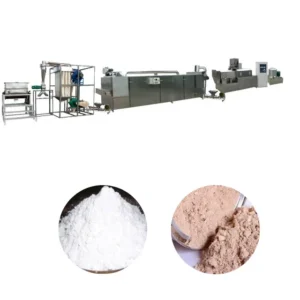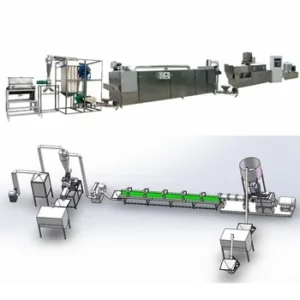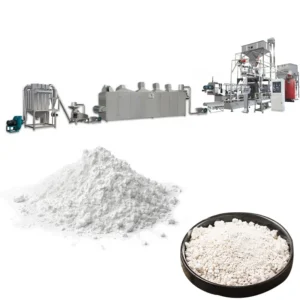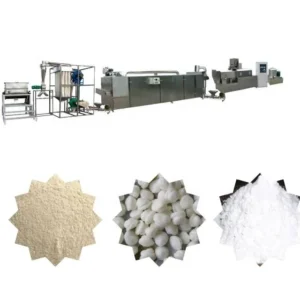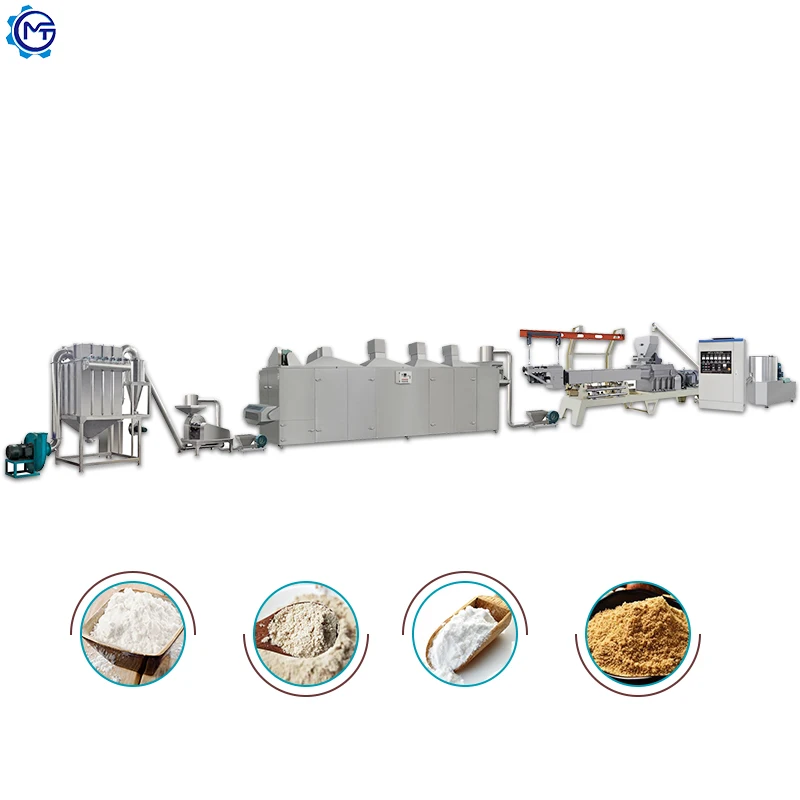
Integrated Equipment Line — Every station from mixer to grinder is catalogued and throughput-matched, preventing bottlenecks that arise when processors source extruders, dryers, and grinders from separate vendors without verifying capacity alignment across the modified starch processing line.
Technical Specifications
| Parameter | Value |
|---|---|
| Product Type | Modified Starch Processing Line |
| Capacity Range | 80-500 kg/h (basis not stated in source — confirm raw material type, moisture content and modification degree) |
| Screw Type | Twin screw |
| Contact Material | Food grade stainless steel 304 |
| Frame Material | Stainless steel 201 |
| Energy Options | Electricity / Gas / Diesel / Steam |
| Power Consumption | Approx. 100 kW (electric heating); 50-60 kW (gas or diesel heating) (rated or peak not specified in source) |
| Voltage & Frequency | Three phases 380V/50Hz, Single phase 220V/50Hz (customizable to local voltage) |
| Control System | Inverter by Delixi or Delta; motor by Siemens (China) or domestic top brand |
| Mixer Main Motor | 4.0 kW |
| Mixer Batch Output | 3.0–4.0 kg/time |
| Mixer Dimensions | 1.2 × 0.9 × 1.4 m |
| Screw Conveyor Main Motor | 1.1 kW |
| Screw Conveyor Output | 0–150 kg/h |
| Screw Conveyor Dimensions | 2.5 × 0.6 × 2.3 m |
| Assembly State | Complete line with supporting equipment |
| Standards | CE |
Application Suitability
| Application | Material or Output |
|---|---|
| Food-grade modified starch production | Wheat flour, corn starch, potato starch |
| Pregelatinized adhesive starch for industrial use | Non-food starch for paper and packaging |
| Starch modification processing | High-temperature and high-pressure gelatinization to increase molecular weight, viscosity and gelling properties |
The Dryer Bottleneck That Halts a 500 kg/h Extruder
Specifying the extruder without confirming dryer and grinder throughput is the most common reason modified starch lines fail to reach rated output.
When processors buy extrusion equipment based solely on barrel capacity, the downstream stations often cannot keep pace. Wet, gelatinized starch exiting the twin-screw extruder requires precise moisture reduction before grinding; if the dryer is undersized, material backs up, forcing operators to throttle the extruder feed rate. I have seen lines where the extruder was rated for several hundred kilograms per hour but actual sustained output was much lower because the thermal drying stage could not handle the volume. This mismatch is rarely apparent on a specification sheet. [NEED_CITE: typical moisture reduction requirements for pregelatinized starch drying]
Station-by-Station Equipment Survey
Evaluating a modified starch processing line manufacturer means examining every station as an independent unit before committing to a complete layout. The mixer operates at a batch output of 3.0–4.0 kg per cycle, feeding a screw conveyor rated at 0–150 kg/h. This staged feeding prevents the twin-screw extruder from being flooded, which would cause uneven gelatinization and inconsistent starch modification across the batch.
Matching Thermal Capacity to Extrusion Output
The dryer station represents the critical control point for pregelatinized starch quality. Multiple energy options — electricity, gas, diesel, or steam — allow processors to match utility availability at the installation site. Electric heating draws approximately 100 kW across the line, while gas or diesel configurations reduce electrical demand to 50-60 kW. Selecting the energy source early determines not only operating cost but also the physical footprint required for fuel storage or gas supply infrastructure. [NEED_CITE: industrial dryer energy consumption standards for starch processing]
How Screw Configuration Affects Gelatinization Degree
The twin-screw design provides the shear and residence time necessary to achieve full starch gelatinization under controlled temperature and pressure. Unlike single-screw systems, the intermeshing screw elements create a self-wiping action that prevents material buildup in the barrel — a frequent cause of burnt starch deposits that contaminate subsequent batches. The barrel temperature profile, divided into multiple heating zones, allows operators to ramp heat gradually as starch granules absorb moisture and swell. Food-grade 304 stainless steel contact parts ensure that no metal ion migration occurs during high-temperature processing, which is essential when producing starch destined for food or pharmaceutical applications. The screw configuration and die design must be matched to whether the raw material is corn starch, potato starch, or wheat flour, since each has different gelatinization temperatures and shear sensitivity.
When Voltage Mismatch Delays Commissioning
A modified starch processing line specified for 380V/50Hz three-phase power will not commission correctly on a 440V/60Hz supply without motor replacement or transformer installation. This oversight accounts for a significant share of delayed startups in export markets. The inverter and motor specifications must be confirmed against the destination facility’s actual grid supply before production begins, not after the equipment arrives on site. [NEED_CITE: voltage and frequency standards by export market]
Why Procurement from a Single Equipment Source Matters
Sourcing the entire modified starch processing line from one manufacturer means throughput calculations are performed across all stations before fabrication. The mixer batch cycle, screw conveyor feed rate, extruder barrel capacity, dryer residence time, and grinder throughput are balanced so that no single station forces the others to idle. Equipment arrives with electrical schematics matched to the buyer’s confirmed voltage and frequency, reducing the wiring errors that plague multi-vendor installations. Factory test records document individual machine performance on the buyer’s specified raw material before shipment. CE documentation supports import compliance in markets requiring conformity declarations. Technical support covers the complete line rather than forcing buyers to coordinate between separate extruder, dryer, and grinder suppliers when troubleshooting process issues.
Documentation & Verification
- Line layout drawing showing station spacing and utility connection points for the modified starch configuration
- Machine specification sheet detailing screw element arrangement and barrel zone temperatures for each extruder
- Electrical schematic confirming voltage, frequency, and inverter parameters matched to destination grid
- Factory test record documenting gelatinization degree and throughput on buyer’s starch raw material before dispatch
- CE declaration of conformity supporting machinery directive compliance for European import markets
- Wear parts list identifying screw elements, barrel liners, and die inserts requiring periodic replacement
Installation, Commissioning & Support
- Foundation must support combined weight of twin-screw extruder and dryer with level tolerance for conveyor alignment
- Dedicated electrical circuit required for 100 kW electric heating configuration or separate gas supply line for thermal drying
- Equipment ships in modular station assemblies requiring on-site mechanical connection and conveyor integration
- First startup includes barrel temperature profiling and screw speed adjustment to match gelatinization target for buyer’s starch type
- Operator training covers inverter parameter adjustment via Delixi or Delta interface for feed rate and screw speed control
- Initial spare parts package includes replacement screw elements and die inserts specific to the configured barrel assembly
Specifying Your Modified Starch Line
To configure a modified starch processing line that matches your production requirements, provide the raw material type — corn starch, potato starch, wheat flour, or industrial-grade starch — along with the target modification degree or end-use application. Specify the local voltage and frequency at the installation site, the available energy sources for the dryer station, and whether existing upstream or downstream equipment must be integrated into the layout. If product development on your specific formulation is needed before line commitment, request a trial run using your raw material in the testing workshop.
Frequently Asked Questions
Q: How do I select the right extruder capacity when raw material moisture content varies between batches?
A: Capacity ratings assume specific moisture and modification conditions. Provide your typical raw material moisture range and target gelatinization degree so that screw configuration and barrel heating zones can be matched to your actual processing parameters rather than generic test conditions.
Q: What voltage and control language options are available for export markets?
A: The line supports three-phase 380V/50Hz and single-phase 220V/50Hz as standard configurations, with customization available for destination market requirements. Confirm your facility’s exact supply voltage and frequency before production so that motors and inverters are wound correctly.
Q: How do I prevent throughput bottlenecks between the extruder and dryer stations?
A: Specify both stations together rather than purchasing the extruder independently. The dryer must handle the wet output mass flow rate from the extruder at the target moisture reduction level; undersizing the dryer forces operators to reduce extruder feed rate below rated capacity.
Q: What is the practical difference between electric, gas, diesel, and steam heating for the dryer?
A: Electric heating draws approximately 100 kW total line power but requires no fuel infrastructure. Gas or diesel reduces electrical demand to 50-60 kW but needs fuel storage and supply lines. Steam heating depends on existing boiler capacity at the installation site.
Q: Which spare wear parts should I order with the initial equipment purchase?
A: Order replacement screw elements, barrel liners, and die inserts matched to your configured screw assembly. These components experience continuous abrasion from starch granules under pressure and typically require replacement before other mechanical parts.