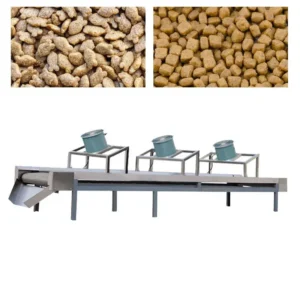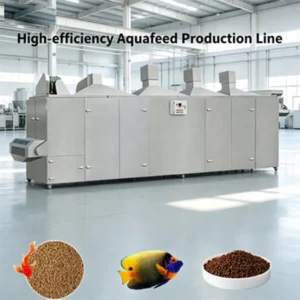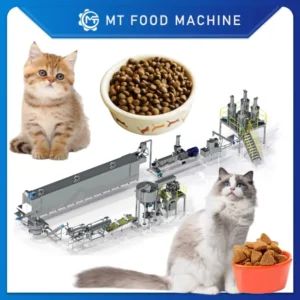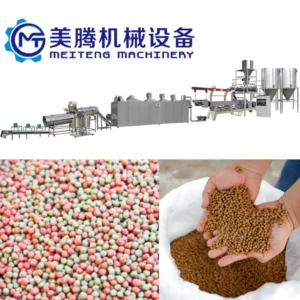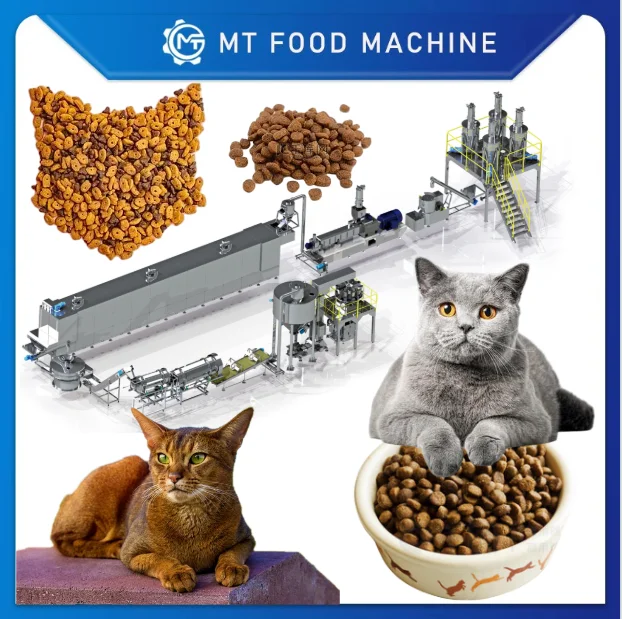
Full equipment range matched to recipe — throughput across every station from the mixer to the packer is balanced around the buyer’s actual raw material profile, not a catalog average, preventing the bottlenecks that appear when extruder output exceeds dryer capacity on high-moisture meat slurries.
Technical Specifications
| Parameter | Value |
|---|---|
| Product Type | Multi-Species Cat Food Processing Line |
| Output Capacity | 250-300 kg/h (basis not stated in source — confirm raw material / moisture content / kibble size) |
| Control System | PLC controlled |
| Line Type | Complete processing line (batching to packing) |
| Automation Level | Full automation |
| Screw Type | Twin-screw |
| Product Formats | Dry kibble, semi-moist, treats |
| Species Coverage | Multi-species (cat, dog, companion animals) |
| Recipe Adaptability | Versatile recipe adaptation |
| Quality Control | Consistent output for uniform product and stable nutritional content |
| Energy Design | Energy saving design |
| User Interface | User-friendly interface |
| Standards | CE, ISO |
Application Suitability
| Application | Material or Output |
|---|---|
| Dry kibble production for cats | Poultry meal, fish meal, corn flour, grain blends |
| Semi-moist and treat formats | High meat slurry, fresh meat paste, humectant blends |
| Multi-species companion pet food | Variable protein and starch ratios across cat and dog formulations |
| Startup brand turnkey production | Corn grits, soy protein, vitamin premix, fat coatings |
Why "Nominal Capacity" Fails When the Recipe Changes
A pet food processing line full equipment range quoted on a standard corn-based test recipe often cannot sustain that output once the buyer introduces a high fresh-meat formulation. The rated throughput holds only while the raw material matches the conditions used during the factory test. When the meat slurry ratio climbs and moisture content shifts, the material behaves differently inside the barrel — friction drops, expansion becomes inconsistent, and the downstream dryer receives product outside its designed load. I have watched lines stall for days because the extruder was pushing material the dryer could not handle in time. Selecting a pet food processing line full equipment range where every station is sized against your specific recipe, rather than a generic benchmark, avoids this gap [NEED_CITE: throughput matching principles in twin-screw extrusion lines].
Station Matching Across the Entire Line
The pet food processing line full equipment range covers batching, mixing, extrusion, drying, flavouring, cooling, and packing under one supplier scope. Each station is selected so its throughput aligns with the others, meaning the flavouring drum can handle what the dryer delivers and the cooler can keep pace with the coater. This eliminates the mid-line pile-ups that happen when a buyer sources an extruder from one vendor and a dryer from another, only to find the moisture removal rate does not match the output volume.
Recipe Flexibility Without Line Modifications
Switching between dry kibble, semi-moist pieces, and treats on the same pet food processing line full equipment range relies on screw configuration, barrel temperature profiling, and die selection. The twin-screw setup allows operators to adjust shear and residence time to suit recipes that range from high-starch grain blends to high-fat meat slurries. A producer running cat kibble in the morning and dog treats in the afternoon changes screw elements and die plates rather than replacing hardware, keeping the line productive across multiple product formats [NEED_CITE: twin-screw configuration flexibility in pet food extrusion].
Reading the Specs That Actually Matter
The PLC control system manages recipe parameters — barrel zone temperatures, screw speed, feeder rates, and dryer retention time — from a central interface. This matters because cat food formulations often include heat-sensitive vitamins and amino acids; tight temperature control across the barrel zones preserves nutritional content while still achieving the starch gelatinisation needed for proper expansion. The twin-screw design provides the mixing intensity required to disperse minor ingredients like taurine and vitamin premixes evenly through the dough, which a single-screw configuration would struggle to accomplish on high-meat recipes. Energy-saving design across the dryer and barrel heaters reduces the overall utility draw, an important factor when a line runs multiple shifts. Full automation across the batching, extrusion, and packing stations keeps operator intervention to a minimum, which supports batch-to-batch consistency.
The Hidden Cost of Misaligned Stations
When an extruder is specified without matching dryer or coating capacity, the bottleneck shows up within the first week of production. Wet kibble piles up at the dryer infeed, coating drums receive product that is still too warm, and packing stations face irregular feed rates. The result is product with inconsistent moisture content, uneven fat application, and shelf-life issues that surface after the goods reach the warehouse. I have seen producers run their extruder at reduced speed to compensate, which means they never reach the capacity they paid for [NEED_CITE: downstream bottleneck effects in food extrusion lines].
Why Source the Full Range from One Supplier
Every station in this line — mixer, extruder, dryer, flavouring drum, cooler, and packer — comes from one engineering scope, so the capacity calculation document reflects actual throughput across the entire chain rather than individual machine ratings. Screw configuration and die design are specified against the buyer’s raw material before production begins. The in-house testing workshop runs trial batches on the customer’s actual ingredients before shipment, so the line parameters are set based on real behaviour, not catalog assumptions. Twin-screw expertise spans pet food, aquatic feed, snacks, cereals, and protein applications, meaning the engineering team has encountered a wide range of material behaviours. Pre-sales consultation through on-site installation, commissioning, and operator training keeps responsibility with one supplier from first inquiry through steady-state production.
Documentation & Verification
- Line layout and capacity calculation matched to your specific raw material and target kibble size
- Trial run report on customer recipe conducted in the testing workshop before dispatch
- Screw and die configuration record tied to your product format and texture targets
- Electrical schematic with voltage and frequency confirmed for your facility
- Machine specification sheet covering every station from batching through packing
Installation, Commissioning & Support
- Foundation layout provided based on the full line footprint and station spacing requirements
- Electrical feed sized for the combined load of the extruder motor, barrel heaters, and dryer burners
- PLC interface configured in the operator’s language before the control cabinet leaves the workshop
- Commissioning includes trial runs on your raw material with screw speed and temperature adjustments logged
- Wear parts list covering screws, dies, and dryer belts supplied with the initial shipment
- Maintenance schedule aligned with the twin-screw element inspection intervals and bearing lubrication cycles
What We Need to Specify Your Line
Send your target recipe with raw material percentages, moisture content, and desired kibble dimensions so the extruder and dryer can be sized correctly. Include your facility voltage and frequency, available floor space with ceiling height, and the daily production target across all planned product formats. If you run existing upstream or downstream equipment that must integrate with the new line, share those specifications so the connection points can be engineered before fabrication.
Frequently Asked Questions
Q: How is the 250-300 kg/h capacity verified and on what raw material basis?
A: The stated output is verified during a trial run in the testing workshop using the buyer’s actual raw material. Because capacity varies with moisture content, meat slurry ratio, and kibble size, the final confirmed throughput is documented in the trial run report rather than assumed from a generic test on corn flour.
Q: How is throughput matched between the extruder, dryer, and coating stations?
A: Each station is selected so its processing rate aligns with the others. The dryer retention time and airflow are calculated against the extruder output moisture, and the flavouring drum volume is set to handle the coated product flow without accumulation or starvation.
Q: What stations are included and where does each fit in the production flow?
A: The line covers batching, mixing, twin-screw extrusion, drying, flavouring or fat coating, cooling, and packing. Each station connects in sequence with conveying equipment sized to transfer product between stages without bottlenecks or product degradation.
Q: How are screw configuration and die design specified to the buyer’s recipe?
A: The engineering team reviews the buyer’s raw material profile and target texture, then selects screw element arrangement and die geometry accordingly. High-meat recipes typically require different shear profiles and die openings compared to high-starch grain formulations.
Q: What documentation is provided for installation, operation, and ongoing maintenance?
A: Buyers receive a line layout, capacity calculation, electrical schematic, operation and maintenance manual, wear parts list, CE declaration of conformity, and the trial run report. These documents support local installation teams and ongoing production management.