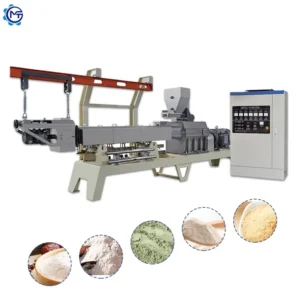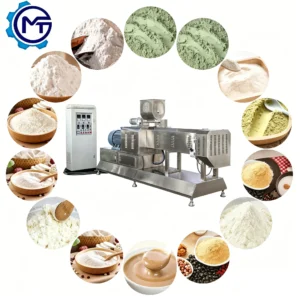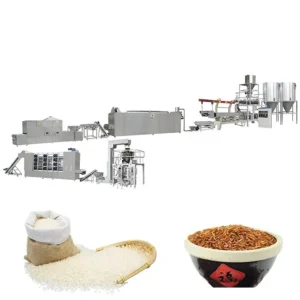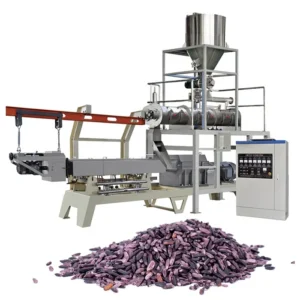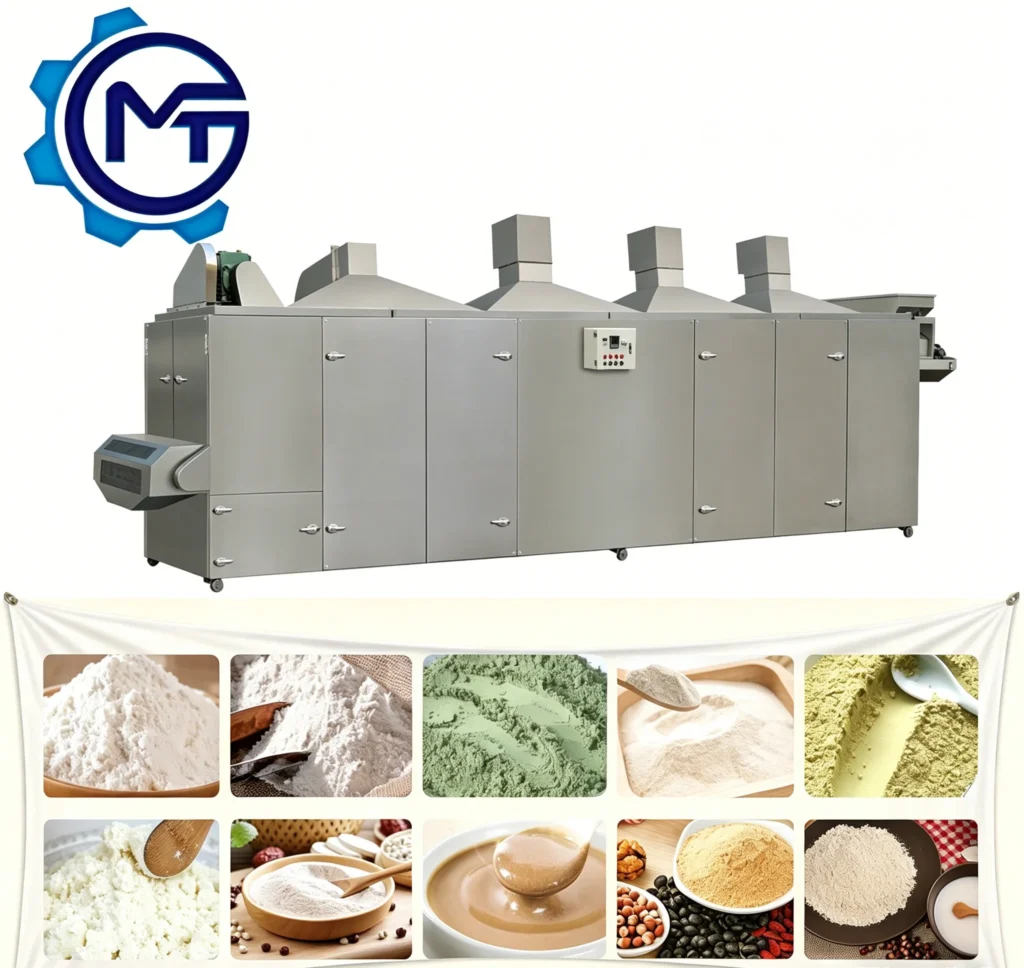
Single-Source Line Matching — Every station from batching to packing is sized against the extruder’s actual throughput on your grain formulation, preventing downstream bottlenecks that commonly occur when assembling equipment from separate vendors.
Technical Specifications
| Parameter | Value |
|---|---|
| Product Type | Nutrition Powder Processing Line |
| Output Capacity | 200–500 kg/h (basis not stated in source — confirm raw material type, moisture content, and formulation) |
| Construction Material | Food-Grade 304 Stainless Steel (contact surfaces) |
| Control System | Touch Control Panel with Digital System |
| Heat Source Options | Electric / Gas / Steam |
| Line Stations | Baking Ovens, Mixers (full line station list to be confirmed based on layout proposal) |
| Assembly State | Complete production line |
| Warranty | 1 year |
| After-Sales Service | Overseas engineer service available |
Application Suitability
| Application | Material or Output |
|---|---|
| Infant cereal and baby food production | Rice, corn, oats, and blended grain bases |
| Fortified nutrition powder manufacturing | Multi-grain formulations with added vitamins and minerals |
| Instant porridge and weaning food processing | Beans, legumes, and coarse grain mixtures |
| Dietary supplement and meal replacement base | Soy, corn, and rice protein blends |
Why the Heat Source Decision Must Precede the Extruder Order
Confirming your factory’s available utility infrastructure before selecting oven and dryer stations prevents costly commissioning delays.
A nutrition powder processing line full equipment range specification often focuses heavily on the extruder while treating drying and baking as afterthoughts. When ovens arrive configured for steam heating but the facility only has electrical capacity, installation stalls for weeks while retrofitting heating elements and recalculating power distribution loads. I have walked into plants where the dryer sat idle for a month because the gas supply pressure was insufficient for the burner specification on the purchase order [NEED_CITE: industrial gas supply pressure requirements for food processing ovens].
The downstream thermal stations must match the extruder output in both mass flow and moisture removal rate. If the dryer is undersized relative to the extruded product’s moisture content, the line backs up and operators reduce extruder feed rate, defeating the purpose of the rated capacity. Specifying electric, gas, or steam heat sources at the inquiry stage ensures each thermal station arrives configured for your actual workshop utilities.
How Station-to-Station Throughput Gets Balanced
The extruder pushes product at a continuous rate determined by screw speed, feed rate, and raw material density. Every downstream station — the conveyor, the dryer, the cooling belt, the milling or flaking unit, and the packing scale — must accept that flow without creating a queue or a starvation gap. When a nutrition powder processing line full equipment range is sourced from multiple vendors, each supplier sizes their equipment to a nominal figure that rarely accounts for the moisture load, bulk density, or cooling time your specific formulation demands.
Sizing the dryer requires knowing the inlet moisture from the extruder die and the target moisture for safe storage and milling. Grain-based infant cereal formulations behave differently from soy-heavy protein blends in both expansion and drying kinetics. The line proposal must document the calculated dwell time in each thermal zone against your raw material’s drying curve rather than quoting a generic belt length.
Where Multi-Grain Formulations Challenge Generic Screw Setups
Baby cereal and nutrition powder producers rarely run a single grain. Formulations shift between rice-heavy blends for younger infants and multi-grain mixtures incorporating corn, oats, beans, and sorghum for older age segments. Each raw material gelatinises at different temperatures and shear levels inside the barrel [NEED_CITE: starch gelatinisation temperature ranges for common cereal grains].
A screw configuration optimised for pure rice flour may fail to break down the harder endosperm structure in corn or beans, leaving gritty particles in the finished powder. The screw profile, compression ratio, and barrel temperature zones need to be selected against the most demanding formulation in your product portfolio, not the easiest one. Trial runs on the buyer’s actual raw material before shipment reveal whether the die pressure and shear history produce the target expansion and water absorption index for instant reconstitution.
Reading the Specification Sheet Beyond the Headline Numbers
The output capacity of 200–500 kg/h cannot be evaluated without knowing which formulation and moisture content produced that figure. Corn grits at fifteen percent moisture will flow and expand differently from a high-fibre bean blend at twenty percent moisture, meaning the same extruder delivers different mass throughput on each recipe. Food-grade 304 stainless steel on all contact surfaces meets the hygiene expectations for infant food production and withstands the repeated washdown cycles that cereal lines require.
The touch control panel with digital system replaces manual potentiometers and analogue gauges, giving operators repeatable setpoints for barrel zone temperatures and screw speed. Heat source flexibility across electric, gas, and steam options means the baking ovens and dryers can be matched to whatever utility is economically available at the installation site, rather than forcing an expensive infrastructure upgrade to accommodate a single-fuel machine.
What Happens When Dryer Capacity Lags Behind Extruder Output
An undersized dryer forces the operator to slow the extruder feed, reducing actual line output below the quoted figure. Product sits too long in the extruder barrel, overcooking and developing burnt flavours that contaminate the nutrition powder [NEED_CITE: effects of excessive residence time on cereal flavour profiles]. In severe cases the product discolours at the die and must be scrapped until the line reaches steady-state balance.
When the cooling conveyor cannot handle the thermal mass arriving from the dryer, product enters the milling stage above ambient temperature. Warm powder absorbs moisture from the air during storage, clumping in the silo and causing packing weight inaccuracies. These cascading failures trace back to a line that was quoted as a collection of individual machines rather than a throughput-matched system.
Why Buyers Consolidate This Equipment Under One Supplier
Line layout and capacity calculation documents show the mass balance at every transfer point, so you can verify that the dryer, cooler, and packing station each handle the extruder’s output on your specific formulation. Screw and die configuration records are specified against your raw material sample rather than copied from a generic template, reducing the trial-and-error period during commissioning.
The in-house testing workshop allows trial runs on customer-supplied raw material before shipment, so gelatinisation degree, expansion ratio, and powder reconstitution behaviour are validated before the line leaves the factory. Electrical schematics and voltage confirmation documents ensure the control panel and motor drives match the destination market’s power grid [NEED_CITE: voltage and frequency standards by export market]. Ongoing maintenance support includes wear parts supply for screws, dies, and cutter assemblies, preventing unplanned downtime when the first replacement cycle arrives.
Documentation & Verification
- Line layout drawing with throughput matched at every station for your target output
- Screw and die configuration record specified to your grain formulation sample
- Trial run report on your raw material from the in-house testing workshop
- Electrical schematic with voltage, frequency, and control language confirmed for your market
- Factory test record documenting run conditions and product quality measurements
- Operation and maintenance manual covering daily inspection points and wear part replacement intervals
Installation, Commissioning & Support
- Foundation load requirements specified per station weight and vibration profile of the extruder and milling units
- Dedicated electrical circuits sized for the total connected load of the extruder motor, dryer heaters, and control panel
- Assembly sequence planned so the extruder is positioned before overhead conveyor and dryer modules are rigged
- First-run parameter logging on the touch control panel to establish baseline barrel temperatures and screw speeds
- Operator training covering daily screen interpretation, alarm response, and emergency stop procedures
- Wear parts list identifying screw sections, die inserts, and oven belt links with recommended stock quantities
What to Include in Your Inquiry
Share the primary grain types and any high-fibre or high-protein ingredients in your formulation so the screw configuration can be matched before quotation. Specify the destination country’s voltage and frequency, along with your preferred control panel language, to avoid rewiring during commissioning. Indicate your available heat source — electric, gas, or steam — so the ovens and dryers arrive with the correct burners or heating elements installed.
Frequently Asked Questions
Q: How is the output capacity of 200–500 kg/h verified, and on which raw material formulation?
A: The rated range must be validated against your specific grain blend, moisture content, and target expansion. We request a raw material sample and conduct a trial run in the testing workshop, documenting the actual mass throughput, product density, and powder reconstitution quality. The report specifies which screw speed, barrel temperature profile, and die configuration produced the verified output, giving you a realistic production baseline rather than a generic catalogue figure.
Q: What is the complete list of line stations, and how is throughput balanced between extruder, dryer, and packing?
A: The full station list includes batching, mixing, extrusion, drying, cooling, milling or flaking, sifting, and packing. Each station is sized using a mass balance calculation that accounts for moisture removal in the dryer and volumetric flow on the cooling conveyor. The line layout document shows the rated capacity at every transfer point, confirming that no station creates a bottleneck when the extruder runs at its target output on your formulation.
Q: Which voltage, frequency, and control panel language options are available for the destination market?
A: The electrical system is configured to your site’s supply before production. We confirm voltage, phase, and frequency from your facility data sheet, and the touch control panel is loaded with the operator language you specify. The electrical schematic and a voltage confirmation document are included in the shipping documentation, so your local electrician can verify compliance with national standards upon arrival.
Q: Can a trial run be performed on the buyer’s actual raw material before shipment?
A: Yes. Send a representative sample of your grain formulation to the testing workshop before the line ships. Engineers run the extruder on your material, adjusting screw configuration and barrel temperature zones until the product meets your density, expansion, and reconstitution targets. The trial run report is shared with you, and any necessary configuration changes are implemented before the machine is crated for dispatch.
Q: What spare and wear parts are included, and what is the availability timeline for first replacement?
A: The shipment includes a starter set of wear parts — typically spare screw sections, die inserts, and cutter blades matched to your configuration. A wear parts list with part numbers and recommended reorder intervals is provided in the documentation. Replacement components are manufactured to the same specification and can be dispatched within a standard lead time once the first set reaches its service limit.