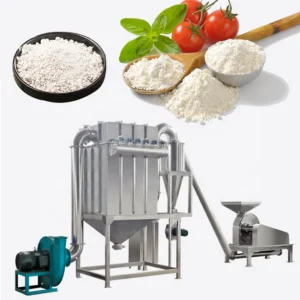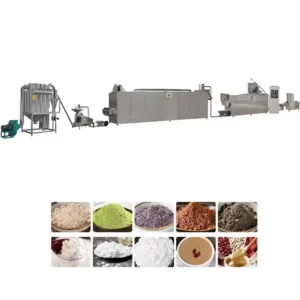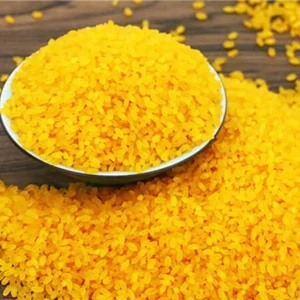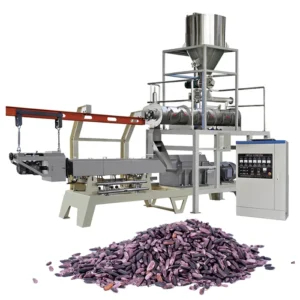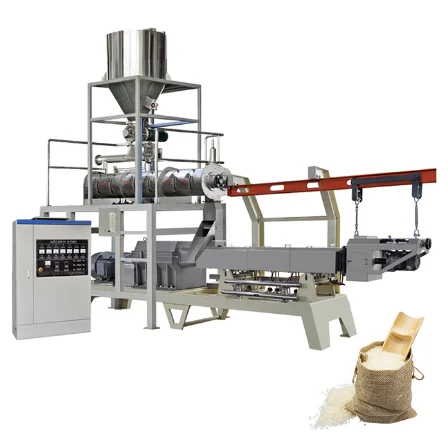
Screw Configuration Matched to Formulation — we specify barrel profiles and die geometry against the buyer’s actual grain blend and fortification additives before a single component is cut.
Technical Specifications
| Parameter | Value |
|---|---|
| Product Type | Nutritional Fortified Rice Extrusion Line |
| Available Extruder Models | MT65 / MT70 / MT85 / MT75 / MT95 |
| MT65 Installed Power / Consumption | 85 kW / 60 kW |
| MT65 Output Capacity | 80-100 kg/h (basis not stated in source — confirm raw material and moisture content) |
| MT65 Dimensions (L×W×H) | 28 × 1.2 × 2.2 m |
| MT70 Installed Power / Consumption | 120 kW / 85 kW |
| MT70 Output Capacity | 100-120 kg/h (basis not stated in source — confirm raw material and moisture content) |
| MT70 Dimensions (L×W×H) | 30 × 1.5 × 2.2 m |
| MT85 Installed Power / Consumption | 235 kW / 165 kW |
| MT85 Output Capacity | 200-300 kg/h (basis not stated in source — confirm raw material and moisture content) |
| MT85 Dimensions (L×W×H) | 34 × 3.5 × 4.3 m |
| MT75 Installed Power / Consumption | 180 kW / 135 kW |
| MT75 Output Capacity | 300-500 kg/h (basis not stated in source — confirm raw material and moisture content) |
| MT75 Dimensions (L×W×H) | 32 × 3.5 × 4.3 m |
| MT95 Installed Power / Consumption | 260 kW / 195 kW |
| MT95 Output Capacity | 800-1000 kg/h (basis not stated in source — confirm raw material and moisture content) |
| MT95 Dimensions (L×W×H) | 36 × 3.5 × 4.3 m |
| Screw Type | Twin-screw (with single or double screw feeding system option) |
| Control System | Frequency speed controlling with high automation |
| Lubrication | Automatic lubricating and cooling system |
| Drying Oven Heating Source | Electric or gas |
| Drying Method | Circulation drying with frequency motor mesh belt speed control |
| Key Features | CE and ISO certified manufacturing, full line integration from mixing to packing |
Application Suitability
| Application | Material or Output |
|---|---|
| Nutritional fortified rice production | Broken rice, corn, millet, wheat, oats, buckwheat, bean, starch with vitamin and mineral additives |
| Artificial rice kernel manufacturing | Rice flour blends and starch bases reconstituted into uniform rice-shaped kernels |
| High-nutrition reconstituted rice processing | Rice bran and broken rice upcycled with micro-nutrient fortification |
| Fortified food programme supply | Government and NGO nutrition programmes requiring controlled vitamin and mineral retention in rice kernels |
| Breakfast cereal rice grain production | Multi-grain blends including corn, oats and buckwheat extruded into rice-shaped cereal pieces |
Why Catalogue Capacity Alone Will Mislead Your Fortified Rice Project
Capacity figures on a spec sheet only mean something once the raw material formulation and moisture baseline are locked in.
I spent years on factory floors in the Pearl River Delta before moving into equipment selection, and the most expensive mistake I see buyers repeat is signing off on a line based on a brochure number. A nutrition rice extrusion project I consulted on last year was contracted against a rated throughput, but the buyer’s formulation carried a higher protein share from bean and bran additions. The screw shear could not gelatinise the starch properly at that load, expansion collapsed, and the downstream dryer and packer ran half-empty while the extruder choked. The nutritional fortified rice machine full equipment range listed here spans multiple extruder models so you can match a unit to your actual blend rather than forcing a blend to fit a catalogue number. [NEED_CITE: starch gelatinisation behaviour under varying protein and fibre ratios in twin-screw extrusion]
Matching Extruder Models to Grain Blends and Fortification Loads
Selecting from the MT65 through MT95 series is not simply a matter of picking the largest barrel you can power. Each model in this nutritional fortified rice machine full equipment range carries a different screw volume, motor rating and residence time profile. A formulation heavy in broken rice with modest vitamin dusting behaves very differently in the barrel from one loaded with oat fibre and bean protein. The twin-screw configuration allows screw element rearrangement so that shear intensity, mixing length and compression ratio are set to the specific raw material rather than a default build.
How Drying and Cooling Stations Must Track Extruder Output
The extruder is only one station. The circulation drying oven uses a frequency-controlled mesh belt to adjust residence time, which matters because fortified rice kernels with higher moisture from the barrel need longer dwell at lower temperature to avoid cracking the vitamin matrix. If the dryer belt speed is fixed while the extruder output fluctuates, you get either under-dried kernels that spoil in the bag or over-dried kernels that fracture during packing. The low-temperature drying followed by high-temperature roasting and a second cooling stage in this line is designed so that each station can be tuned independently to match the upstream throughput. [NEED_CITE: thermal degradation thresholds for common vitamin premixes during grain drying]
Reading the Specification Table Without Getting Misled
The installed power figures — ranging from 85 kW on the MT65 to 260 kW on the MT95 — tell you the electrical infrastructure you need to prepare, not how much the machine will draw during steady-state running. Power consumption values are lower because the main drive does not run at full torque continuously. The overall dimensions span from 28 metres line length on the smallest configuration to 36 metres on the largest, which means your workshop needs clear floor space plus service access on both sides. Frequency speed control across the line means that motor speeds at the feeder, extruder, dryer belt and cooling conveyor are all independently adjustable, so you are not locked into a fixed ratio between stations.
What Happens When Line Stations Are Sized Independently
A buyer who sources an extruder from one vendor and a dryer from another often discovers that the dryer thermal capacity was rated on a different product moisture content. The result is a bottleneck where the extruder must slow down to let the dryer catch up, or the dryer runs at maximum belt speed with kernels still too wet for packing. I have walked into plants where the flavouring drum could not keep pace because its rotation speed was specified for a lighter snack product, not dense rice kernels. When every station in the nutritional fortified rice machine full equipment range is specified together, the throughput calculation runs through all of them at once, and the quotation reflects matched capacity rather than individual machine ratings that do not add up. [NEED_CITE: common throughput mismatches in multi-station food processing lines]
Why Procurement Should Happen Against Your Formulation, Not a Sample
Every line we configure goes through a trial run using the buyer’s actual raw material before shipment. The screw and die record from that trial becomes part of the documentation package, so when you install the line, the starting parameters are already proven on your grain blend. Electrical schematics are confirmed against your local voltage and frequency before production begins — not discovered on site when the motor will not start. Capacity calculations are documented with the formulation basis stated, so there is no ambiguity about what throughput was actually tested. The testing workshop is in-house, which means the engineers who set the screw configuration are the same ones who will support commissioning at your facility.
Documentation & Verification
- Line layout drawing showing every station from mixer to packer with utility connection points
- Screw and die configuration record from trial run on your grain blend and fortification premix
- Electrical schematic with voltage and frequency confirmed to your facility specification
- Factory test record documenting throughput and kernel quality on your raw material before dispatch
- CE declaration of conformity and ISO certificate for customs and regulatory submission
- Operation and maintenance manual with wear parts list specific to your extruder model
Installation, Commissioning & Support
- Floor space planning based on line dimensions from 28 to 36 metres length with service corridor allowance
- Dedicated electrical circuit sized to the installed power of your selected extruder model, up to 260 kW
- Equipment arrives in modular sections for assembly on site with alignment checks at each station
- Commissioning includes first-run parameter setting on your raw material with screw speed and barrel temperature profiling
- Operator training covers frequency drive adjustment at every station and automatic lubrication system monitoring
- Wear parts list provided with screw elements, die inserts and dryer belt sections identified for first reorder
What to Include in Your First Technical Enquiry
Send us your target formulation — the grain base, the percentage of protein and fibre additions, and the vitamin or mineral premix you intend to use. Specify your daily production target in kilograms so we can match an extruder model and calculate dryer and cooling residence times. Confirm the voltage, frequency and control language at your facility, because the electrical build starts from that point. If you have existing upstream batching or downstream packing equipment, share the interface details so the line can connect without a throughput gap.
Frequently Asked Questions
Q: How do I confirm actual output capacity for my specific grain formulation and moisture level?
A: Output capacity varies with raw material composition, protein content and moisture percentage. We run a trial in the testing workshop using your exact grain blend and fortification premix before shipment. The trial run report documents the throughput achieved and the kernel quality measured, giving you a verified baseline rather than a catalogue estimate.
Q: Which extruder model fits a mid-scale fortified rice production target?
A: Model selection depends on your formulation and daily output goal, not just a capacity number. The MT75 and MT85 sit in the middle of the range with different screw volumes and power ratings. We recommend sharing your target throughput and grain blend so the screw configuration and downstream dryer capacity can be matched together in one calculation.
Q: How is voltage and control system configuration handled for different export markets?
A: Voltage, frequency and control language must be confirmed before production starts. The electrical schematic is prepared against your facility specification, and the frequency drive system at each station is set accordingly. This avoids commissioning delays caused by mismatched motor ratings or unreadable interface labels on site.
Q: How are screw and die parameters set for rice fortified with vitamin and mineral additives?
A: Fortification additives change the rheology inside the barrel, affecting starch gelatinisation and expansion. Screw element arrangement and die geometry are configured during the pre-shipment trial run on your actual formulation. The resulting screw and die configuration record is documented and shipped with the machine so you start production with proven parameters.
Q: What supporting equipment is included beyond the extruder itself?
A: The full line covers mixing, extruding, vibrating, low-temperature drying, cooling, high-temperature roasting, a second cooling stage and packing. Each station is sized against the extruder output so there is no bottleneck. The drying oven heating source is available in electric or gas, and mesh belt speed is frequency-controlled for independent adjustment.