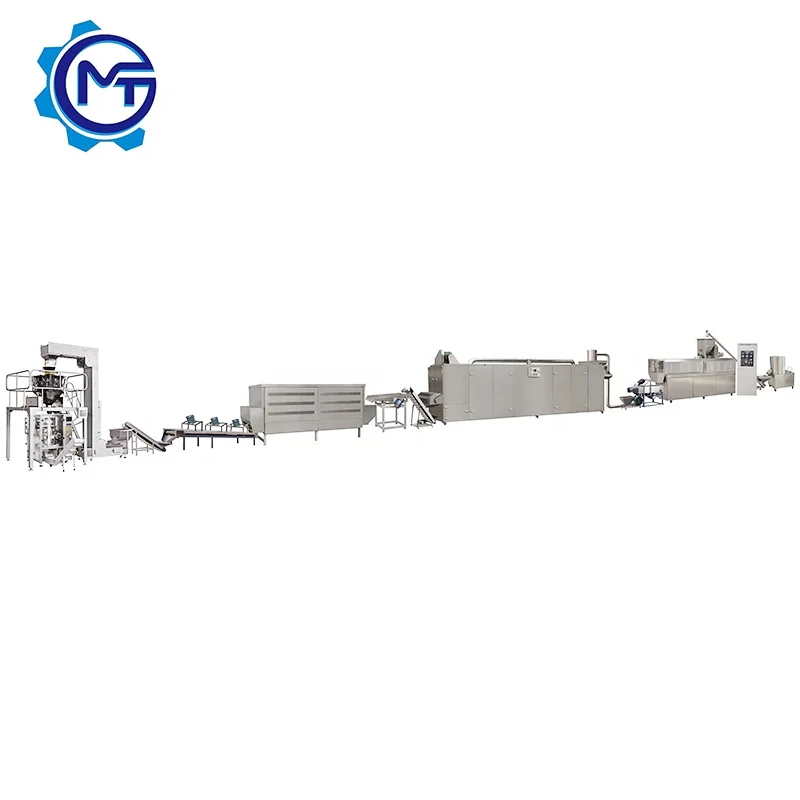
Screw configuration matched to your formula — Every nutritional powder processing line begins with a trial run on your actual raw material in our in-house testing workshop, ensuring the twin-screw profile and die geometry are specified before the line ships.
Technical Specifications
| Parameter | Value |
|---|---|
| Model | MT65 / MT70 / MT70C |
| Product Type | Nutritional Powder Processing Line |
| Screw Type | Twin-screw (Double Screw Extruder) |
| Installed Power | MT65 — 70 kW; MT70 — 90 kW; MT70C — 110 kW |
| Real Power Consumption | MT65 — 40 kW; MT70 — 60 kW; MT70C — 90 kW |
| Output Capacity | MT65 — 100–150 kg/h (basis not stated in source); MT70 — 150–200 kg/h (basis not stated in source); MT70C — 200–250 kg/h (basis not stated in source) |
| Overall Dimensions (L×W×H) | MT65 — 22,000×1,200×2,200 mm; MT70 — 25,000×1,500×2,200 mm; MT70C — 30,000×3,500×4,300 mm |
| Control System | PLC and MCC, language configurable per target market |
| Line Stations | Mixing & batching, twin-screw extrusion, drying, milling/pulverizing, packing |
| Contact Materials | Food-grade throughout all product-contact surfaces |
| In-house Trial Run | Available on customer raw material before shipment |
| Assembly State | Complete line from batching to packing |
| Warranty | At least 1 year from completion of commissioning |
| Certification | CE, ISO |
Application Suitability
| Application | Material or Output |
|---|---|
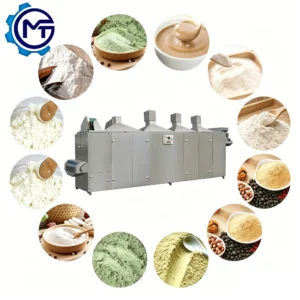
| Infant and baby food powder | Rice flour, corn flour, wheat flour blended with dairy or whey protein |
| Fortified breakfast cereal powder | Multi-grain blends with added vitamins and mineral premixes |
| Instant nutritional drink powder | Starch-based carriers with protein isolates and micronutrients |
| Modified and pregelatinised starch powder | Corn starch, cassava starch, potato starch for food and industrial use |
| Texturized vegetable protein powder | Defatted soy flour, pea protein concentrate |
Why the Formula You Send Determines the Line You Buy
A nutritional powder processing line is only as reliable as the raw material data behind its screw and die configuration.
I spent years running extrusion trials for overseas food projects, and one lesson came at the cost of an entire commissioning week. A South Asian client ordered a baby rice cereal line, and our pre-shipment trial ran flawlessly on standard rice flour. When the machine arrived on site, their actual formula carried a high whey protein ratio. The die clogged within minutes, expansion collapsed, and we rebuilt the screw profile from scratch under factory conditions [NEED_CITE: starch gelatinisation behaviour under varying protein-to-starch ratios]. That experience changed how every nutritional powder project is handled here — no line leaves the workshop until the customer’s real formula has been tested on the actual extruder.
When buyers compare a nutritional powder processing line full equipment range across suppliers, the specification sheet rarely reveals whether the screw elements were chosen for generic grain flour or for the buyer’s specific blend. High-protein formulas behave differently under shear and heat than pure starch bases. Moisture content, fat ratio, and particle size all shift the residence time and pressure profile inside the barrel. Without a documented trial on your exact material, capacity figures on paper mean little once production begins.
Station-by-Station Equipment Breakdown
The nutritional powder processing line full equipment range spans five major stations. The batching and mixing stage meters each ingredient by weight, blending grain flours with protein concentrates, vitamin premixes, and mineral salts before feeding the extruder hopper. Consistent premix homogeneity directly affects the gelatinisation uniformity inside the barrel.
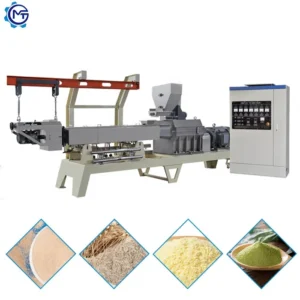
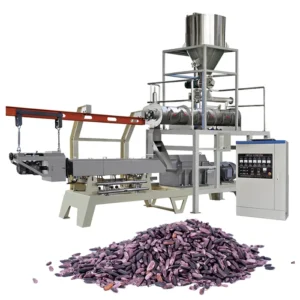
The twin-screw extruder applies high temperature and high pressure to gelatinise starch and denature protein in a single continuous pass. Barrel sections are independently heated, and the screw configuration — combining conveying, kneading, and reverse elements — is selected after the in-house trial run. This extrusion step is where digestibility and nutrient bioavailability are largely determined for infant and nutritional powders.
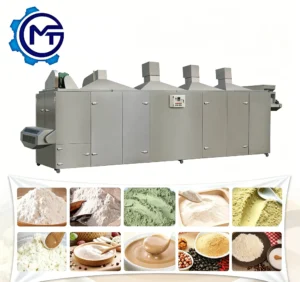
Downstream, the dryer reduces moisture to a level safe for milling and storage. Multi-pass belt dryers allow residence time adjustment so that the powder precursor reaches the target moisture without case-hardening. The milling and pulverizing station then reduces the dried extrudate to the fine particle size required for instant powder reconstitution. Finally, the packing station fills and seals the finished powder in formats ranging from sachets to bulk bags.
Throughput Matching Across Every Station
An extruder running at its rated output is worthless if the dryer cannot remove moisture fast enough or the mill cannot keep up with the dried extrudate feed rate. Each station in the nutritional powder processing line full equipment range is sized so that its maximum throughput exceeds the extruder output by a defined margin, preventing bottlenecks during steady-state production [NEED_CITE: throughput matching methodology for continuous food processing lines].
The PLC and MCC control system links every station through interlocked start-stop sequences and variable-frequency drives. If the dryer temperature drifts outside the set band, the extruder feed rate automatically reduces, protecting product quality. This coordinated control is critical when processing heat-sensitive nutritional ingredients such as added vitamins and probiotics, where even brief over-temperature exposure degrades potency.
Reading the Specification Sheet with a Process Engineer’s Eye
Three parameters on the nutritional powder processing line spec sheet carry the most weight for buyers evaluating fit. First, installed power versus real power consumption reveals the actual energy draw during steady-state extrusion — the gap between the two figures indicates motor reserve capacity for start-up torque and dense formula surges. Second, overall dimensions define the floor space and ceiling height needed; the MT70C line, for instance, stands over four metres tall, requiring adequate overhead clearance for maintenance access and ventilation ductwork.
Third, the screw type — twin-screw across all three models — provides self-wiping action that prevents material stagnation inside the barrel, a non-negotiable requirement when processing infant food formulas with strict hygiene standards. The number of barrel sections and the L/D ratio determine residence time, which directly controls the degree of starch gelatinisation. Longer residence allows more complete gelatinisation at lower peak temperatures, preserving heat-labile nutrients.
The Hidden Cost of Skipping the Pre-Shipment Trial
When a nutritional powder line is built on generic screw configurations and shipped without a material-specific trial, the buyer absorbs the cost of commissioning delays. Engineers spend days on site adjusting barrel temperatures, screw speed, and feed rate to compensate for a screw profile that was never matched to the actual formula [NEED_CITE: on-site commissioning delays caused by generic screw configurations]. Every day of lost production represents unfulfilled orders and idle downstream staff.
Beyond the time cost, repeated trial-and-error runs consume raw material and generate off-spec powder that must be discarded or sold at a discount. More critically, inconsistent gelatinisation from an unoptimized screw profile affects the nutritional claims printed on the packaging — a regulatory risk in markets with strict infant food standards.
Why Buyers Survey the Full Range Here
Every station from batching to packing is listed with its role and capacity band, so buyers can verify throughput matching before committing to a line layout. The nutritional powder processing line full equipment range is presented as individual stations that can be specified separately or as a coordinated line.
Screw configuration and die design are documented per the buyer’s raw material, not copied from a generic template. The in-house testing workshop runs trials on the customer’s actual formula before the line is approved for shipment, producing a written trial report.
Food-grade contact materials are used throughout every product-touching surface, meeting the sanitary requirements for infant and nutritional food production. Pre-sales consultation covers line layout, utility planning, and phased installation scheduling, continuing through on-site commissioning and operator training.
Documentation & Verification
- Line layout and capacity calculation showing throughput at each station for your target output
- Screw and die configuration record matched to your grain flour and protein blend
- Trial run report on your raw material from the in-house testing workshop before dispatch
- Electrical schematic with voltage and frequency confirmed to your factory standard
- CE declaration of conformity and ISO certificate for customs and regulatory clearance
- Operation and maintenance manual with illustrated wear parts list
Installation, Commissioning & Support
- Foundation and floor space planning based on the selected model’s overall dimensions and weight distribution
- Dedicated electrical circuit sized to the line’s real power consumption, with voltage and frequency matched to local supply
- Modular station delivery allowing phased installation where ceiling height or doorway width limits access
- First-run parameter setting on your raw material with barrel temperature zones and screw speed tuned to your formula
- Operator training covering PLC interface navigation, emergency stop procedures, and daily sanitation protocols
- Wear parts list for screws, dies, and dryer belts with recommended replacement intervals
What to Share with Your Inquiry
To configure a nutritional powder processing line that fits your production target, provide your raw material list with approximate ratios — especially the protein and fat content alongside the base grain flour. Specify your target hourly or daily output so the correct extruder model and dryer length can be selected. Confirm your factory’s voltage, frequency, and preferred control language so the PLC and MCC system is built to match.
Frequently Asked Questions
Q: What machines are included in the full nutritional powder processing line, and can I order individual stations?
A: The line covers mixing and batching, twin-screw extrusion, drying, milling, and packing. Each station is listed in the nutritional powder processing line full equipment range and can be specified individually or as a coordinated line. Throughput matching between stations is calculated during the layout phase to ensure no bottleneck forms at any point.
Q: How do the MT65, MT70, and MT70C extruder models differ in capacity and footprint?
A: The three models span increasing capacity bands, with corresponding rises in installed power and overall dimensions. The MT70C, for example, requires a longer floor span and greater ceiling clearance than the MT65. Selection depends on your target output and available factory space, confirmed during the line layout and capacity calculation stage.
Q: What raw materials can this line process, and how does screw configuration change between formulas?
A: Rice flour, corn flour, wheat flour, and other grain bases are standard, often blended with whey protein, soy isolate, or vitamin premixes. High-protein formulas require different kneading block arrangements and die geometries than pure starch blends. The screw configuration is specified after an in-house trial on your actual material.
Q: Is the dryer capacity matched to the extruder, and can dryer dimensions be customised?
A: Dryer belt length, layer count, and air flow volume are sized to handle the extruder’s output at the target moisture reduction. Customisation is available to accommodate factory ceiling height or specific drying curves required by heat-sensitive nutritional ingredients. The throughput matching document confirms the dryer’s capacity relative to the extruder.
Q: What documentation accompanies each machine at shipment?
A: Buyers receive a machine specification sheet, screw and die configuration record, electrical schematic, trial run report, CE declaration, ISO certificate, operation manual, and wear parts list. These documents support customs clearance, on-site commissioning, and ongoing maintenance scheduling throughout the equipment’s service life.