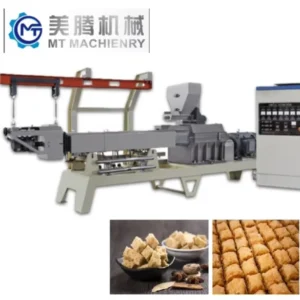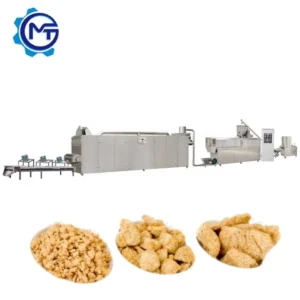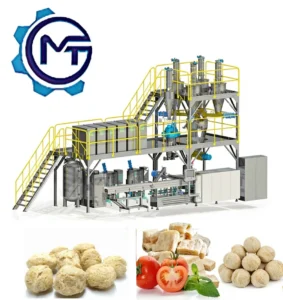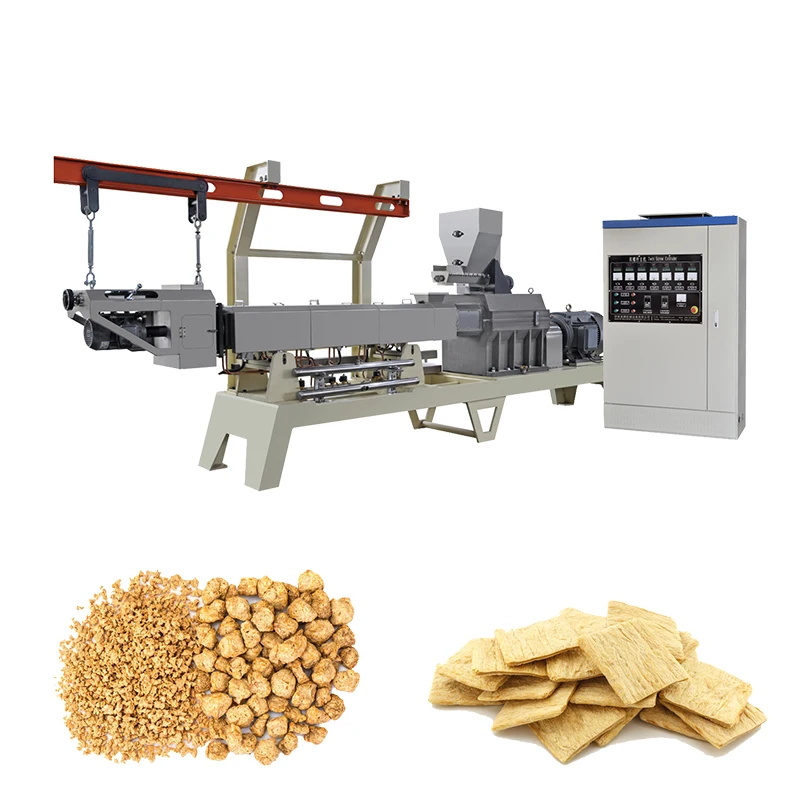
Integrated Equipment Range — Every station from powder blending to finished soy chunk packing is capacity-matched within a single supplier scope, eliminating the throughput gaps that occur when machines are assembled from separate vendors.
Technical Specifications
| Parameter | Value |
|---|---|
| Product Type | Textured Vegetable Protein (TVP) / Soy Protein Extrusion Production Line |
| Line Configuration | Mixer → Screw Conveyor → Twin-screw Extruder → Vibrating Conveyor → Dryer → Cooling Machine → Packing |
| Extruder Type | Twin-screw |
| Model Options | MT65 / MT70 / MT85 |
| MT65 Installed Power / Actual Power | 85 kW / 65 kW |
| MT65 Output | 150–200 kg/h (basis not stated in source — confirm raw material formulation and moisture content) |
| MT65 Overall Dimensions | 18000 × 1300 × 2300 mm |
| MT70 Installed Power / Actual Power | 120 kW / 90 kW |
| MT70 Output | 200–300 kg/h (basis not stated in source — confirm raw material formulation and moisture content) |
| MT70 Overall Dimensions | 20000 × 1500 × 2400 mm |
| MT85 Installed Power / Actual Power | 195 kW / 165 kW |
| MT85 Output | 600–800 kg/h (basis not stated in source — confirm raw material formulation and moisture content) |
| MT85 Overall Dimensions | 24000 × 3500 × 4300 mm |
| Mixer Tank Volume | 150 kg per batch |
| Mixer Rotary Speed | 385 rpm |
| Mixer Power | 4 kW |
| Mixer Dimensions | 1000 × 630 × 1100 mm |
| Dryer Belt Effective Length | 3.5 m |
| Dryer Heating | Far infrared, 3.9 kW × 24 elements |
| Dryer Gas Consumption | 6.8 m³/h (source value — verify against manufacturer catalog) |
| Dryer Dimensions | 4500 × 1500 × 1600 mm |
| Contact Material | Stainless steel (food-grade) |
| Assembly State | Pre-assembled modules |
| Certification | CE, ISO |
| Warranty | 1 year complete, lifetime maintenance service |
Application Suitability
| Application | Material or Output |
|---|---|
| Textured vegetable protein / soy chunks | Low-temperature soybean meal, defatted soy flour |
| Plant-based meat analogues for sausage and ham | Soy and peanut protein blends |
| Vegetarian products for canned and quick-frozen food | Protein meals requiring fleshy fiber structure |
| Meat substitutes for fast food industry | TVP with oil, water and flavour absorption characteristics |
Why Matching Dryer Capacity to Extruder Output Changes Everything
A twin-screw extruder running at full throughput is only as productive as the dryer downstream can handle.
I have watched production floors where a high-output extruder pushes out several hundred kilograms of wet protein per hour, only to pile up in front of an undersized dryer belt. The result is material backing up on the vibrating conveyor, operators manually shovelling product to keep things moving, and fibre structure collapsing because the chunks sat too long before drying began [NEED_CITE: consequences of extruder-dryer throughput mismatch in protein extrusion]. When sourcing a textured vegetable protein production line full equipment package, the capacity calculation must start from the slowest station, not the fastest. Buyers who quote an extruder by its nameplate output without auditing the downstream dryer and cooler often discover the real line capacity weeks after commissioning.
Every Station in the Protein Extrusion Flow
The textured vegetable protein production line full equipment sequence begins with powder blending in the mixer, where soybean meal and any supplementary protein sources are combined with moisture at a controlled ratio. The screw conveyor then meters this blend into the twin-screw extruder at a consistent feed rate, which is critical because fluctuations in feed volume directly affect barrel fill level and residence time. After extrusion, the hot, expanded protein strands pass over the vibrating conveyor to the dryer, where far infrared elements remove surface and internal moisture to stabilise the fibrous structure.
How Fibre Formation Depends on Station Sequencing
The fleshy fibre structure that defines TVP quality forms inside the extruder barrel under specific shear, temperature and moisture conditions, but it is preserved or destroyed by what happens immediately after the die. If the vibrating conveyor transfers product too aggressively, the delicate strands break apart before they reach the dryer belt. If the dryer temperature profile is uneven across the 3.5 m belt length, some chunks over-dry and become brittle while others retain too much moisture, creating inconsistency in the final water absorption characteristics [NEED_CITE: protein fibre stabilisation during post-extrusion drying]. The cooling machine downstream must then bring product temperature down gradually to prevent condensation inside packaging, which would invite mould growth during storage.
Reading the Power and Dimension Data for Line Planning
The three extruder models — MT65, MT70 and MT85 — span a range of installed power from 85 kW to 195 kW, with actual running power substantially lower due to motor load factors during steady-state extrusion. The MT85 requires a 24 m floor length and 4.3 m headroom, which means facility planning must account for ceiling clearance and service access around the barrel and die zone. The mixer draws 4 kW at 385 rpm, processing 150 kg batches, so batch cycle time must be calculated against the extruder’s continuous feed rate to avoid starvation or overflow at the conveyor inlet. The dryer’s 24 far infrared elements at 3.9 kW each represent a significant thermal load, and the gas consumption figure of 6.8 m³/h suggests a dual-fuel option that buyers should confirm against local utility availability.
What Happens When Screw Configuration Ignores Your Raw Material
A generic screw profile designed for standard defatted soybean meal will produce poor results when the actual feedstock is pea protein, chickpea flour or a blend with higher fibre content. The compression ratio, kneading block placement and die aperture all interact with the specific gelatinisation behaviour of the protein source [NEED_CITE: screw configuration adaptation for alternative plant proteins]. I have seen entire trial batches emerge from the die as powder rather than structured fibre because the screw elements were configured for a different raw material than what the buyer actually sources locally. The configuration must be documented and tested against the buyer’s own formulation before the extruder leaves the factory.
Why This Equipment Range Holds Together
The line is supplied as a single integrated package rather than assembled from separate equipment vendors, which means throughput calculations are performed across every station before the layout is finalised. Screw configuration and die design are specified to the buyer’s raw material formulation, not copied from a generic template. The in-house testing workshop allows trial runs on the buyer’s actual protein meal before shipment, catching formulation mismatches early. Stainless steel food-grade contact surfaces are maintained across the mixer, extruder, dryer and cooler, simplifying hygiene compliance for food safety audits. Pre-sales engineering consultation covers layout, utility planning and voltage confirmation so that commissioning is not delayed by electrical mismatches on arrival.
Documentation & Verification
- Line layout and capacity calculation showing matched throughput at every station for your target output
- Machine specification sheet with screw and die configuration recorded for your specific protein meal
- Electrical schematic with voltage and frequency confirmed against your facility supply standard
- Trial run report produced on your raw material in the testing workshop before dispatch
- CE declaration of conformity and ISO certificate included with shipment documentation
- Wear parts list identifying screws, dies and heater elements for first replacement ordering
Installation, Commissioning & Support
- Floor space planning based on the MT65, MT70 or MT85 overall dimensions and dryer footprint
- Dedicated electrical circuit sized for the selected extruder’s installed power rating up to 195 kW
- Pre-assembled modules arriving in sequence for staged positioning along the 18–24 m line length
- On-site commissioning including screw speed, barrel temperature and dryer belt speed parameter setting
- Operator training covering feed rate adjustment, die changeover and mixer batch cycle management
- Spare wear parts inventory recommendation covering twin-screw elements, die plates and far infrared heater elements
What to Prepare Before Requesting a Quotation
Specify the exact protein meal or blend you intend to process, including moisture content and particle size distribution. Confirm your target hourly output, available floor space and ceiling height, along with the local voltage, frequency and preferred control language. If you are integrating this line with existing upstream milling or downstream packing equipment, provide the interface specifications so the line layout can account for those connection points.
Frequently Asked Questions
Q: How do I verify each station’s capacity matches the extruder output on my raw material?
A: Request the line layout and capacity calculation document, which maps throughput at the mixer, conveyor, extruder, dryer and cooler based on your specific protein formulation. A trial run in the testing workshop using your actual raw material provides measured output data before the equipment ships, confirming that no single station creates a bottleneck.
Q: What voltage and control options are available for different export markets?
A: Voltage and frequency are confirmed during the specification stage to match your facility electrical supply. Control system options including PLC and MCC configurations are available, with operator interface language set to your preference. The electrical schematic is provided before production so your electrical contractor can prepare the incoming supply.
Q: Which screw and die setup is used for soybean meal versus peanut meal?
A: The screw configuration and die aperture are specified individually based on the protein content, fibre level and gelatinisation characteristics of your raw material. A configuration record is documented for your formulation, and the trial run in the testing workshop validates the fibre structure and expansion behaviour before the extruder is shipped.
Q: How is the dryer sized to prevent bottlenecks at higher extruder outputs?
A: The dryer belt length, heating element count and gas or electric heating capacity are calculated against the extruder’s actual output on your formulation. This ensures moisture removal keeps pace with extrusion throughput, preventing product accumulation on the vibrating conveyor and maintaining consistent fibre structure through the drying stage.