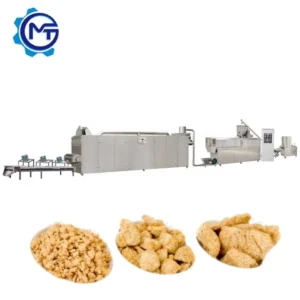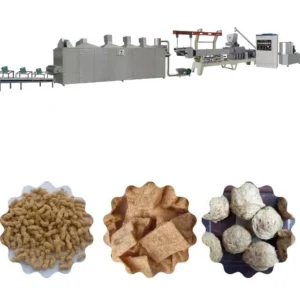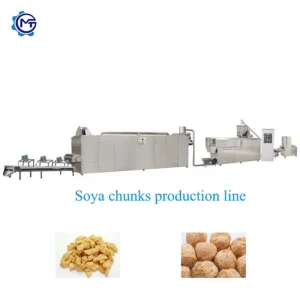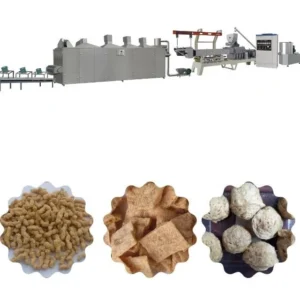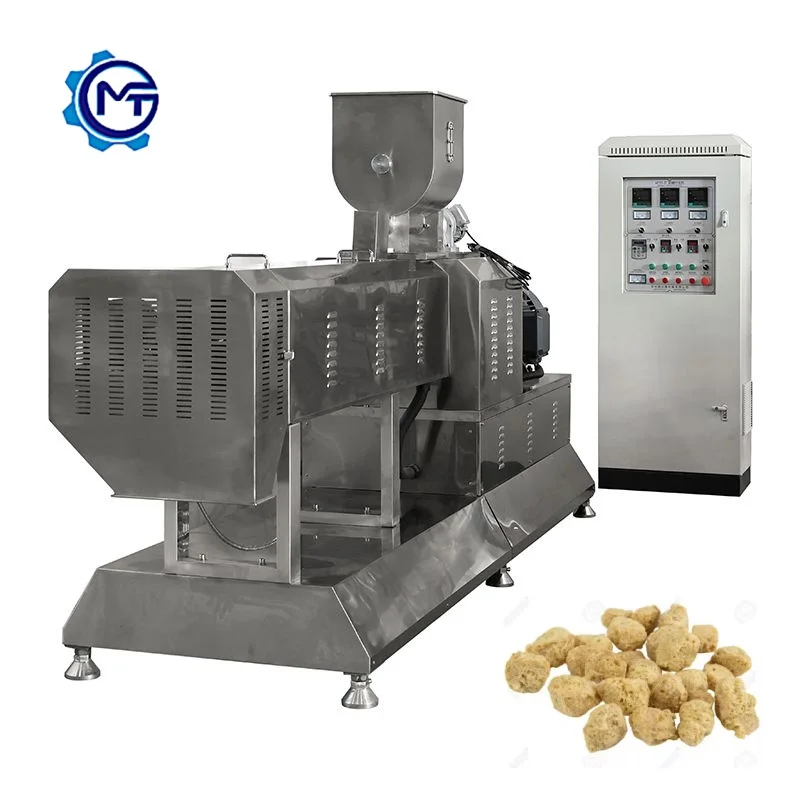
Integrated line from batching through extrusion to drying under one supplier — every station’s throughput is matched to the next so your MT85 extruder never waits on an undersized dryer.
Technical Specifications
| Parameter | Value |
|---|---|
| Product Type | Twin Screw Extruder Production Line for Texturized Soy Protein (TVP/TSP) |
| Models Available | MT65 / MT70 / MT75 / MT85 |
| Installed Power | MT65 — 84 kW; MT70 — 160 kW; MT75 — 190 kW; MT85 — 210 kW |
| Power Consumption | MT65 — 59 kW; MT70 — 120 kW; MT75 — 140 kW; MT85 — 140 kW |
| Output Capacity | MT65 — 100–150 kg/h; MT70 — 150–200 kg/h; MT75 — 150–200 kg/h; MT85 — 250–300 kg/h (basis not stated in source — confirm raw material, moisture and die configuration) |
| Overall Dimensions (L×W×H) | MT65 — 40000×1200×2200 mm; MT70 — 41000×1500×2200 mm; MT75 — 43000×1500×3200 mm; MT85 — 45000×1500×3500 mm |
| Screw Type | Twin Screw |
| Screw Length | 1050 mm / 1520 mm |
| Main Motor Power | 22 kW / 30 kW / 45 kW |
| Rotary Cutting Motor | 0.75 kW |
| Feeding Motor | 0.75 kW |
| Heating Power | 10 kW / 14 kW |
| Mixer Power Options | 4 kW / 7.5 kW / 15 kW |
| Mixer Capacity Options | 20–30 kg / 70–80 kg / 170–180 kg |
| Mixer Contact Material | Stainless Steel 304 |
| Dryer Fuel Options | Fuel / Gas / Electricity |
| Dryer Drive | Double Pitch Roller Chain, Round-trip Drying |
| Line Sequence | Mixer → Screw Conveyor → Twin Screw Extruder → Air Conveyor → Multi-layer Dryer → Cooling Machine |
| Certification | CE, ISO |
Application Suitability
| Application | Material or Output |
|---|---|
| Soy nugget production for meat substitute manufacturers | Defatted soya flour, low-temperature soya flakes |
| Soya chunk processing for frozen food lines | Soy protein isolate, soy protein concentrate |
| Plant-based protein block forming for vegetarian snacks | Soybean dregs blended with pea or wheat protein |
| Texturized vegetable protein for fast food ingredients | Peanut dregs and mixed legume flours |
Why Dryer Sizing Decides Whether Your Extruder Ever Reaches Its Rated Output
An extruder that extrudes faster than the dryer can remove moisture will choke the entire line within hours.
I have walked into plants where the twin screw extruder was running at full barrel capacity while the dryer downstream was still half-wet product backlog. The operator kept reducing the extruder feed rate to let the dryer catch up. What the nameplate promised and what actually shipped were two different numbers. This mismatch happens more often than buyers expect when equipment is sourced station by station rather than as a coordinated sequence. [NEED_CITE: thermal mass balance between extrusion output and multi-pass dryer residence time]
Matching Every Station to the Next
The Twin Screw Food Extruder full equipment range on this line moves product through six defined stations. The mixer feeds a screw conveyor, which meters material into the twin screw extruder at a controlled rate. From there, an air conveyor carries the extrudate to a multi-layer dryer, and finally a cooling machine brings the product to packing temperature. Each station has a defined throughput window, and the line is configured so that no single station limits the others.
How the Dryer and Mixer Scale With Extruder Selection
The multi-layer dryer uses a double pitch roller chain drive with round-trip drying passes. It can be specified with fuel, gas, or electric heating depending on what utility is available at the installation site. This matters because a gas-fired dryer in a region without reliable gas supply will force you to run the extruder at reduced output. On the mixing side, three capacity tiers — 20–30 kg, 70–80 kg, and 170–180 kg — pair with the extruder model you select so that batch intervals align with continuous extrusion demand. Stainless steel 304 contact surfaces in the mixer keep protein batches free from carbon steel contamination that can discolor light soy products. [NEED_CITE: food contact material regulations for protein processing equipment in export markets]
Reading the Power and Dimension Data Across Models
The four models span installed power from 84 kW on the MT65 to 210 kW on the MT85. The main motor options — 22 kW, 30 kW, and 45 kW — map to the screw torque required for different protein densities and moisture levels. Higher protein concentration and lower moisture both demand more shear energy, which is why the MT85 carries the largest motor allocation. Screw length options of 1050 mm and 1520 mm change the residence time inside the barrel: a longer screw path gives soy protein more time to align into fibrous strands under heat and shear, which directly affects the拉丝 structure buyers in the meat substitute market expect. Overall line length stretches from 40 meters on the MT65 setup to 45 meters on the MT85, so floor planning must account for the full run including dryer and cooling sections.
The Cost of Skipping the Trial Run
I saw a line in Brazil where the buyer ordered standard soy protein isolate screw and die configuration but ran a blend heavy on pea protein. The extrudate came out with no fiber structure at all — the line stopped, and we flew down to reconfigure. That downtime and the rework cost far more than a trial run on the actual raw material would have. When you skip testing before shipment, product development shifts to your factory floor, where every failed batch is raw material wasted and production time lost. [NEED_CITE: impact of raw material variability on twin screw extrusion texture outcomes]
Why Sourcing the Full Line From One Catalogue Matters Here
Every station from mixer to cooling machine is specified within one equipment range, so the throughput at each transfer point is calculated against the extruder output rather than guessed. Screw configuration and die design are matched to your declared raw material blend — not copied from a generic soy build. An in-house testing workshop allows trial runs on your actual protein mix before the line ships, so you see fiber structure and moisture data before installation begins. Electrical schematics and voltage confirmation happen before production starts, eliminating the commissioning delay that hits when frequency or control language is discovered on site. Documentation covers the full line rather than individual machines, giving you one set of layout drawings and one capacity calculation for the entire sequence.
Documentation & Verification
- Line layout and capacity calculation matching each station to your selected extruder model
- Screw and die configuration record specific to your raw material blend
- Electrical schematic with voltage and frequency confirmed before production
- Trial run report on your protein mix run in the testing workshop before dispatch
- Operation and maintenance manual covering all six line stations
Installation, Commissioning & Support
- Floor space planning based on the 40–45 meter overall length depending on model selected
- Dedicated power circuit sized for up to 210 kW installed power on the MT85 configuration
- Station-by-station assembly sequence with screw conveyor and air conveyor duct routing
- First-run parameter setting for barrel temperature zones and die pressure on your raw material
- Operator training covering mixer batch timing, extruder feed rate, and dryer pass adjustment
- Wear parts list for screws, dies, and dryer chain components with replacement intervals
Before You Request a Quote
Send your raw material composition — including the percentage split between soy, pea, wheat, or other protein sources — along with your target output in kilograms per hour. We also need your workshop length and ceiling height to confirm whether the full line sequence fits, and your local voltage and frequency so the electrical package is built correctly from the start. If you have existing upstream milling or downstream packing equipment, share the interface dimensions so the conveyors can be sized to match.
Frequently Asked Questions
Q: Which supporting stations are included and can any be omitted?
A: The standard sequence covers mixer, screw conveyor, twin screw extruder, air conveyor, multi-layer dryer, and cooling machine. Some buyers omit the cooling machine if their packing area is climate-controlled, and others add a secondary seasoning station. We adjust the line layout based on your actual process flow and factory conditions.
Q: How do I match mixer batch size to the extruder model I choose?
A: The mixer is available in 20–30 kg, 70–80 kg, and 170–180 kg capacity tiers. The correct tier depends on your extruder model’s hourly output and the batch interval that keeps continuous feeding uninterrupted. We calculate this during line configuration so the mixer cycle never starves the extruder.
Q: What dryer heating options are available and how do they affect the line?
A: The multi-layer dryer supports fuel, gas, or electric heating. Gas and fuel options typically require external burner housing and exhaust routing, which affects floor space. Electric heating keeps the footprint compact but demands significant additional amperage. The choice depends on your site utility availability and local energy cost structure.
Q: Can conveyor type or length be adjusted for an existing factory layout?
A: Yes. Both the screw conveyor feeding the extruder and the air conveyor between extruder and dryer can be extended or shortened within practical limits. We need your factory drawing to route them around columns, doorways, or existing equipment without compromising material flow angle.
Q: Is the cooling machine always necessary after the dryer?
A: The cooling machine brings extrudate temperature down before packing to prevent condensation inside bags. If your packing area maintains controlled temperature and humidity, you may be able to rely on ambient cooling over a longer conveyor run. We evaluate this based on your climate data and packing speed.