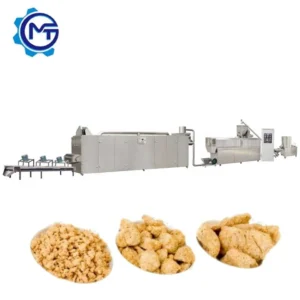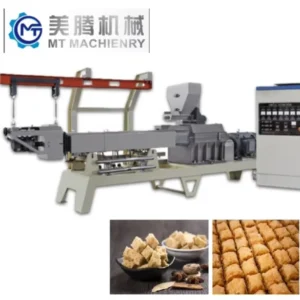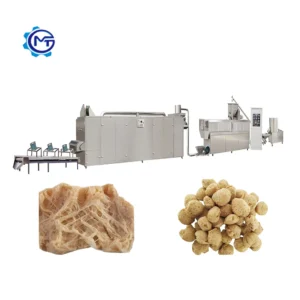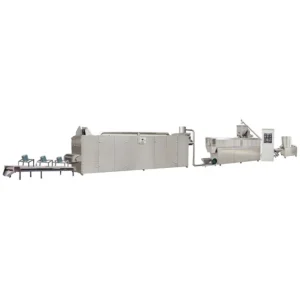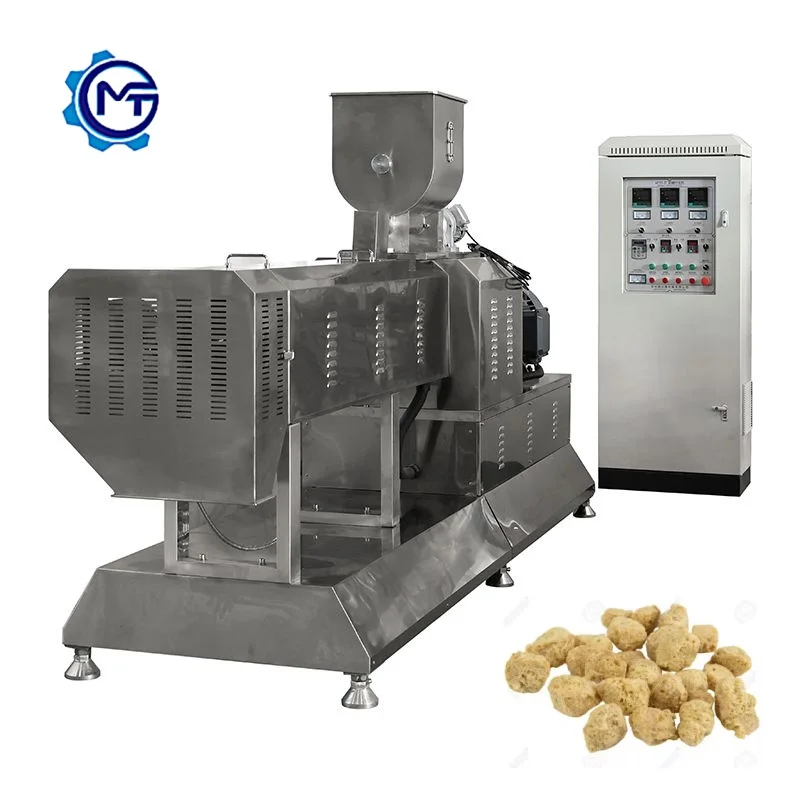
Matched Extruder and Dryer Throughput — Every station from mixer to cooling conveyor is specified as a complete set, preventing the bottleneck that occurs when a twin screw extruder outpaces an undersized multi-layer dryer.
Technical Specifications
| Parameter | Value |
|---|---|
| Product Type | Twin Screw Extruder for Textured Soy Protein Production Line |
| Model Options | MT65 / MT70 / MT75 / MT85 |
| Screw Type | Twin Screw |
| Installed Power | 84 kW (MT65) / 160 kW (MT70) / 190 kW (MT75) / 210 kW (MT85) |
| Power Consumption | 59 kW (MT65) / 120 kW (MT70) / 140 kW (MT75) / 140 kW (MT85) |
| Output Capacity | 100–150 kg/h (MT65) to 250–300 kg/h (MT85) (basis not stated in source — confirm raw material type and moisture content) |
| Main Motor Power | 22 kW / 30 kW / 45 kW (mapping varies by model) |
| Screw Length | 1050 mm / 1520 mm |
| Heating Power | 10 kW / 14 kW |
| Control System | PLC and MCC control |
| Dryer Configuration | Multi-layer; fuel, gas, or electric heating options |
| Mixer Capacity | 20–30 kg / 70–80 kg / 170–180 kg batch options |
| Line Stations | Mixer → Screw Conveyor → Twin Screw Extruder → Air Conveyor → Multi-layer Dryer → Cooling Machine |
| Standards | CE, ISO certified |
Application Suitability
| Application | Material or Output |
|---|---|
| Textured soy protein (TVP/TSP) chunks and nuggets | Defatted soy flour, low-temperature soy flakes |
| Soy and peanut dregs fibre structuring | Soybean dregs, peanut dregs |
| Plant-based meat analogues for fast food and deep-freeze products | High-protein soy blends, cholesterol-free formulations |
| Secondary cereal and snack formats | Adjusted screw configuration for alternative starch bases |
Why the "Output Capacity" Question Misses the Real Problem on a Plant Based Meat Processing Line
A nominal throughput figure means nothing if the dryer cannot remove moisture at the same rate the extruder produces it.
When I first started doing installations, I saw lines where the extruder was pushing out textured soy protein at a steady rate, but the downstream dryer was undersized. The result was wet, clumped product piling up before it could be dried and cooled. Buyers had paid for a plant based meat processing line that could not hold its rated output on their actual defatted soy flour or soy flakes. The mismatch was not in the extruder itself, but in the gap between stations [NEED_CITE: matching extruder output to dryer evaporation rate in food processing lines].
Station-by-Station Catalogue for TVP and Soy Nugget Production
This plant based meat processing line equipment range covers every station required from raw material blending through to cooled, ready-to-pack product. The vertical mixer options range from small 20–30 kg batches for pilot runs up to 170–180 kg batches for continuous production. Stainless steel 304 mixing rulers ensure even hydration of defatted soy flour before the material enters the screw conveyor.
Each twin screw extruder model — MT65 through MT85 — is paired with an air conveyor that transfers the extruded strands or chunks directly into the multi-layer dryer. The dryer itself is configurable for fuel, gas, or electric heating, with adjustable temperature zones and dwell time. This station matching is what separates a line that runs continuously from one that stalls every few hours waiting for the dryer to catch up.
How Raw Material Dictates the Machine Configuration
The screw configuration and die design are not generic. Defatted soy flour behaves very differently from low-temperature soy flakes or soybean dregs. I once worked on a line where the buyer switched to a lower-protein soy flour without informing the factory. The fibre structure collapsed, the extrudate lost its meat-like texture, and output dropped because the material could not sustain the same shear profile. That is why a trial run on your actual raw material in the testing workshop matters before the plant based meat processing line equipment ships [NEED_CITE: raw material protein content and its effect on extrusion fibre formation].
The multi-layer dryer also needs to be tuned to the moisture content of your specific extrudate. Soy nuggets retain moisture differently than fine TVP granules, and the drying time must be set so that the product reaches the correct final moisture without case-hardening the outer layer.
Power, Screw Geometry, and What They Mean for Soy Protein Extrusion
The installed power across the MT65 to MT85 range spans 84 kW to 210 kW, with main motor options of 22 kW, 30 kW, or 45 kW. Higher motor power delivers greater shear force inside the barrel, which is essential for aligning soy protein molecules into the fibrous, layered structure that mimics animal meat. Screw lengths of 1050 mm and 1520 mm determine residence time — longer screws give the material more time under heat and shear, which improves protein texturisation but reduces throughput if the feed rate is not adjusted accordingly.
Heating power of 10 kW or 14 kW maintains the barrel temperature profile across multiple zones. Precise temperature control prevents premature gelatinisation at the feed end while ensuring full protein denaturation at the die. The PLC and MCC control system manages these zones independently, so operators can adjust each section without shutting down the full line. Rotary cutting at 0.75 kW provides consistent chunk sizing at the die face, while the 0.37 kW pump motor maintains steady liquid injection for moisture and steam conditioning.
The Hidden Cost of an Unmatched Line
When stations are sourced from different vendors, no single supplier takes responsibility for throughput balance. The extruder vendor blames the dryer, the dryer vendor blames the extruder, and the buyer is left with a line that never reaches its expected output. I have seen this happen on soy protein lines where the cooling machine was too short to bring the product temperature down before packing, causing condensation inside the bags and spoilage within days [NEED_CITE: post-drying cooling requirements for shelf-stable textured protein products].
Electrical mismatches create a different kind of failure. An extruder wired for 380V/50Hz shipped to a 440V/60Hz market will run the main motor at a higher RPM than designed, altering shear rate and residence time. The fibre structure changes, and the buyer spends weeks trying to reconfigure the screw layout without realising the root cause is electrical.
Why Source the Full Equipment Range from One Supplier
Every station in this catalogue is sized against the others, so the mixer batch cycle, extruder throughput, dryer dwell time, and cooling conveyor speed all align. The screw configuration and die design are specified to your raw material — defatted soy flour, soy flakes, or dregs — rather than copied from a generic build.
An in-house testing workshop runs your actual raw material before shipment, producing a trial run report that confirms fibre structure, density, and output on your specific formulation. Voltage, frequency, and control language are confirmed before production begins, so the PLC interface and motor wiring match your facility from day one. CE and ISO certification is held across the full range, supporting import compliance in regulated markets.
Documentation & Verification
- Line layout drawing showing station spacing and utility connection points for your TVP line configuration
- Screw and die configuration record matched to your defatted soy flour or soy flake specification
- Trial run report from testing workshop confirming fibre structure and output on your raw material
- Electrical schematic with voltage and frequency confirmation for your target market
- Operation and maintenance manual covering every station from mixer to cooling conveyor
- Wear parts list specifying screw segments, die plates, and cutter blades for your model
Installation, Commissioning & Support
- Foundation must support the full 40–45 metre line length with level tolerance for screw conveyor alignment
- Dedicated electrical circuit required matching confirmed voltage and the 84–210 kW installed power range
- Extruder barrel sections arrive separated for site assembly and alignment with the downstream air conveyor
- First-run commissioning includes barrel temperature profiling and screw speed calibration on your raw material
- Operator training covers PLC interface navigation, die changeover, and emergency stop procedures across all stations
- Wear parts stock includes replacement screw segments, die plates, and mixer rulers for ongoing maintenance
What We Need to Configure Your Line
Send your raw material specification sheet — protein content, moisture level, and particle size of your defatted soy flour or soy flakes. Confirm your target output in kg/h and the format you are producing, whether TVP granules, soy nuggets, or larger meat analogue blocks. Provide your facility voltage, frequency, and preferred control language so the PLC and motor wiring are built to match.
Frequently Asked Questions
Q: How is output capacity verified on my specific raw material?
A: We run your actual defatted soy flour, soy flakes, or dregs through the extruder in our testing workshop before shipment. The trial run confirms fibre structure, product density, and achievable throughput. You receive a written report so there is no guesswork when the plant based meat processing line equipment arrives at your facility.
Q: Can I purchase individual stations instead of the complete line?
A: Yes. Each station — mixer, twin screw extruder, multi-layer dryer, cooling machine — is available individually. However, throughput matching is only guaranteed when the full line is configured together. If you are replacing a single station, we need the specifications of your existing upstream and downstream equipment.
Q: What screw configuration works best for my target product texture?
A: Screw arrangement and die design depend on your raw material protein content and your target product. Soy nuggets require a different shear profile than fine TVP granules. We specify the screw layout based on your raw material test results and confirm it during the pre-shipment trial run in our workshop.
Q: How do you prevent the dryer from bottlenecking the extruder?
A: Dryer capacity is calculated against the extruder output and the moisture content of your specific extrudate. The multi-layer configuration, heating method, and dwell time are all matched so the dryer removes moisture at the same rate the twin screw extruder produces wet product, preventing pile-ups between stations.
Q: What voltage and control options are available?
A: Voltage and frequency are confirmed before production to match your facility supply. The PLC and MCC control system can be configured with your preferred operator language. We provide a full electrical schematic so your local electrician can verify the wiring before the line is powered on for the first time.