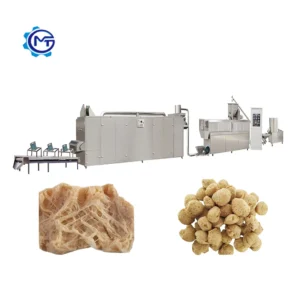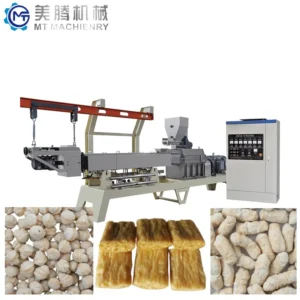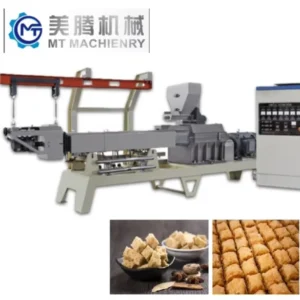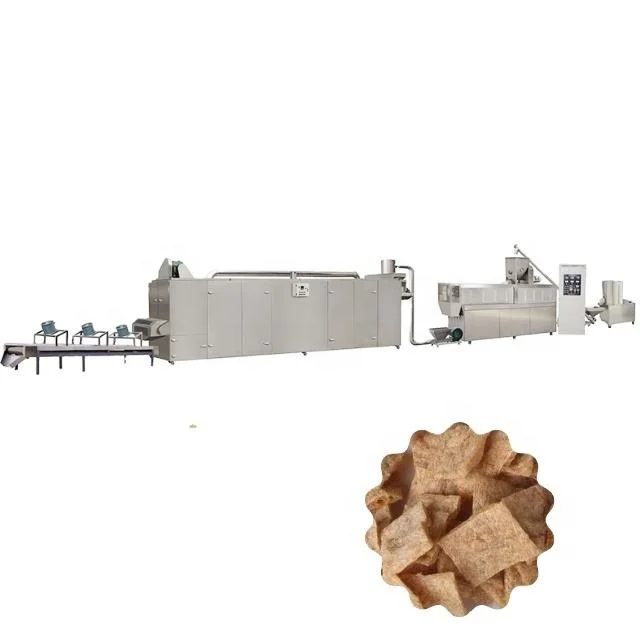
Screw Configuration Matched to Feedstock — Die geometry and barrel zones specified to your soybean meal formulation rather than copied from a generic extruder build, ensuring protein restructuring holds across the full production run.
Technical Specifications
| Parameter | Value |
|---|---|
| Model | MT65 |
| Product Type | Textured Vegetable Protein Production Line |
| Screw Type | Single-screw |
| Installed Power | 85 kW |
| Actual Power Consumption | 65 kW |
| Output Capacity | 150–200 kg/h (basis not stated in source — confirm raw material, moisture, die format) |
| Overall Dimensions | 18000 × 1300 × 2300 mm |
| Control System | PLC / MCC |
| Assembly State | Complete line from mixing through packing |
| Warranty | 1 year complete line; lifetime maintenance service |
| Certification | CE |
Application Suitability
| Application | Material or Output |
|---|---|
| Textured soybean protein meat | Low-temperature soybean meal restructured into fibrous protein strands |
| Vegetarian and plant-based meat alternatives | Soybean meal and peanut meal blends formed into whole-cut or minced formats |
| Ham and sausage filler material | High-moisture extruded protein chunks for further processing |
| Canned and quick-frozen food inputs | Shelf-stable TVP pieces sized for retort or IQF downstream lines |
| Fast-food patty and nugget bases | Textured protein sheets or granules with controlled bite and chew |
Why a Full Equipment Range Plant Based Meat Production Line Manufacturer Matters More Than the Extruder Alone
A single extruder without matched drying and cooling capacity will bottleneck the entire texturizing process.
In the equipment selection work I have done across the Pearl River Delta, I have watched processors invest in a single-screw extruder, plug it in, and find wet, sticky protein strands piling up at the discharge because no cooling conveyor was specified. The product clumps before it even reaches packing. A properly specified full equipment range plant based meat production line manufacturer sequences every station — mixing, conveying, extrusion, drying, cooling, packing — so throughput stays balanced at each transfer point [NEED_CITE: common line bottleneck causes in protein extrusion]. When the dryer cannot keep pace with the extruder output, moisture remains trapped inside the protein structure and the final texture collapses during storage.
Every Station Sized to the Same Throughput Target
When surveying equipment for a textured vegetable protein project, buyers frequently compare extruders in isolation — motor power, screw diameter, barrel length — while treating the dryer and cooler as afterthoughts. The MT65 line addresses this by presenting every station as part of one equipment flow. The mixer batch cycle, the extruder continuous output, the dryer residence time, and the cooling conveyor speed are all calculated against the same 150–200 kg/h target (basis to be confirmed for your specific soybean meal formulation and moisture level). This prevents the common scenario where one station runs idle while another is overwhelmed.
Stainless Steel Construction Across Food-Contact Surfaces
Plant-based meat production demands strict hygiene compliance because soybean meal and peanut meal are susceptible to microbial growth when moisture and temperature are uncontrolled. Every food-contact surface on this line — mixer interior, extruder barrel, dryer trays, cooling belt — uses stainless steel. This material choice aligns with CE machinery requirements for food-grade equipment and simplifies washdown between product changeovers [NEED_CITE: food-grade material standards for extrusion machinery in the EU]. For processors running multiple TVP formats on the same line, quick teardown and corrosion resistance reduce sanitation downtime between batches.
Reading the Specifications That Actually Affect Your Output
The installed power of 85 kW and actual consumption of 65 kW tell two different stories. Installed power represents peak motor capacity across the extruder main drive and auxiliary systems; actual consumption reflects the continuous thermal and mechanical load during steady-state extrusion of soybean meal. Buyers should match their facility transformer capacity to the installed figure, not the running average, to avoid tripped breakers during startup surges. The 18-meter line footprint dictates the minimum workshop length and requires a straight, level floor with utility trenches or overhead drops for electrical and compressed air. The PLC and MCC control option allows processors to choose between programmable logic automation for repeatable recipe management and motor control center setups for facilities that prefer manual override at each station [NEED_CITE: PLC versus MCC control selection criteria in food extrusion]. Barrel zone count and die configuration are not listed in the source specifications and must be confirmed against your target protein texture — whether fibrous strands for whole-cut analogues or granular crumbles for minced applications.
The Cost of Skipping Downstream Equipment
Processors who source the extruder alone and add drying or cooling later often discover that aftermarket dryers lack the airflow distribution to handle extruded protein strands without matting them together. Cooling conveyors added after the fact may not align with the extruder discharge height, creating spillage and product loss at the transfer point. I have seen plants where the omission of a dedicated cooling stage left residual heat in packed bags, causing condensation and mold growth within days [NEED_CITE: post-extrusion cooling requirements for textured vegetable protein]. These problems do not show up on a quotation — they appear weeks after commissioning, when product complaints begin arriving.
Why Source This Line from One Supplier
Every station on the MT65 line — from the high-temperature roaster option to the powder mixer and cooling machine — is specified under one equipment flow, eliminating the interface gaps that occur when machines from different vendors are bolted together. Screw configuration and die design are matched to your soybean or peanut meal formulation rather than pulled from a standard library. An in-house testing workshop allows trial runs on your actual raw material before the line ships, so protein texture and expansion are verified in advance rather than discovered during on-site commissioning. The complete documentation package includes line layout, capacity calculation, and electrical schematics for every station, not just the extruder. CE certification applies to the full line assembly, supporting machinery import clearance in regulated markets.
Documentation & Verification
- Line layout drawing with throughput calculation for each station matched to your soybean meal formulation
- Machine specification sheet per individual unit covering mixer, extruder, dryer, and cooler
- Screw and die configuration record matched to your target protein strand or granule format
- Electrical schematic and voltage confirmation for your facility power supply
- Factory test record on your raw material before dispatch, not just a generic run
- Operation and maintenance manual with wear parts list for every line station
Installation, Commissioning & Support
- The 18-meter footprint requires a level floor with clearance on both sides for maintenance access and operator walkways
- 85 kW installed power demands a dedicated circuit breaker and transformer sizing confirmed before machine arrival
- Line ships in modular station sections requiring on-site mechanical assembly, electrical interconnection, and control wiring
- First-run commissioning includes barrel temperature profiling and die adjustment on your specific soybean meal batch
- Operator training covers PLC or MCC interface navigation, recipe storage, and emergency stop sequences per station
- Wear parts inventory includes replacement screws, die plates, and mixer paddles sized to the MT65 configuration
What to Include in Your Inquiry
To configure this full equipment range plant based meat production line manufacturer catalog for your facility, share your raw material specification — soybean meal protein content, particle size, and incoming moisture percentage — along with your target product format, whether fibrous strands, chunks, or granules. Provide your daily output requirement, available workshop length and ceiling height, and local voltage and frequency standards. If you operate existing upstream or downstream equipment that this line must integrate with, include those machine specifications so throughput can be balanced across the entire process.
Frequently Asked Questions
Q: How do I size the dryer and cooler to match the extruder throughput?
A: The dryer residence time and cooler belt speed must be calculated against the extruder continuous output and the moisture content of your specific soybean meal formulation. Undersized drying leaves trapped moisture that degrades texture during storage. We provide a line layout and capacity calculation document that balances every station before the order is confirmed.
Q: What raw material specifications affect extruder and dryer selection?
A: Soybean meal protein content, particle size distribution, and incoming moisture percentage all influence screw configuration, barrel temperature zones, and dryer airflow requirements. Peanut meal blends behave differently from pure soy formulations. Share your material certificate of analysis so die geometry and drying parameters can be matched to your feedstock.
Q: Which voltage and control options are available for international installations?
A: The control system is available with PLC or MCC configuration, and electrical schematics are prepared to match your facility voltage and frequency. Confirming these requirements before production avoids commissioning delays. Control language and interface labeling can be specified to match your operator team.
Q: What spare wear parts should I stock for the first year?
A: Screws, die plates, and mixer paddles experience the highest wear on a textured vegetable protein line. A wear parts list specific to your MT65 configuration is included with the documentation package. Ordering initial spares alongside the line avoids production stops while waiting for replacement components.
Q: How much workshop space does the complete line require?
A: The overall line dimensions are 18000 × 1300 × 2300 mm, but additional clearance is needed on both sides for maintenance access, raw material staging, and finished product handling. Provide your workshop floor plan so the layout can be adapted to your available space and utility connection points.