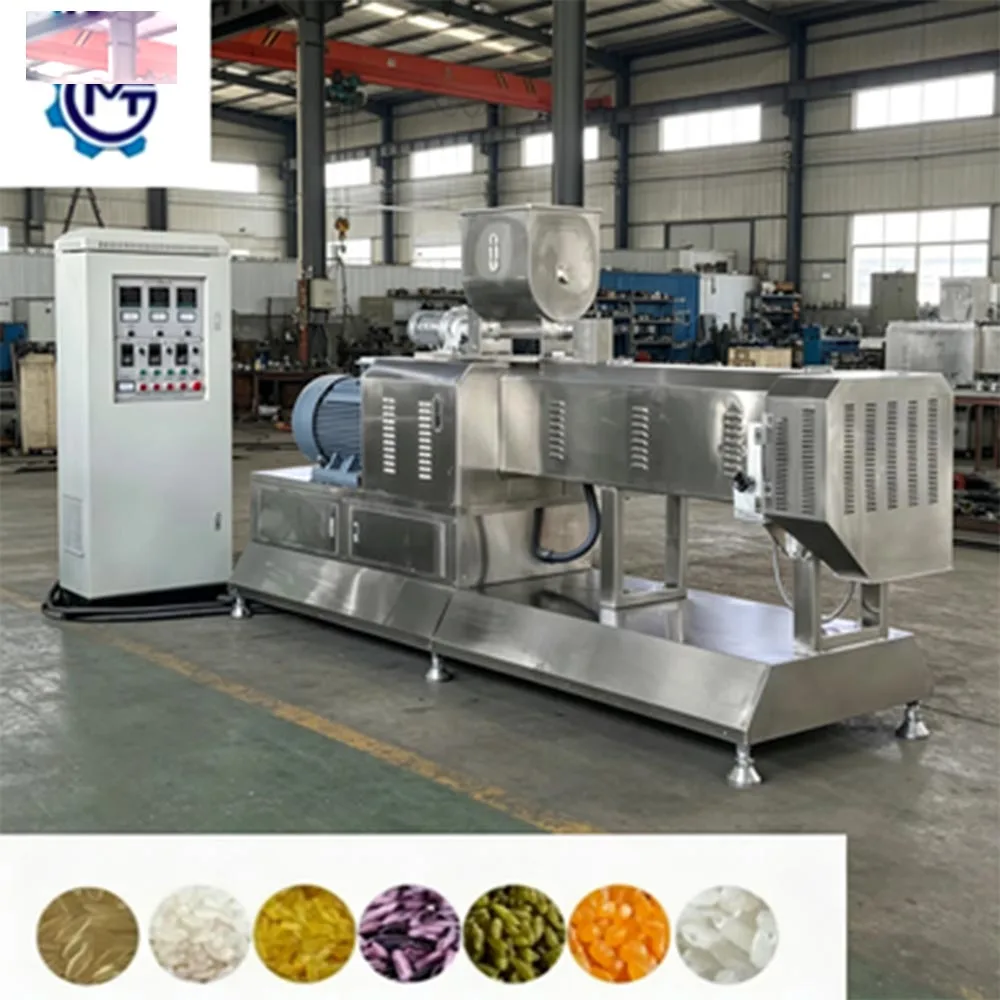
Throughput-Matched Line Integration — Every station from raw material batching to finished pellet packing is configured under one engineering scope, preventing the capacity mismatches that occur when extruders, dryers, and coating drums are sourced from separate vendors.
Technical Specifications
| Parameter | Value |
|---|---|
| Product Type | Twin Screw Fish Feed Extruder Production Line |
| Screw Type | Twin screw |
| Control System | PLC automatic control system |
| Material (Contact Parts) | Food grade 304 stainless steel |
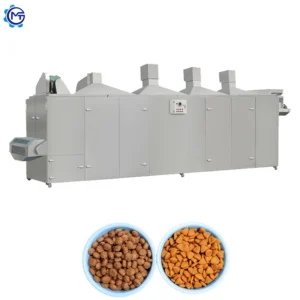
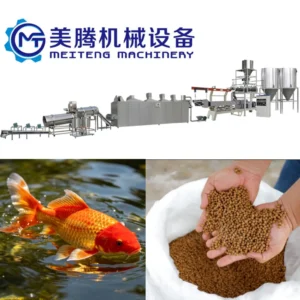
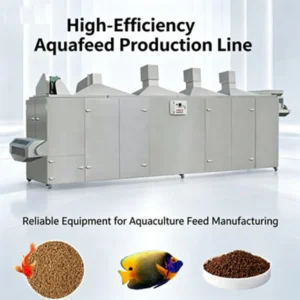
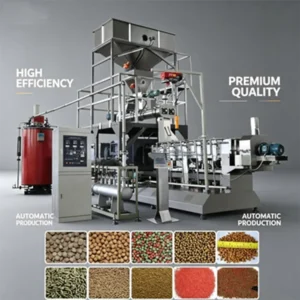
| Line Stations | Raw material mixer, extruder, dryer, seasoning coating machine, vibrating sieve, conveyor equipment |
| Pellet Adjustability | Pellet size, hardness, buoyancy adjustable |
| Production Mode | Full continuous automatic production |
| Output Capacity | Medium to large scale industrial production (basis to be confirmed — depends on raw material formulation, pellet size, and moisture content) |
| Standards | CE, ISO |
Application Suitability
| Application | Material or Output |
|---|---|
| Floating fish feed pellets for koi, goldfish, and tropical fish | Fish meal, soybean meal, corn powder, compound additives |
| Sinking aquatic feed for catfish, tilapia, and bottom-feeding species | High-protein formulations with adjusted starch ratios |
| Freshwater aquaculture feed production | Compound raw materials requiring high-temperature ripening |
| Ornamental fish feed manufacturing | Specialty formulations with color-enhancing additives |
What Nominal Line Capacity Figures Leave Out for Aquatic Feed Buyers
A fish feed extruder production line rated at a given tonnage on a reference formula will behave differently on your actual raw material blend, especially when protein content and starch ratios diverge from the supplier’s test conditions.
When a buyer sources a twin screw aquatic feed extrusion equipment setup based purely on a brochure capacity number, the reality on the factory floor often tells a different story. I have seen lines where the extruder was pushing pellets at the rated output, but the downstream dryer could not keep pace, creating a bottleneck that forced the entire line to slow down. The screw configuration was set for a standard corn-heavy formula, while the customer’s actual recipe leaned heavily on fish meal and soybean protein, which changes how the material behaves under heat and shear inside the barrel [NEED_CITE: raw material formulation effects on extrusion throughput]. The result is pellets that either float when they should sink, or crumble before they reach the coating drum.
How Screw Configuration Dictates Pellet Buoyancy
The twin screw design in this fish feed extruder production line allows operators to adjust the screw element sequence and die geometry to control how much mechanical energy transfers into the raw material. For floating pellets, the configuration prioritizes higher shear and expansion so the starch gelatinizes fully and traps air pockets inside each pellet. Sinking pellets require a different arrangement — lower shear, higher compression, and a die design that produces denser output. Getting this wrong means an entire production run fails the buoyancy test that aquaculture buyers demand, and the feed is rejected at the distributor level.
Why Dryer and Coating Capacity Must Match the Extruder
A twin screw aquatic feed extrusion equipment setup only performs as well as its weakest station. If the dryer cannot remove moisture fast enough from the extruded pellets, the downstream seasoning coating machine receives material that is still too wet to hold a uniform oil or flavor coating. This cascading mismatch is common when lines are assembled from individual vendors who each quote their own machine in isolation. The line must be engineered so that the dryer’s evaporation rate and the coating drum’s residence time both align with the extruder’s actual output on the buyer’s specific formulation [NEED_CITE: thermal processing requirements for aquatic feed moisture reduction].
Reading the Specs That Matter for Aquatic Feed
The PLC automatic control system on this line enables consistent barrel temperature profiles and screw speed settings across production batches, which is critical because even small fluctuations in thermal input change the gelatinization degree and final pellet density. Food grade 304 stainless steel on all contact parts is not just a hygiene requirement — it resists the corrosive salts and fish oils present in aquatic feed formulations far better than carbon steel, extending the service life of barrels and dies. The adjustable pellet parameters — size, hardness, and buoyancy — are achieved through die plate swaps and screw speed modulation rather than requiring a separate machine for each pellet type.
The Hidden Cost of Skipping a Trial Run
When a line ships without being tested on the buyer’s actual raw material, the first production run becomes an expensive experiment. Screw elements that work perfectly on the supplier’s reference formula may produce pellets with the wrong density or surface texture on a different blend. I worked on a shipment for a Southeast Asian customer where the screw combination was specified using a generic template, and the high protein content in their formula caused every pellet to float — even the sinking feed they were contracted to deliver. Their distributor returned the entire lot. That failure could have been caught in a testing workshop before the line left the factory floor [NEED_CITE: importance of pre-shipment trial runs on customer raw materials].
Why Procurement Here Reduces Integration Risk
The line is engineered as a single system, meaning the mixer output, extruder throughput, dryer capacity, and coating drum volume are all calculated together rather than quoted as independent machines. Screw configuration and die design are specified to your raw material formulation and target pellet buoyancy before the build begins. An in-house testing workshop allows trial runs on your actual raw material so pellet density, surface finish, and buoyancy are verified before the equipment ships. The PLC control architecture and electrical schematics are confirmed against your site voltage and frequency before production starts, avoiding commissioning delays that occur when control language or power supply does not match the installation site.
Documentation & Verification
- Line layout drawing showing station spacing and throughput calculation for your target pellet size
- Screw and die configuration record matched to your raw material formulation
- Trial run report on customer-supplied raw material documenting pellet buoyancy and density results
- Electrical schematic with voltage, frequency, and PLC language confirmed for your installation site
- CE declaration of conformity and ISO certificate for the complete line
- Wear parts list with screw elements, dies, and seals identified by part number
Installation, Commissioning & Support
- Foundation requirements based on the twin screw extruder and dryer footprint with load distribution data
- Dedicated electrical circuit specifications matching the PLC control system voltage and frequency rating
- Assembly sequence for line stations from mixer through vibrating sieve with conveyor alignment checkpoints
- First-run parameter setting for barrel temperature zones and screw speed on your raw material
- Operator training covering die changes for pellet size adjustment and buoyancy tuning
- Wear parts inventory covering screw elements and die plates with replacement lead time guidance
What to Include in Your Inquiry
To configure a fish feed extruder production line that actually holds capacity on your material, share your raw material formulation including protein and starch percentages, target pellet diameter, and whether you need floating, sinking, or both formats. Confirm your site voltage and frequency, the control language your operators need, and whether the line will connect to existing upstream batching or downstream packing equipment. If you can send a sample of your raw material, a trial run in the testing workshop will produce real pellet samples before any build commitment.
Frequently Asked Questions
Q: How is output capacity verified against my specific fish feed formulation and pellet size?
A: The capacity of this twin screw aquatic feed extrusion equipment depends on your raw material blend, target pellet diameter, and moisture content at the die exit. A trial run on your actual formulation in the testing workshop produces measured output data and pellet samples, so the line is quoted against verified throughput rather than a nominal reference figure.
Q: What screw configuration and die design is recommended for sinking versus floating pellets?
A: Floating pellets require screw elements arranged for higher shear and greater expansion at the die, trapping air inside the gelatinized starch matrix. Sinking pellets need a compression-heavy screw sequence and smaller die orifices to produce denser output. The configuration is selected based on your formulation and confirmed during the pre-shipment trial run.
Q: How is the dryer and seasoning station capacity matched to the extruder output to avoid bottlenecks?
A: Each station on this fish feed extruder production line is calculated against the extruder’s verified output on your material. The dryer’s evaporation capacity and the coating drum’s residence time are both sized so that no station forces the line to run below the extruder’s actual throughput.
Q: Can I run a trial on my raw material in your testing workshop before the line ships?
A: Yes. The in-house testing workshop accepts customer raw material samples and runs them through a twin screw extruder with the same screw and die configuration specified for your production line. The trial produces pellet samples and a written report covering density, buoyancy, surface finish, and measured output rate.
Q: What spare wear parts are supplied and what is the replacement lead time?
A: The line ships with a wear parts inventory including screw elements, die plates, and barrel liners identified by part number in the documentation package. Replacement lead times depend on the specific screw element type and die specification, and are confirmed during the quotation stage so you can plan inventory before your first scheduled changeover.