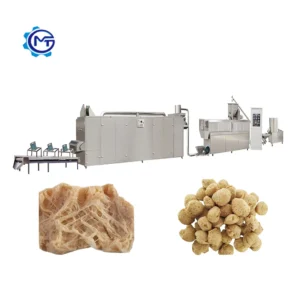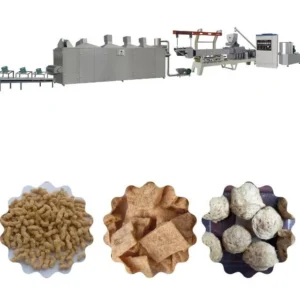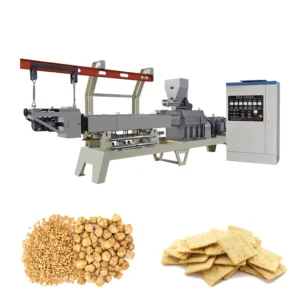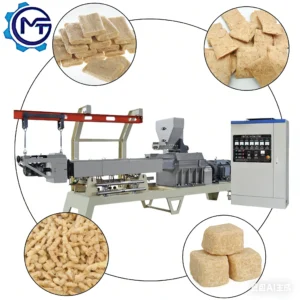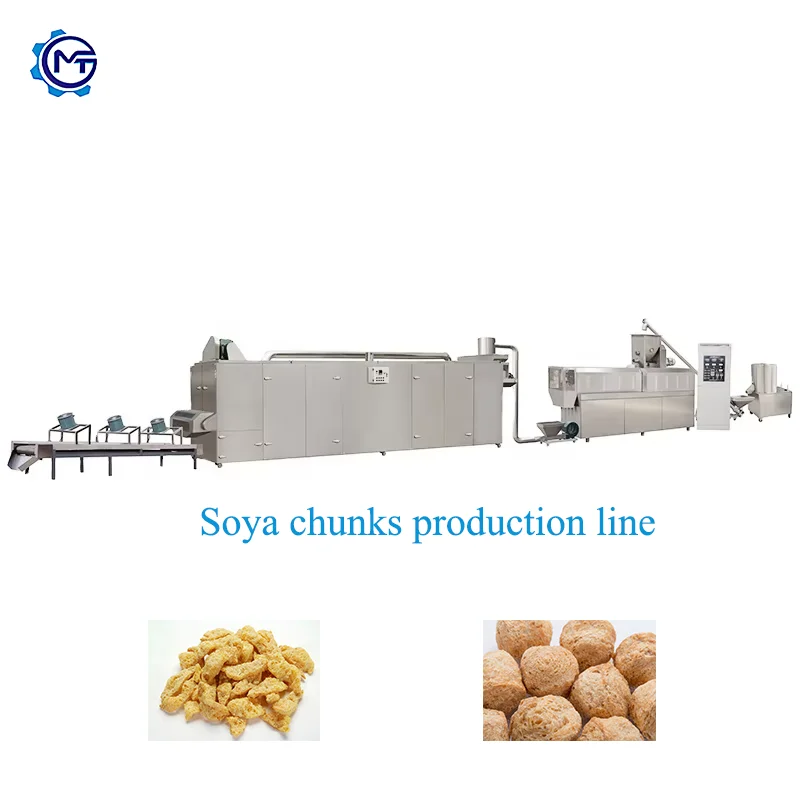
Screw configuration matched to formulation — Every TVP line is trial-run on the buyer’s actual defatted soy flour or protein isolate before shipment, eliminating guesswork at commissioning.
Technical Specifications
| Parameter | Value |
|---|---|
| Product Type | Texturized Vegetable Protein (TVP) / Soy Chunk Production Line |
| Line Type | Twin-screw extrusion based TVP / soy chunk production line |
| Screw Type | Twin-screw |
| Raw Material Compatibility | Defatted soy flour, soy protein isolate, soy concentrate, pea protein, wheat gluten |
| Control System | PLC and MCC control |
| Line Stations | Mixing and batching → Extrusion → Drying / Cooling → Packing (basis to be confirmed) |
| Output Capacity | Rated capacity subject to raw material formulation, moisture content, and target product format (basis to be confirmed) |
| Die Configuration | Configured for chunk, granule, or flake format based on target product (basis to be confirmed) |
| Moisture Range | Barrel moisture and steam injection parameters set per formulation (basis to be confirmed) |
| Screw Diameter / L:D Ratio | Selected per specific model and application (basis to be confirmed) |
| Overall Dimensions | Dependent on line configuration and station layout (basis to be confirmed) |
| Voltage & Frequency | Configurable to target market standards (basis to be confirmed) |
| Standards | CE, ISO |
Application Suitability
| Application | Material or Output |
|---|---|
| Texturized vegetable protein (TVP) / soy chunk production | Defatted soy flour, soy protein isolate |
| Soy protein granules and flakes for food ingredient supply | Soy concentrate, pea protein blends |
| Meat extender and meat analogue base materials | Soy and wheat gluten formulations |
| Fortified protein products for nutritional programmes | Blended protein and starch bases |
Why "Nominal Capacity" Fails on Real Soy Protein Formulations
A rated output on standard soy grits rarely holds when the actual defatted soy flour protein content shifts.
I have seen buyers receive a texturized vegetable protein production line quoted at a confident hourly tonnage, only to discover during commissioning that their local soy protein isolate behaves differently under heat and shear. The material sets up too fast or fails to cross-link, producing chunks that crumble or turn dense and rubbery. Capacity then drops because the operator must slow the feed rate to chase acceptable fibre structure [NEED_CITE: material behaviour variation in protein extrusion]. This is why every soy chunk production line is tested on the buyer’s actual raw material before the crates are nailed shut.
Barrel Temperature Zones and Protein Cross-Linking
The twin-screw extruder on this soy chunk production line uses multiple independent barrel heating zones. Each zone holds a setpoint that governs how quickly the soy protein unfolds and re-bonds into a fibrous matrix. Running defatted soy flour at the wrong zone profile leaves the interior of the chunk under-structured, so it falls apart when rehydrated.
Die Geometry and Chunk Density
Die orifice diameter and land length together determine how much back-pressure the melt experiences just before exit. A shorter land on a texturized vegetable protein production line reduces density and yields a more open, sponge-like chunk suited to quick rehydration. Longer lands produce denser granules intended for prolonged simmering in soups or stews.
Screw Configuration Across Protein Bases
Different protein sources demand different screw element sequences. Soy protein isolate carries higher fat sensitivity and requires a tighter kneading block arrangement than pea protein. The screw elements on each soy chunk production line are rearranged after the trial run confirms which sequence produces the target bite and fibre tear [NEED_CITE: screw element arrangement for varying plant protein bases]. Matching the configuration to the formulation prevents the common failure of chunks that are either too hard or too powdery.
Moisture Injection and Expansion Control
Steam and water injection points along the barrel control how much moisture the protein mass carries into the die. More moisture at the feed zone softens the matrix and increases expansion at the die face, yielding lighter chunks. Insufficient moisture leaves the protein under-plasticised, producing a dense, brittle output that rehydrates poorly.
The Cost of Skipping the Trial Run
Buyers who skip the raw material trial often spend the first week on-site burning through tons of soy flour while chasing the right fibre structure. Temperature profiles that worked on the supplier’s standard test material fail when the buyer’s protein content or fat residue differs. Die changes, screw reconfigurations, and dryer temperature adjustments compound into unplanned downtime [NEED_CITE: commissioning delays from untested raw material formulations]. Production schedules slip, and the first container of finished product ships weeks late.
Why Procurement Starts With the Raw Material Sample
Every texturized vegetable protein production line is assembled around the buyer’s actual formulation, not a generic template. The screw elements, die plate, and dryer belt length are specified only after the sample has run through the testing workshop and the output chunk passes rehydration and tear tests. Voltage and control language are locked in before metal is cut, so the panel on-site reads the operator’s language. Documentation includes a trial run report referencing the buyer’s own material batch.
Documentation & Verification
- Line layout and capacity calculation based on your specific soy protein formulation
- Screw and die configuration record matched to target chunk size and texture
- Trial run report on your raw material conducted before shipment
- Electrical schematic with voltage and frequency confirmed to your local grid
- CE declaration of conformity and ISO certificate
- Operation and maintenance manual with wear parts list
Installation, Commissioning & Support
- Foundation plan accounts for extruder weight and dynamic vibration loads
- Dedicated power circuit sized for total line connected load including dryer heaters
- Extruder barrel sections and screws shipped separated for on-site assembly
- First-run parameter setting using your raw material stock on-site
- Operator training on PLC screen navigation in confirmed control language
- Wear parts inventory covers initial screw and die replacement cycle
What to Include in Your Inquiry
To configure the right soy chunk production line, send the target product format (chunk, granule, or flake), the exact raw material specification sheet including protein and fat percentages, and the intended daily output. Confirm your workshop ceiling height, available floor area, and local voltage and frequency standard.
Frequently Asked Questions
Q: How is line capacity verified against my specific soy protein formulation?
A: We run your actual defatted soy flour or protein isolate through the testing workshop before building the line. The extruder output is weighed, and chunk density, rehydration ratio, and fibre tear are measured. The rated capacity on your quotation reflects that trial, not a generic benchmark.
Q: What screw and die setup is used for chunk versus granule format?
A: Chunk format requires a larger die orifice and a screw sequence that builds moderate shear for an open fibre matrix. Granules use smaller die holes and higher shear to produce dense, uniform particles. Both configurations are validated on your raw material before shipment.
Q: How is throughput matched between the extruder and the dryer?
A: The dryer belt length and air volume are calculated from the extruder output rate and the moisture content leaving the die. If the extruder pushes more moisture than the dryer can evaporate, the belt speed must drop, bottlenecking the entire texturized vegetable protein production line.
Q: Can I send my raw material for a trial run before the line ships?
A: Yes, sending a representative sample is a required step. We run it through the testing workshop, document the screw configuration, die selection, and temperature profile, and share the trial run report before you approve production of the full soy chunk production line.
Q: What voltage and control language options are available?
A: Voltage and frequency are set to match your local grid standard, and the PLC interface language is confirmed during the design phase. This avoids rewiring and software changes after the line arrives on-site.