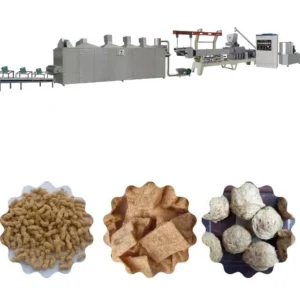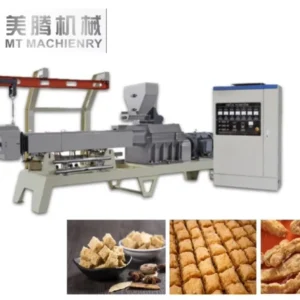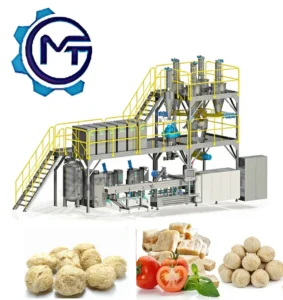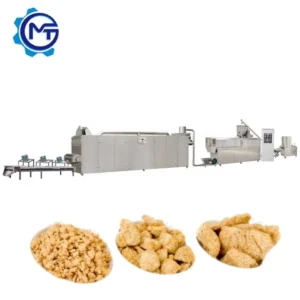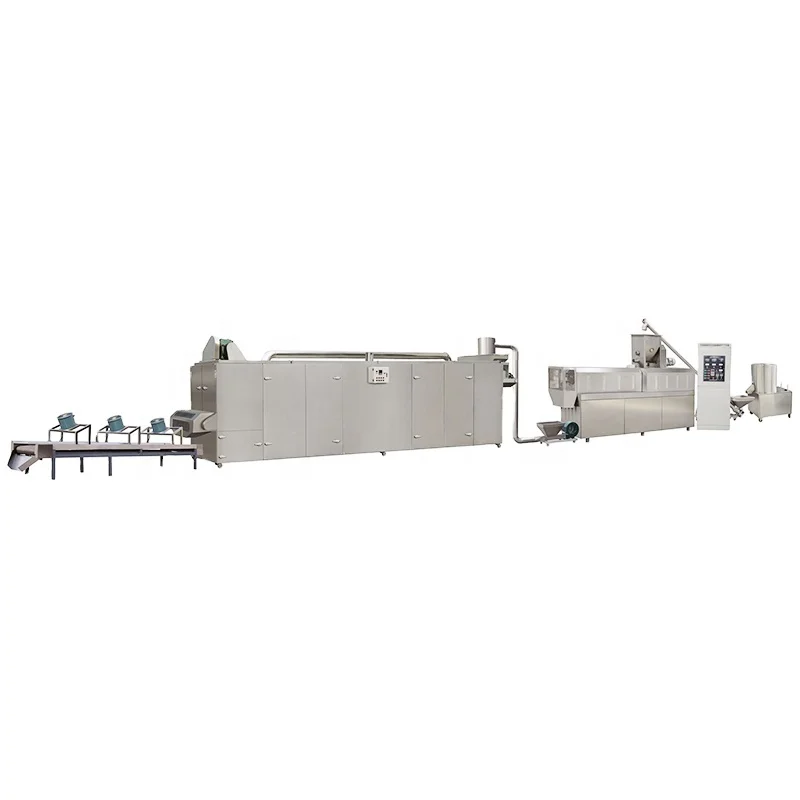
Screw and Die Matched to Feedstock — we run your soybean meal or peanut meal in our testing workshop before the extruder ships, not after it arrives.
Technical Specifications
| Parameter | Value |
|---|---|
| Product Type | Textured Vegetable Protein (TVP) Production Line |
| Model | MT65 / MT70 / MT85 |
| Installed Power (Line) | 85 kW (MT65) / 120 kW (MT70) / 195 kW (MT85) |
| Real Power (Line) | 65 kW (MT65) / 90 kW (MT70) / 165 kW (MT85) |
| Output Capacity (Line) | 150–200 kg/h (MT65) / 200–300 kg/h (MT70) / 600–800 kg/h (MT85) (basis not stated in source) |
| Overall Dimensions (Line) | 18000×1300×2300 mm (MT65) / 20000×1500×2400 mm (MT70) / 24000×3500×4300 mm (MT85) |
| Extruder Screw Type | Twin-screw |
| Extruder Main Motor Power | 30 kW (source value — verify against manufacturer catalog) |
| Mixer Output | 300–600 kg/h |
| Mixer Tank Volume | 150 kg |
| Mixer Rotary Speed | 385 rpm |
| Roaster Effective Belt Length | 3.5 m |
| Cooling Machine Temperature Range | 0–260 °C (source value — verify against manufacturer catalog) |
| Control System | PLC and MCC (source value — verify against manufacturer catalog) |
| Line Stations | Mixing → Conveying → Extrusion → Conveying → Drying → Cooling → Packing |
| Construction Material | Stainless steel, food-grade contact materials |
| Certification | CE, ISO |
Application Suitability
| Application | Material or Output |
|---|---|
| Plant-based meat alternatives for fast food and quick-frozen products | Low-temperature soybean meal, peanut meal |
| High-protein meat analogues for canned food and sausages | Defatted soy flour blends |
| Textured vegetable protein for industrial food ingredients | Soy and pulse protein concentrates |
Why Nominal Output Figures Leave Buyers Exposed
A TVP production line full equipment range quoted at a single throughput number rarely holds that figure when your actual feedstock arrives at the hopper.
Capacity only means something when the raw material, moisture content, and target fiber structure are stated together.
I watched a customer commission a protein line two years ago where the extruder ran fine on standard soy flour during the factory test. When his local meal showed up with a lower protein fraction, the extrudate came out hard with no visible fiber strand. Every barrel temperature, screw speed, and die gap had to be reset from scratch. That kind of delay is entirely preventable when the supplier verifies your specific blend before the machines leave the floor [NEED_CITE: importance of raw material variability in twin-screw extrusion processes].
How the Extruder Shapes the Fiber Matrix
The twin-screw configuration on the MT65, MT70, and MT85 is specified to the buyer’s protein source and the fiber alignment required in the final TVP piece. Barrel sections are heated and cooled independently, letting operators build a temperature profile that matches the gelatinisation point of their particular soy or peanut blend. Die geometry then controls how the protein mass expands and orients as it exits the barrel, which directly determines whether the output tears like chicken or pulls apart like beef.
Station Matching Across the Full Equipment Range
A mixer that delivers 600 kg/h into an extruder rated for half that creates a backlog that operators have to manage manually. This TVP production line full equipment range is specified so the mixer output, extruder throughput, roaster belt speed, and cooling conveyor capacity all align to the same production target. That matching happens on paper during the layout phase, not on the factory floor during commissioning [NEED_CITE: line throughput balancing for extruded food processing].
Reading the Power and Dimension Numbers
The installed power and real power are listed separately for each model, which matters when you are sizing the electrical supply for the workshop. Installed power represents every motor and heater at maximum draw; real power reflects typical running load. For the MT85 line, the 195 kW installed figure versus the 165 kW running figure tells your electrician the peak demand for circuit sizing, while the running figure estimates your actual energy cost. The line dimensions — up to 24 meters long for the MT85 — determine whether the roaster and cooling belt fit in a straight run or need an L-shaped layout to clear existing columns or doorways.
What Happens When Stations Are Mismatched
Buyers who assemble a TVP line from separate vendors often discover that the dryer cannot keep up with the extruder, forcing the entire line to throttle back. The extruder then sits at partial load, which changes the residence time inside the barrel and alters the product texture. Downstream, a cooling conveyor that cannot handle the roaster output leaves hot product stacked in bins, where residual moisture creates uneven drying and spoilage risk [NEED_CITE: consequences of unmatched station capacity in food extrusion lines].
Why Buyers Source This Line From One Supplier
The testing workshop runs your actual soybean meal or peanut meal through the extruder before the line ships, producing a trial report that confirms fiber structure and throughput on your specific blend. Screw configuration and die design are recorded for your formulation, so the first production run on your floor matches the test. Electrical schematics and voltage are confirmed for your market before fabrication begins, preventing the commissioning delays that happen when a 50 Hz machine arrives in a 60 Hz facility. Stainless steel contact materials throughout the line meet food-grade requirements without the buyer having to audit each vendor separately.
Documentation & Verification
- Line layout drawing with station spacing matched to your workshop floor dimensions
- Screw and die configuration record specific to your soybean or peanut meal formulation
- Trial run report on your raw material produced in the testing workshop before dispatch
- Electrical schematic confirming voltage, frequency, and control language for your market
- CE declaration of conformity covering the complete TVP production line full equipment range
- Wear parts list identifying screws, dies, and belts with replacement intervals
Installation, Commissioning & Support
- Foundation requirements calculated from the MT85 line weight and the 3.5 m roaster belt load
- Dedicated circuit sized to the 195 kW installed power peak draw on the MT85 model
- Roaster and cooling conveyor shipped in sections to fit standard container dimensions
- First-run parameter set — barrel temperatures, screw speed, die gap — transferred from trial report
- Operator training covering PLC screen navigation and MCC safety interlock procedures
- Initial spare screw and die set included for the first scheduled changeover
What We Need To Quote Your Line
Send us the protein content and mesh size of your soybean meal or peanut meal, along with the target product form — chunks, flakes, or granules — and your daily output target. Confirm your workshop voltage, frequency, and preferred control language so the electrical package is built correctly from the start. If you have existing mixers or packing machines upstream or downstream, let us know their throughput so we can match the new stations to your current equipment rather than oversizing.
Frequently Asked Questions
Q: How is the output capacity of the TVP production line verified?
A: We run your specific soybean meal or peanut meal in our testing workshop and record the throughput at a documented moisture content and screw speed. The trial report shows what the line actually produces on your feedstock, not a generic figure based on a reference material you will never use.
Q: What screw and die configuration is specified for my formulation?
A: The screw elements and die plate are selected based on the protein content and particle size of your raw material, as well as the fiber orientation required in the final product. That configuration is documented and included with the machine so your first production run matches the workshop trial.
Q: Are the mixer, extruder, roaster, and cooler capacities matched?
A: Yes. Each station is specified to the same throughput target so no single machine creates a bottleneck. The mixer output, extruder capacity, roaster belt speed, and cooling conveyor rate are all calculated together during the line layout phase before the order is confirmed.
Q: What voltage and control language are confirmed before production?
A: We confirm your workshop voltage, frequency, and preferred PLC screen language before the electrical cabinets are wired. This prevents the situation where a machine built for one market requires transformer replacement or panel rewiring after it arrives at your facility.
Q: What spare wear parts are included with the line?
A: The initial shipment includes a set of replacement screws, die plates, and roaster belts identified in the wear parts list. Replacement intervals are documented so you can order the next set before the first changeover is due, avoiding unplanned downtime.