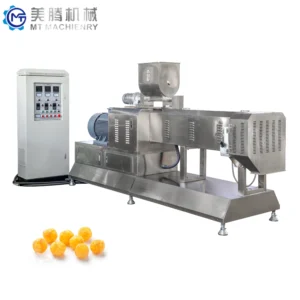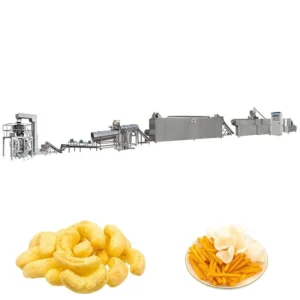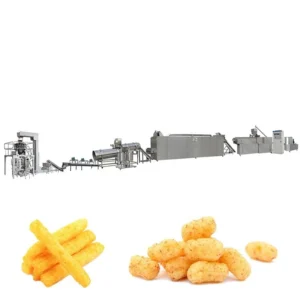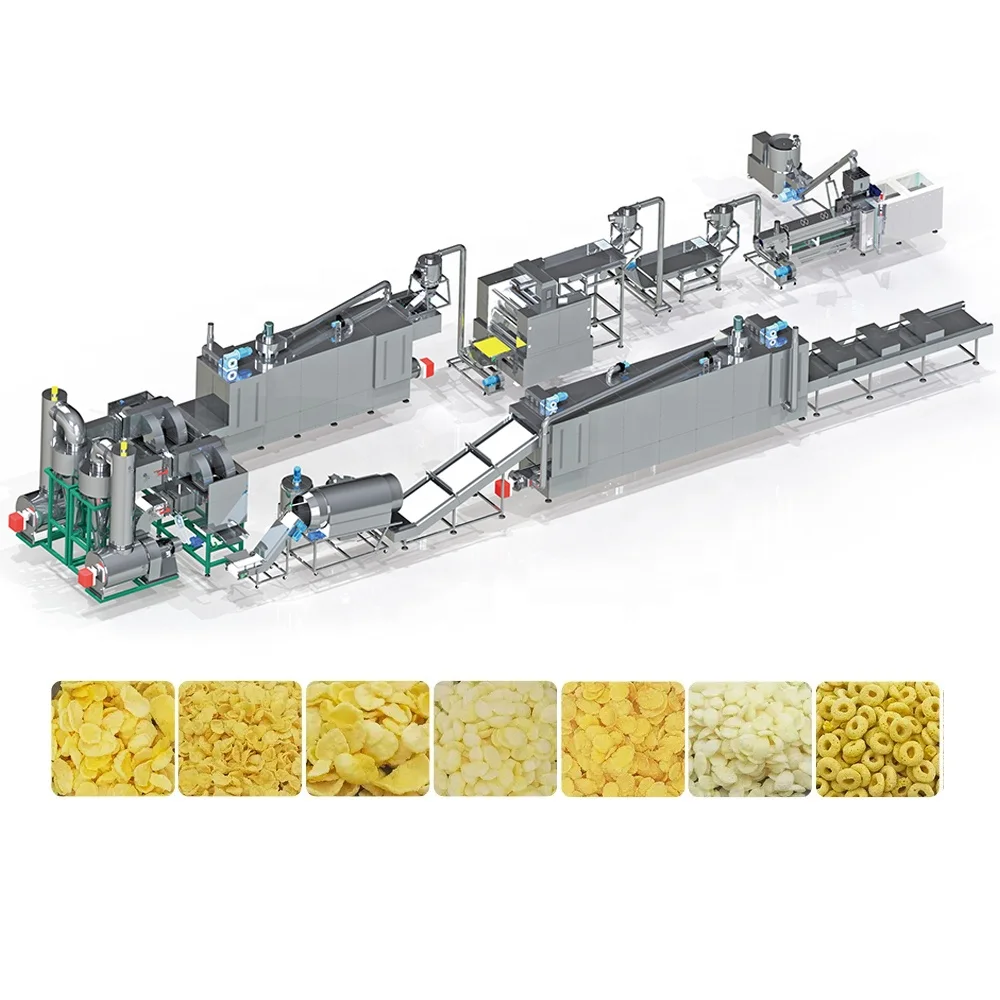
Integrated Line Throughput — Every station from the twin-screw extruder through flaking, drying, roasting, coating, and packing is matched for continuous output under one manufacturer, preventing the bottleneck mismatches that occur when sourcing equipment from separate vendors.
Technical Specifications
| Parameter | Value |
|---|---|
| Product Type | Corn Flakes & Breakfast Cereal Twin Screw Extrusion Line |
| Models Available | MT70 / MT85 / MT75 |
| Installed Power (MT70) | 160 kW |
| Power Consumption (MT70) | 120 kW |
| Output Capacity (MT70) | 150–200 kg/h (basis not stated in source — confirm raw material, moisture content and product format) |
| Overall Dimensions (MT70) | 41 × 1.5 × 2.2 m |
| Installed Power (MT85) | 190 kW |
| Power Consumption (MT85) | 140 kW |
| Output Capacity (MT85) | 300–400 kg/h (basis not stated in source — confirm raw material, moisture content and product format) |
| Overall Dimensions (MT85) | 43 × 1.5 × 3.2 m |
| Installed Power (MT75) | 210 kW |
| Power Consumption (MT75) | 150 kW |
| Output Capacity (MT75) | 300–500 kg/h (basis not stated in source — confirm raw material, moisture content and product format) |
| Overall Dimensions (MT75) | 45 × 1.5 × 3.5 m |
| Screw Type | Twin Screw |
| Control System | PLC with MCC integration |
| Heating Source (Dryer) | Gas or Electric |
| Flaking Drive | Dual independent motors with hydraulic roller system |
| Flaking Temperature Control | Infrared sensor monitoring |
| Roasting Oven Features | Vibrating pan, reconciliation burner, dual circulating fans, cyclone dust removal |
| Coating System | Double tumble melter, elevator, coating drum, spraying nozzle |
| Lubrication | Automatic lubricating and cooling system |
| Assembly State | Complete line with all supporting equipment |
| Certification | CE, ISO |
Application Suitability
| Application | Material or Output |
|---|---|
| Natural corn flakes production | Corn grits and corn flour blends through extrusion, flaking, drying, and roasting |
| Sugar-coated corn flakes | Corn-based extrudate with sugar spray and tumble coating stages |
| Breakfast cereal shapes | Rice, wheat, oat, and barley powders formed into balls, tubes, rings, stars, and loops via die changes |
| Puffed snack foods | Cereal-based formulations expanded through twin-screw processing |
| Fortified cereal products | Grain blends with added nutritional premixes processed through the extrusion and drying stages |
What "Rated Capacity" Actually Means for Your Corn Flakes Line
A capacity number without raw material, moisture content, and product format attached to it is not a capacity — it is a guess.
I spent years on the shop floor in Shandong watching lines get quoted on nominal throughput, only to see output drop significantly once the buyer’s actual corn grits hit the barrel. One breakfast cereal producer ordered a line based on a sample trial using fine corn flour. When his production material arrived — a coarser grind with different moisture levels — the extruder could not sustain expansion, flake density shifted, and the entire line rhythm slowed. That is why this corn flakes production line is specified only after testing your exact formulation in the workshop. The trial run confirms whether the extruder, flaking rolls, dryer, and roasting oven can all hold pace on your material before anything ships [NEED_CITE: extrusion capacity verification on buyer-specific raw materials].
How Raw Material Particle Size Changes Extrusion Behaviour
When corn grits are coarser than what the screw configuration expects, the material does not hydrate evenly inside the barrel. Starch gelatinisation becomes inconsistent, which means some flakes expand properly while others come out dense and hard. This corn flakes production line is configured with screw elements and die geometry matched to your specific grind. The twin-screw design allows adjustment of shear profile and residence time so that the material reaches the die at the correct temperature and moisture balance.
Balancing Every Station to Prevent Line Chokepoints
The extruder may produce material faster than the flaking rollers can press it, or the roasting oven may not keep up with the dryer output. Each station on this breakfast cereal extrusion equipment for sale is sized against the others based on your target throughput. The hydraulic double-roller flaking machinery runs on independent motors with infrared temperature monitoring so that flake thickness stays consistent even when line speed varies. The hot air roasting oven uses dual circulating fans and a reconciliation burner to handle the volume coming off the dryer without creating a backlog.
Reading the Power and Dimension Specs Against Your Workshop
The three available models differ in installed power from 160 kW to 210 kW, with overall line lengths ranging from 41 m to 45 m. Installed power versus actual power consumption shows a gap that reflects the headroom available for startup surges and heavier formulations. The L:D ratio of the twin screws determines how much shear and mixing the material receives — a longer barrel gives more processing zones for difficult formulations, while a shorter barrel suits straightforward corn grits [NEED_CITE: twin screw L:D ratio selection for cereal extrusion]. The PLC and MCC control integration ensures that every motor, heater, and sensor across the full line length communicates through a single interface, which matters when troubleshooting a temperature drop at the roasting oven while the extruder is running at full feed rate.
What Happens When the Dryer and Extruder Are Not Matched
I have walked into workshops where the extruder was pushing material out at a rate the dryer could not handle. Flakes piled up on the conveyor, cooled unevenly, and then went into the roasting oven with residual moisture that ruined the surface blistering. On this line, the dryer capacity is calculated against the extruder output so that every kilogram leaving the flaking station enters the drying zone with adequate residence time. Skipping this matching step means product quality drifts from batch to batch, and operators spend their shifts adjusting parameters instead of running production [NEED_CITE: moisture balance between extrusion and drying stages in cereal processing].
Why Sourcing Every Station From One Supplier Matters
When you buy an extruder from one vendor and a coating drum from another, nobody takes responsibility for the throughput gap between them. The Meiteng team builds the complete line — from the batching and mixing system through extrusion, flaking, drying, hot air roasting, sugar coating, cooling, and packing. Screw configuration and die design are specified to your raw material and target flake density, not copied from a generic template. Before shipment, your actual material runs through the in-house testing workshop so the trial run report reflects real conditions, not catalogue assumptions. Electrical schematics arrive with voltage, frequency, and control language confirmed for your facility. Spare wear parts including screws and dies are documented with replacement timelines so the first changeover does not catch you off guard.
Documentation & Verification
- Line layout drawing scaled to your factory floor dimensions and utility connection points
- Screw and die configuration record matched to your raw material trial run results
- Electrical schematic with confirmed voltage, frequency, and PLC language for your market
- Factory test report showing throughput and product density on your specific corn formulation
- CE declaration of conformity and ISO certificate for equipment compliance
- Wear parts list with screw and die replacement intervals and reorder codes
Installation, Commissioning & Support
- Foundation planning based on the full line length up to 45 m with utility routing for gas or electric dryer options
- Dedicated power circuit design matching the installed power rating from 160 kW to 210 kW depending on model selected
- On-site assembly of flaking machinery hydraulic system and dual-motor drive alignment
- First-run parameter setting for barrel temperature profile, screw speed, and flaking roller gap on your material
- Operator training covering PLC interface navigation, MCC fault diagnosis, and automatic lubrication system checks
- Scheduled wear parts delivery for screws, dies, and roller surfaces based on documented replacement intervals
What to Include in Your Inquiry
Send your raw material specification including grain type, particle size distribution, and moisture content. Confirm your target daily output and the specific flake shapes or coated variants you plan to run. Provide your workshop dimensions, ceiling height, and local voltage and frequency standards. Specify the PLC language preference for your operators and whether you need a trial run on your material before shipment.
Frequently Asked Questions
Q: How is output capacity verified on my specific raw material and moisture content before shipment?
A: Your raw material is processed through the in-house testing workshop where the extruder, flaking rolls, and dryer are run together. The trial run report documents actual throughput, flake density, and moisture levels at each station. This confirms the line holds your target capacity on your formulation, not just on a generic test blend.
Q: What voltage, frequency, and control language options are confirmed before production?
A: The electrical schematic is finalised with your local supply specifications before manufacturing begins. The PLC and MCC control system is programmed in your preferred language. This prevents commissioning delays caused by mismatched voltage or unreadable interface text on the shop floor.
Q: How is screw configuration and die design matched to my target flake density and shape?
A: The screw element arrangement and die geometry are selected based on your raw material characteristics and the flake texture your market expects. Trial runs in the testing workshop verify that expansion, density, and shape meet specification before the configuration is locked for production.
Q: How is throughput balanced between the extruder, flaking rolls, dryer, and roasting oven?
A: Each station is sized against the extruder output so that material flow remains continuous without accumulation or starvation. The flaking machinery, dryer belt length, and roasting oven residence time are all calculated to handle the same mass flow rate under your operating conditions.
Q: What does on-site installation, commissioning, and operator training include?
A: Engineers handle full assembly, utility connection verification, and first-run parameter tuning on your material. Operators receive training on the PLC interface, MCC troubleshooting, flaking roller adjustment, and routine maintenance including the automatic lubrication system and wear part replacement procedures.