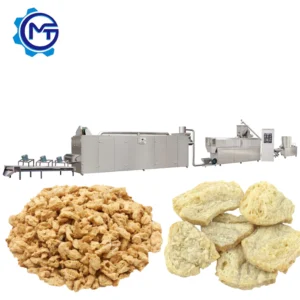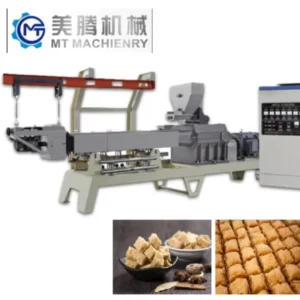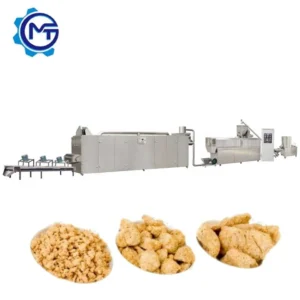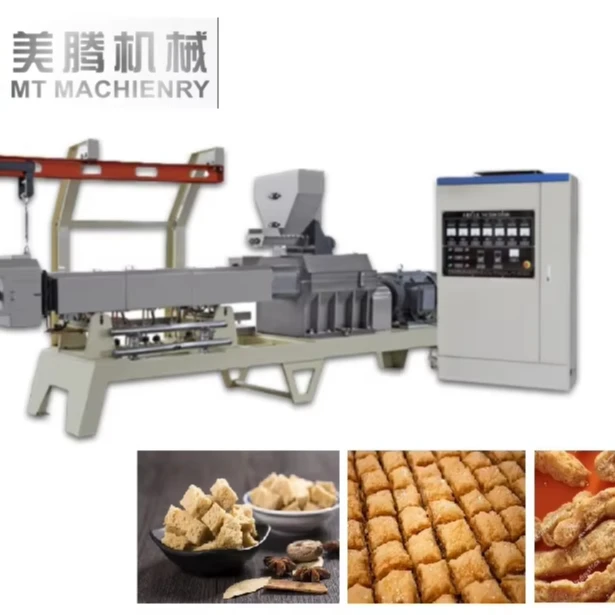
Thermally matched line sections — every mixer, extruder, and dryer in this TVP range is sized so moisture removal keeps pace with throughput, avoiding the common bottleneck where a smaller dryer chokes the output of a larger extruder.
Technical Specifications
| Parameter | Value |
|---|---|
| Product Type | Twin Screw Extruder for Textured Vegetable Protein |
| Available Models | MT65, MT70, MT75, MT85 |
| Screw Configuration | Twin screw, interchangeable sections |
| Screw Length | 1050 mm / 1520 mm options |
| Installed Power | 84 kW (MT65) / 160 kW (MT70) / 190 kW (MT75) / 210 kW (MT85) |
| Power Consumption | 59 kW (MT65) / 120 kW (MT70) / 140 kW (MT75) / 140 kW (MT85) |
| Main Motor Power | 22 kW / 30 kW / 45 kW options |
| Output Capacity | 100–150 kg/h (MT65, basis not stated in source) to 250–300 kg/h (MT85, basis not stated in source) |
| Heating Power | 10 kW / 14 kW |
| Feeding Motor | 0.75 kW |
| Rotary Cutting Motor | 0.75 kW |
| Pump Motor | 0.37 kW |
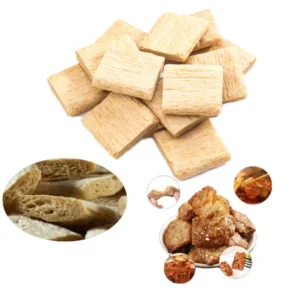
| Die Options | Interchangeable moulds for soya nuggets, TVP/TSP, soya chunks |
| Raw Materials | Defatted soya flour, low temperature soya flakes, soybean dregs, peanut dregs |
| Mixer Options | Vertical, stainless steel 304 mixing ruler; 20–30 kg / 70–80 kg / 170–180 kg capacity; 4 kW / 7.5 kW / 15 kW |
| Dryer | Multi-layer, fuel / gas / electricity heating, adjustable temperature and drying time, double pitch roller chain drive |
| Line Sequence | Mixer → Screw Conveyor → Twin Screw Extruder → Air Conveyor → Multi-layer Dryer → Cooling Machine |
| Overall Dimensions (L×W×H) | 40000×1200×2200 mm (MT65) to 45000×1500×3500 mm (MT85) |
| Control System | PLC / MCC availability to confirm at inquiry |
| Voltage & Frequency | To confirm per destination market before production |
| Certification | CE (company-wide since 2014), ISO certified |
Application Suitability
| Application | Material or Output |
|---|---|
| Textured vegetable protein (TVP / TSP) production | Defatted soya flour and low temperature soya flakes |
| Soya nuggets and soya chunks for food service | Soya flour blends with varying protein concentration |
| High-moisture vegetarian meat analogues | Soybean protein isolate with moisture conditioning |
| Plant-based meat substitutes for frozen food lines | TVP rehydrated and formed into patty or mince formats |
| Maigre snack bases and meat extender ingredients | Peanut dregs and soybean dregs blended with starch carriers |
What "Capacity on the Nameplate" Leaves Out About TVP Lines
The extruder is only as productive as the dryer downstream can handle.
A twin screw extruder for sale in the TVP segment often quotes an output figure based on an ideal raw material at a specific moisture level. When the actual protein blend — say, a high pea-protein mix instead of defatted soya flour — enters the barrel, the residence time, shear profile, and expansion behaviour change. The dryer then receives product with a different moisture load, and throughput drops. I once watched a textured vegetable protein production line stall for four days because the screw speed and barrel temperatures had been set for a standard soy formulation while the customer’s recipe leaned heavily on pea protein [NEED_CITE: raw material variability and extrusion parameter adjustment]. Running the customer’s own material through a trial before the line ships eliminates most of that commissioning friction.
Barrel Zones and Shear Control for Soy and Pea Blends
The twin screw configuration on the MT65 through MT85 range allows operators to adjust screw element sequencing along the 1050 mm or 1520 mm shaft. Different protein sources gelatinise and texturise at different shear thresholds. Swapping kneading blocks and reverse-flight elements lets the same extruder platform handle both defatted soya flour and higher-fibre peanut dregs without a complete hardware changeover.
Die Plate Interchangeability Across TVP Formats
Interchangeable moulds mean a single extruder can shift between soya nuggets, granular TSP, and larger soya chunks by changing the die plate and adjusting the rotary cutter speed. This flexibility matters when a plant-based meat producer wants to offer both fine mince and chunk formats to different customers from the same twin screw extruder for sale in their facility.
Dryer Sizing Against Extruder Moisture Load
The multi-layer dryer uses a double pitch roller chain drive and offers fuel, gas, or electric heating options. Its adjustable temperature and drying time settings must be matched to the extruder’s output moisture. If the extruder pushes product at a higher moisture percentage because the raw material absorbs water differently, the dryer needs sufficient belt length and thermal capacity to bring that moisture down to a stable storage level [NEED_CITE: moisture target ranges for shelf-stable TVP products]. Undersizing the dryer is one of the most frequent causes of line bottlenecks in textured vegetable protein production line equipment installations.
How Motor Power and Heating Interact at Scale
The MT65 starts at 22 kW main motor with 10 kW heating, while the MT85 steps up to 45 kW and 14 kW. Higher motor power delivers greater shear energy into the barrel, which partly substitutes for thermal input during high-moisture texturisation. Understanding this balance helps a process engineer decide whether to specify the MT75 or MT85 for a target output, especially when local electricity costs make heating power a significant operating variable.
The Cost of Skipping a Pre-Shipment Trial Run
When an extruder ships without a documented trial on the buyer’s actual raw material, commissioning becomes a live experiment. Screw speeds, feed rates, and barrel temperature profiles all need recalibration on site. This can consume several days of production time and generate batches of off-spec product that must be discarded or sold at a discount. A textured vegetable protein production line that was supposed to start earning revenue in week one instead burns through raw material and labour while the process parameters are mapped from scratch [NEED_CITE: commissioning delays in food extrusion installations].
Why Sourcing Every Station From One Supplier Matters Here
Matching throughput across the mixer, extruder, air conveyor, dryer, and cooling machine removes the guesswork from line balancing. When each station comes from a different vendor, the integrator must reconcile incompatible capacities and control languages. With the full equipment range under one supplier, the vertical mixer capacity (20–30 kg up to 170–180 kg) is paired with an extruder output that the downstream multi-layer dryer can actually handle. Screw element configuration and die design are specified against the buyer’s raw material before the line is built. Every unit carries CE certification and ships with a factory test record. Electrical schematics and voltage confirmation are locked in before production starts, preventing the common delay where a 50 Hz machine arrives at a 60 Hz site. Wear parts lists covering screws, dies, and cutting blades are provided so the first replacement order can be placed well before the original parts wear through.
Documentation & Verification
- Machine specification sheet with screw configuration matched to your soya flour or pea protein blend
- Electrical schematic and voltage confirmation locked to your site’s frequency before production
- Trial run report on your raw material documenting barrel temperatures, screw speed, and product density
- CE declaration of conformity covering the complete line from mixer through cooling station
- Wear parts list specifying screws, dies, and cutting blades with reorder codes
Installation, Commissioning & Support
- Line footprint requires approximately 40–45 m length depending on model; confirm floor loading for the 2200–3500 mm height envelope
- Dedicated electrical circuit sized for up to 210 kW installed power on the MT85; voltage and frequency confirmed before build
- Extruder ships with screw elements pre-configured; on-site assembly covers conveyor and dryer linkage
- First run uses trial-validated parameters; adjustments made against your live raw material batch
- Operator training covers die changeover, dryer temperature tuning, and cutting speed synchronisation
- Spare screw sections, die plates, and cutting blades stocked for typical multi-week replacement intervals
What We Need to Configure Your Line
To size the right extruder model and supporting stations, share your primary raw material (defatted soya flour, pea protein isolate, or a blend), target hourly output, and the final product format — nuggets, chunks, or high-moisture fibre. Include your site voltage and frequency, available floor space, and whether you need a pre-shipment trial on your own material. If you are integrating this twin screw extruder into an existing line, let us know the upstream mixer capacity and downstream forming or packaging equipment so throughput can be balanced.
Frequently Asked Questions
Q: How do I choose between the MT65, MT70, MT75, and MT85 for my TVP output target?
A: Selection depends on your raw material, target capacity, and available power. Each model has a different installed power and motor rating, and actual output varies with protein type and moisture content. We confirm throughput against your specific formulation during a pre-shipment trial rather than relying on generic capacity figures.
Q: What dryer capacity do I need to avoid bottlenecking the extruder?
A: The multi-layer dryer must handle the moisture load the extruder delivers. We match dryer length, heating source (fuel, gas, or electric), and retention time to the extruder model and your raw material’s moisture profile so the dryer never becomes the limiting station on the line.
Q: Can one extruder produce both soya nuggets and soya chunks?
A: Yes. The die plates are interchangeable, and the rotary cutter speed adjusts to the target piece size. Switching formats requires a die change and parameter adjustment, both documented in the operation manual provided with the line.
Q: What voltage and control options are available for different export markets?
A: Voltage and frequency are confirmed per destination before production. Control systems are available with PLC or MCC configurations. We lock in the electrical schematic and operator language during the specification stage to prevent commissioning delays.
Q: How quickly can I get replacement screws and dies?
A: A wear parts list is provided with every line, covering screw sections, die plates, and cutting blades. Lead times for replacement parts vary by specification, so we recommend placing the first spare order before the initial set reaches its replacement interval.